ECO 100 - Lecture 1 - Fall 2026
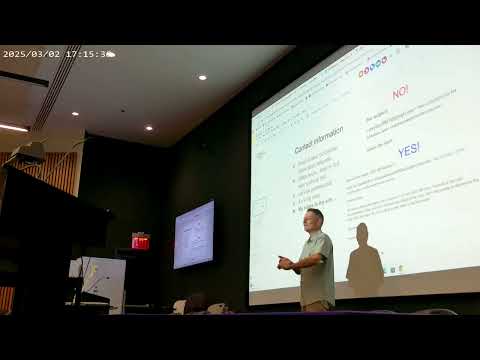 Watch on YouTube →
Overview
Matthew Baker introduces ECO 100 at Hunter College and explains how course logistics, Top Hat materials, attendance, and paper-and-pencil exams will work. He frames economics as a method for analyzing rational choices under scarcity, then uses insurance, workplace risk, and mutually beneficial exchange to show how observed decisions can reveal value, opportunity costs, and the possible effects of markets.
Key takeaways
- Economics begins with scarcity: choices have opportunity costs, including alternatives such as wages forgone while attending college.
- Expected loss is calculated as probability multiplied by loss; a 5% chance of losing a $100,000 home produces an expected loss of $5,000.
- Observed decisions can reveal valuations: declining a $1,000 safety feature that reduces fatality risk by 0.001 implies a value below $1 million in the simplified model.
- A worker choosing a $200,000 oil-field job over a $100,000 desk job despite a 0.001 death risk implies a statistical value of life below $100 million under Baker's assumptions.
- A trade can benefit both parties even when the gains are unequal: a textbook valued at $10 by its seller and $50 by its buyer can create $40 in total gains.
- Policy analysis needs counterfactuals and long-run effects; rent control may help current tenants while also affecting rental supply and people who want apartments but do not yet have them.
Chapters
- Matthew Baker has taught at Hunter College for about 20 years and has taught ECO 100 for roughly six or seven years.
- His academic interests include economic anthropology, law and economics, history of economic thought, and econometric methods.
- The course assumes only basic graphing and simple algebra, but Baker stresses that students need to practice and check whether they truly understand the ideas.
- Students join the course through Top Hat using code 261077; Baker says students have roughly two weeks before payment is required.
- Grades combine three exams, quizzes, homework, and attendance, with possible writing assignments that use AI to help produce graphs and short reports.
- The course proceeds in three blocks of about eight lectures, followed by review, an exam, and homework deadlines; the final exam takes place at its scheduled time.
- Baker expects exams to be paper and pencil, with no calculators or phones, and asks students to avoid scheduling other commitments on the final exam date.
- For a class of nearly 200 students, Baker recommends professional emails that identify the student and clearly state the question; his office is Hunter West 15326.
- He encourages students to use their Hunter email for academic communication and to write notes by hand, especially when practicing graphs and equations.
- The Top Hat course space contains the syllabus, readings, homework, lecture notes, and a course matrix linking each lecture to its materials.
- The custom Hunter economics textbook includes chapters 1, 2, and 3; the first homework, due October 5, mainly introduces the software.
- Baker contrasts the older definition of economics as the study of markets with the modern view of economics as a method that can be applied to many problems.
- Economists share a broadly unified analytical approach, often using mathematical models and statistics, though they may reach different conclusions.
- Economics can be a STEM-oriented major with technical methods, including calculus at advanced levels, even though ECO 100 does not require calculus.
- Research Papers in Economics, or RePEc, archives working papers that have not yet appeared in journals and gives a view of current research.
- Examples of popular topics include stock-market performance, AI, sustainability, dating markets, and the relationship between women's labor-force participation and fertility.
- Baker describes experimental economics and his own research on Civil War surgery, local television news with Hunter colleague Lisa George, and the origins of land ownership.
- Baker presents scarcity as the starting point of economic reasoning: people cannot do everything and must choose among alternatives.
- The decision maker could be a consumer, business, government, surgeon, or worker; rational choice means pursuing some objective, such as profit or saving lives.
- College costs include visible expenses such as tuition and books as well as opportunity costs, including wages or other activities given up.
- Economic analysis must consider counterfactuals and consequences beyond the immediate effects of a policy, a point Baker connects to Henry Hazlitt's Economics in One Lesson.
- Baker defines expected loss as the probability of a loss, P, multiplied by its amount, L.
- For a $100,000 South Carolina beach house with a 5% annual chance of a destructive hurricane, expected loss is 0.05 × $100,000, or $5,000.
- The $5,000 figure gives an illustrative benchmark for an annual insurance premium that compensates for the expected damage.
- Baker emphasizes that economic models must define their symbols and assumptions clearly, including that L represents the house's value in this example.
- Baker considers a $1,000 car feature that reduces the probability of death in an accident by 0.001, or one chance in 1,000.
- If a buyer declines the feature, the simplified model implies that 0.001 × L is less than $1,000, so the buyer's implied value of the risk reduction is under $1 million.
- The example illustrates revealed preference: a choice can provide evidence about a person's valuation, but the inference depends on simplifying assumptions.
- Baker notes that statistical values of life are estimated using methods like this, made more realistic through econometric analysis.
- A desk job pays $100,000 per year, while a job in the Permian Basin oil fields pays $200,000 and carries a stated 0.001 chance of death.
- Choosing the oil-field job implies, in the example, that $200,000 minus 0.001 × L exceeds the desk-job wage of $100,000.
- The resulting inequality implies L is below $100 million, illustrating how wage differences and workplace risks can be used to estimate statistical value of life.
- Baker identifies dangerous jobs with higher wages as a common basis for this kind of valuation.
- Baker raises whether individually rational choices and profit-seeking businesses can improve society overall.
- The course will examine whether markets are fair, how to assess the value of housing and health care, and how to compare market outcomes with alternatives.
- He suggests evaluating social well-being by considering individuals' well-being, while acknowledging that the full analysis is more complicated.
- If a student values a used economics textbook at $10 and an incoming student values it at $50, a sale at $30 gives each buyer and seller $20 in gains.
- A retail worker paid $30 per hour who values their alternative use of time at $10 gains $20, while a store earning $300 from that hour keeps $270 after wages.
- The unequal division of gains raises questions about fairness, even when both parties benefit from a voluntary exchange.
- Repeated exchanges form markets that help determine what is produced, bought, sold, and developed; Baker argues that prices can reveal both value and costs.
Transcript excerpt
0:00 All right, I think all systems are go here today, so maybe we'll get started. Uh hopefully we're all in the right place here. Intro to economics, ECO 100. Right? I'm excited. It's going to be a a great semester, so I'm going to hopefully do the usual thing today where I introduce myself and the subject and we do some stuff and uh hopefully you get out of here a little bit early today. Um I shouldn't say that right when I start class, but uh that'll, you know, I'll credibly commit to that now. Um Okay, so I don't even, you know what? I should probably say my name on this uh slide. A little bit of an oversight there. I am Matthew Baker. Um I've been uh here at Hunter now just about 20 years, believe it or not. Um and I've been teaching this class for
0:48 the past uh six or seven years or so. Um And so, you know, I'm thinking I'm I'm just about starting to get it about right. So, um Uh but I'm excited. It's a it's a it's a it's a fun class and uh it's evolved over time for reasons that I'll I'll get into a little bit today. Before I forget, we do have a little bit of material. You'll see here it says Top Hat texts, chapters 1, 2, and 3. And then there's a homework which I say isn't due for a while. I'm going to get into all of this as I uh go through the usual uh stuff. I talk about the syllabus and all that jive. Um Uh okay. Uh so, who am I? Well, I just said I've been here about 20 uh 20 years. Uh I went to, let's see, the University of
This is the start of the transcript. Save this video free for the whole transcript, searchable and time-coded.
Related notes
Summary, takeaways, and chapters were generated by AI from the video's transcript and may contain errors. The video belongs to its creator, Matthew Baker.