ECE 1230 F26 U2 L4 Sinusoids and Phasor
 Watch on YouTube →
Overview
Professor Angela Rasmussen introduces sinusoidal steady-state analysis by representing a cosine signal as a phasor, which turns calculus operations into algebra. The lecture develops conversions between time-domain sinusoids and complex polar or rectangular forms, explains frequency and phase conventions, and works through phasor addition with quadrant checks and calculator guidance.
Key takeaways
- A sinusoid A cos(ωt + θ) maps to the phasor A∠θ, and its time-domain frequency must be retained when converting the result back.
- Angular frequency defaults to radians per second and phase defaults to radians; convert to hertz with f = ω/(2π) and obtain period from T = 1/f.
- Before forming a phasor, convert sine to cosine and replace any negative amplitude with a positive magnitude plus a 180° phase shift.
- Add and subtract phasors in rectangular form, where real and imaginary components combine independently; use polar form for multiplication and division.
- The basic inverse tangent of imaginary over real can give a wrong quadrant, so verify signs with a vector sketch or use a quadrant-aware angle calculation.
- Phasors can be combined directly only when their signals have the same frequency; the worked 100 rad/s example produces an approximate resultant of 1.55∠203°.
Chapters
- Exam One solutions and exam materials are posted for review, and grading questions should be submitted through Gradescope regrade requests.
- The next exam is scheduled for Wednesday, October 28, after fall break.
- The exam is expected to include both RC and RL first-order circuit problems, so Rasmussen recommends practice and using instructor, TA, and campus tutoring hours.
- Phasors replace time-domain differentiation and integration with algebraic addition, subtraction, multiplication, and division.
- The lecture focuses on converting signals into phasor form, manipulating them there, and converting results back to the time domain.
- Sinusoids can encode information through amplitude, frequency, and phase, and Fourier series represent signals as sums of sinusoids.
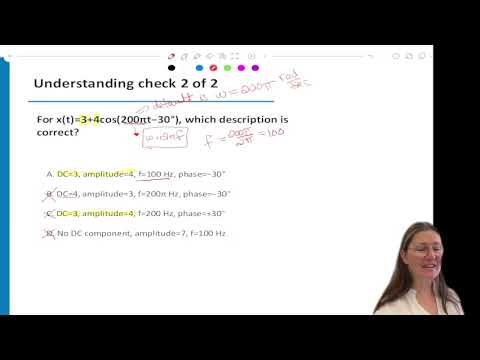
- For a sinusoid such as 3 + 4 cos(200πt + θ), the constant 3 is the DC shift and 4 is the amplitude.
- The coefficient of time is angular frequency, ω, in radians per second by default; convert to hertz with f = ω/(2π).
- An angle is in radians unless degrees are explicitly marked, so unit conventions matter when identifying a signal's phase.
- A sinusoid can be visualized as the projection of a constant-speed rotating vector onto an axis.
- The vector length represents amplitude, while its angle represents phase.
- The time-domain waveform is the vector's changing projection as it rotates around a circle.
- The lecture uses the frequency, phasor, and complex domains as names for representing a sinusoid with a complex vector.
- A complex quantity can be written in polar form as a magnitude and angle, or in rectangular form as x + jy.
- Euler's formula connects the forms: magnitude times e^(jθ) equals magnitude times (cos θ + j sin θ).
- Rasmussen uses cosine as the standard reference because it aligns with the rotating vector's real, or x, axis.
- Every sinusoidal source must be rewritten as a cosine before forming its phasor.
- A phasor records a signal's magnitude and phase, while the angular frequency remains associated with the signal.
- Electrical engineering uses j instead of the mathematical i for the imaginary unit, avoiding confusion with current notation.
- For rectangular values, add real parts together and imaginary parts together, keeping j with the imaginary component.
- Polar form is convenient for multiplication and division because magnitudes multiply or divide and angles add or subtract.
- Convert polar to rectangular with x = r cos θ and y = r sin θ, giving z = x + jy.
- Convert rectangular to polar with magnitude √(x² + y²) and angle based on the inverse tangent of y/x.
- Canvas materials include additional complex-number review, and Rasmussen recommends practicing these conversions before using phasors.
- Convert sin(ωt + θ) to cosine as cos(ωt + θ − 90°); convert a negative sine by shifting the cosine phase in the opposite direction.
- A negative real value such as −1 has positive magnitude 1 and phase 180° or −180°, while j and −j correspond to phases 90° and −90°.
- Angles may be expressed in radians or degrees, but degrees must be marked; equivalent angles such as 270° and −90° describe the same direction.
- A negative cosine coefficient is not a negative phasor magnitude: make the magnitude positive and add 180° to the phase.
- For a sinusoid, convert angular frequency to hertz with f = ω/(2π), then find period with T = 1/f.
- Practice examples reinforce identifying amplitude, angular frequency, phase, frequency in hertz, and period from a cosine expression.
- Convert a cosine A cos(ωt + θ) to the phasor A∠θ, equivalently A e^(jθ).
- A circuit's sinusoidal output keeps the input angular frequency; circuit behavior changes amplitude and phase.
- To return to the time domain, use the phasor's magnitude and phase together with the original signal frequency.
- Practice examples require converting sine sources to cosine and moving any negative sign into the phase before writing polar phasors.
- The worked conversions use both exponential notation, such as A e^(jθ), and angle notation, such as A∠θ.
- Rasmussen previews later conversion of resistors, inductors, and capacitors into the frequency domain, after students become comfortable with source conversion.
- The inverse tangent of y/x can return an angle in the wrong quadrant, so check the signs of the real and imaginary parts.
- For quadrants II and III, the calculator's basic arctangent result may need a 180° correction; a vector sketch provides a useful check.
- Use signed real and imaginary components rather than absolute values, which can incorrectly place every result in quadrant I.
- Convert each input to a cosine phasor, apply sine phase shifts and negative-sign corrections, then convert each phasor to rectangular form for addition.
- In the worked example, the two sources share ω = 100 rad/s; their rectangular components sum to approximately −1.425 − 0.6j.
- The resultant is approximately 1.55∠203°, giving a time-domain output near 1.55 cos(100t + 203°); the frequency is unchanged.
- A polar-to-rectangular check converts 5∠53.13° into approximately 3 + 4j using cosine for the real component and sine for the imaginary component.
- Rasmussen warns students to use a handheld calculator and confirm whether its angle mode is degrees or radians.
- If no unit is specified, angular frequency is in radians per second and phase is in radians; hertz and degrees should be explicitly indicated.
- For each operation, first check whether a source is a sine or has a negative amplitude, then rewrite it as a positive-amplitude cosine phasor.
- Use rectangular form for addition and subtraction, and polar form for multiplication and division.
- Sketch vectors to catch quadrant mistakes and combine ordinary phasors only when they share the same frequency.
Transcript excerpt
0:06 All right, welcome. Um, so a couple things I've posted in the exam one information review and solutions. So that has the exams in there. So make sure to review that with what you've done. If you have any questions about the grading, please submit a regrade request in grade scope. >> What's your next? >> So the next exam, that was the next step. So, next exam is Wednesday, October 28th. So, next week, um, we'll have fall break and then we'll have a week and then a day and then we'll have the exam for this unit. All right. Any questions so far? Yes. Okay. So, we have already covered first order solutions. So, make sure you're very
0:54 comfortable with that. there will be um probably an RC and an RL both of those on the next exam. So being able to do both those. So lots of practice is what you're going to need. If you have any questions about the concept of it, you know, please come to my office hours. Um or if you just need help like working through those types of problems, office hours for TAs, myself. Um so please please utilize that free resource. There's also tutors for this class. um here in the the Waro building. Um so you can go and look at the tutoring resources. Those are also free. So please utilize all your free resources. All right. Any questions about any of the content we've come up to so far?
1:43 Okay. Very fun. We get to move to kind of the next material. So we are going to move to understanding what's called a phaser. And so this phaser is what we use to instead of using a differential in the time domain and or an integral to remove those. We move to
This is the start of the transcript. Save this video free for the whole transcript, searchable and time-coded.
Related notes
Summary, takeaways, and chapters were generated by AI from the video's transcript and may contain errors. The video belongs to its creator, University of Utah: Professor Angela Rasmussen.