ECE 1230 F26 U1 L7 Review Superposition Thevenin
 Watch on YouTube →
Overview
Professor Angela Rasmussen reviews Unit 1 exam logistics and practice resources, then works through superposition and Thevenin-equivalent methods. The review emphasizes zeroing independent sources correctly, tracking voltage polarity and current direction, and finding Thevenin resistance and voltage; it also previews op-amp identification, analysis, and design.
Key takeaways
- For superposition with independent sources, keep one source active at a time, replace ideal voltage sources set to zero with shorts, and replace ideal current sources set to zero with opens.
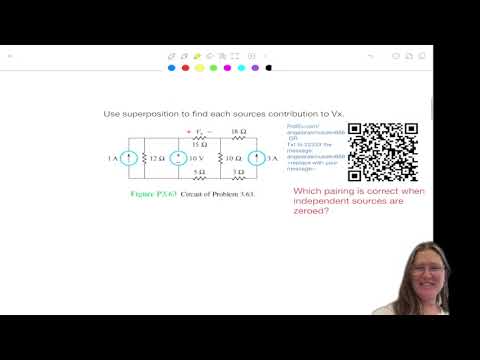
- The superposition example gives a 0-V contribution from the 1-A source, a −15-V contribution from the 3-A source, and a +5-V contribution from the 10-V source, for Vx = −10 V.
- The sign of a resistor voltage depends on the relationship between the selected current direction and voltage polarity; matching directions give a positive I times R, while opposite directions give a negative value.
- A Thevenin equivalent requires both VTH, the open-circuit terminal voltage, and RTH, the resistance seen looking into the terminals with independent sources disabled.
- In the A-to-B Thevenin example, combining 4 ohms and 2 ohms in series gives 6 ohms; placing that branch in parallel with 2 ohms and 4 ohms yields RTH of approximately 1.09 ohms.
- Exam One allows printed notes and books but prohibits internet-connected devices; students should bring a handheld calculator and can use posted practice exams and competency quizzes to prepare.
Chapters
- Exam One is scheduled for Monday in the classroom and requires a handheld calculator.
- The exam is open book and open notes, but all reference materials must be printed or in physical books.
- Phones, tablets, laptops, and other devices that connect to the internet are not allowed.
- The exam is designed for about 50 minutes, with the full class period available.
- The Unit One module includes solutions for previously assigned quizzes and additional practice problems.
- Competency quizzes are timed for 45 minutes and can be retaken through Sunday night; the higher score counts.
- Past exams from the previous two semesters, with solutions, are posted for timed practice.
- Professor Angela Rasmussen suggests using Google Gemini to generate similar practice problems.
- Exam topics include superposition, Thevenin equivalents, op-amp configuration identification, op-amp analysis, and op-amp design.
- The review begins with a circuit problem asking students to use superposition to find each source's contribution to voltage Vx.
- Past exams include a superposition problem requiring students to break the solution into separate source contributions.
- Students work through the circuit by considering one independent source at a time.
- The class discusses how simplifying the active-source circuit changes which branches carry current.
- The key goal is to calculate each source's effect on Vx separately before combining the results.
- The in-class solution tracks current through resistor branches to determine the voltage drop relevant to Vx.
- The discussion distinguishes a resistor's voltage drop from the total voltage across a larger section of the circuit.
- Superposition lets students simplify the circuit for each source rather than solve all sources simultaneously.
- The class examines how equivalent resistance and shared branch currents can simplify the source-by-source calculations.
- Current continuity helps identify when multiple resistors carry the same current.
- The voltage contribution is obtained from the relevant resistor drop, with the chosen polarity determining its sign.
- Students check whether current can flow through each branch after the other independent sources are disabled.
- Identifying branches with no current prevents assigning an incorrect voltage drop to their resistors.
- The review repeatedly uses resistor current and polarity to connect branch behavior to Vx.
- The class continues comparing the simplified circuit for each active source and tracking how the resulting currents relate.
- A current shared by connected resistors can be reused to calculate the voltage across the resistor of interest.
- The separate contributions must be combined algebraically, retaining their positive or negative signs.
- When independent sources are zeroed, an ideal voltage source becomes a short circuit and an ideal current source becomes an open circuit.
- A short enforces zero volts between its terminals, while an open prevents current from flowing through that path.
- Remembering that an open circuit has zero current helps prevent swapping the two source-suppression rules.
- With the 1-A source active, the voltage source is replaced by a wire and the other current source is replaced by an open.
- The resulting resistor network has zero voltage across the relevant paths, so the 1-A source contributes 0 V to Vx.
- The same result can be checked by writing the branch-current equations and solving for Vx.
- For the 3-A source case, the disabled voltage source becomes a short and the other current source becomes an open.
- Rasmussen adds a ground reference and labels the upper node V1 so the branch currents can be expressed with respect to zero volts.
- The review relates the target voltage to current through a 15-ohm resistor and stresses checking polarity against the chosen current direction.
- With the 10-V source active, the source sets its connected node to 10 V relative to ground.
- The relevant series resistors are combined to 30 ohms, giving a current from Ohm's law and a 5-V contribution.
- The contributions are added algebraically: the discussed values, −15 V and +5 V, produce a final Vx of −10 V.
- The next exercise asks for the Thevenin equivalent between A and B and asks students to identify the defining pair of Thevenin quantities.
- There is no load resistor to remove before analyzing the circuit.
- The solution requires finding both the open-circuit voltage VTH and the equivalent resistance RTH.
- The review connects op-amp configuration identification to counting inputs and examining the feedback connections.
- The discussion distinguishes a circuit with two inputs from a single-input amplifier configuration.
- Feedback paths are highlighted as a key feature to identify when classifying an op-amp circuit.
- To find RTH, the independent voltage sources are replaced by wires, and the resistor network is simplified by identifying shared nodes.
- The 4-ohm and 2-ohm resistors combine to 6 ohms; that 6-ohm branch is in parallel with 2 ohms and 4 ohms, giving RTH of about 1.09 ohms.
- For VTH, the open-circuit terminal voltage is found by labeling the output node and writing a node-current equation relative to ground.
- The class runs out of time before the final VTH arithmetic is completed; Rasmussen says the remaining solutions will be posted and offers a video solution.
Transcript excerpt
0:04 Hi. So, welcome today. Um, so exam first exam will be on Monday. So, come prepared for the exam. It will be in this room. Make sure to bring a handheld calculator. So, you will need your own handheld calculator for it. No um nothing that connects to the internet will be allowed. So, no phones, no tablets, no laptops. Um, print out any material you want. It's all open notes, open book. Um, but just anything that it needs to be a physical paper or book. Um, and just nothing that can connect to the internet. So, if you've been taking notes on something just and you want to print them out, note also that you can print out things in the K lab upstairs in our in our lab rooms.
0:54 So, there's lots of places that you can print. As far as any questions about the exam, basically logistics, it will be designed for more of like a 50-minute exam, but you'll have the whole time period to take it. So, to study for the exam, again, the unit one practice problems are going to be great to work through. I've also um on unit one, I've posted all of the solutions. So, under this unit one module with the material, [laughter] you can scroll down and then I've I've put all the solutions for the quizzes you've had so far um to give you again extra practice. And then I've
1:44 added on these competency quizzes. So, if you want to use them as practice, feel free. Um whichever one scores higher will be the one that will be counted. So, if you took the quiz at the week but felt like you wanted to do better, you're welcome to take this to improve that grade if you want or if you
This is the start of the transcript. Save this video free for the whole transcript, searchable and time-coded.
Related notes
Summary, takeaways, and chapters were generated by AI from the video's transcript and may contain errors. The video belongs to its creator, University of Utah: Professor Angela Rasmussen.