Dynamics (MIT 16.07) - Lecture 11: Quaternions from Geometry
Overview
Zac Manchester develops quaternion intuition by connecting rotation kinematics and the matrix exponential to axis-angle coordinates, then building from planar rotations to the geometry of the quaternion double cover. The lecture explains why quaternions represent rotations with four components, how q and -q encode the same attitude, and how angular velocity maps to quaternion derivatives; it ends by extending the planar construction from a ball of radius π to a 4D hemisphere.
Key takeaways
- For constant body-frame angular velocity, rotation-matrix propagation has the closed form Q(t) = Q₀ exp(S(ω)t), with matrix ordering essential because rotations do not generally commute.
- Axis-angle coordinates turn local rotation uncertainty into a three-dimensional vector problem: sample φ, then map it to a valid rotation using the matrix exponential.
- Direct numerical integration of a 3×3 rotation matrix can violate QᵀQ = I; SVD projection repairs the error but adds computation and still uses nine values for three rotational degrees of freedom.
- The quaternion double cover comes from gluing two copies of a lifted angle space: q and −q encode the same attitude, and a quaternion returns to its original value after a 4π rotation.
- In the planar case, quaternion multiplication is complex multiplication, while the attitude Jacobian maps angular velocity at the identity to the tangent direction at the current quaternion.
- The 3D geometric construction lifts the radius-π axis-angle ball into a hemisphere in four dimensions, then glues on a reflected hemisphere to produce the quaternion sphere.
Chapters
- Zac Manchester frames quaternions as standard tools for aerospace, robotics, computer graphics, flight dynamics, and attitude estimation.
- Rotation matrices, Euler angles, axis-angle vectors, and quaternions are different representations of rotations, which do not commute.
- The lecture prioritizes geometric intuition and practical rotation calculations over a full treatment of Lie group theory.
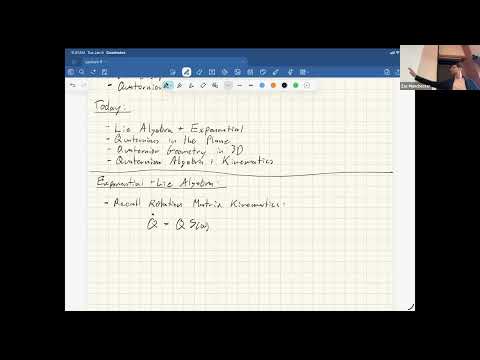
- For body-frame angular velocity, rotation-matrix kinematics take the form Q̇ = Q S(ω), where S(ω) is the skew-symmetric cross-product matrix.
- If ω is constant, the differential equation has the closed-form solution Q(t) = Q₀ exp(S(ω)t).
- The matrix order matters because matrices do not generally commute, so the initial rotation matrix multiplies the exponential on the left.
- A Taylor expansion can be useful for small time steps, but it is not a reliable general-purpose numerical strategy for every step size.
- Manchester identifies Padé approximants as the practical method used by tools such as MATLAB and Python to compute matrix exponentials.
- The lecture points to Van Loan's paper, “19 Dubious Ways to Compute the Matrix Exponential,” as a reference on the numerical challenges.
- For a fixed angular velocity, the axis-angle vector φ = ωt has a direction equal to the rotation axis and a norm equal to the angle in radians.
- The matrix exponential maps the skew-symmetric matrix S(φ) to a rotation matrix, while the matrix logarithm maps a rotation matrix back to S(φ).
- Axis-angle coordinates provide a three-dimensional vector representation that is more suitable for modeling rotation uncertainty than sampling arbitrary 3×3 matrices.
- For small φ, the first-order approximation is exp(S(φ)) ≈ I + S(φ).
- Applying this rotation to a vector x gives approximately x + φ × x, making the cross product the first-order change in the rotated vector.
- The approximation explains why skew-symmetric matrices and cross products appear in rotation kinematics and local attitude estimation.
- Numerically integrating rotation-matrix entries directly can violate the defining constraint QᵀQ = I.
- Manchester illustrates orthogonality error growing during a one-minute simulation, even with a standard adaptive integrator.
- An SVD-based projection can restore a matrix to the nearest rotation matrix, but its cost and the matrix's nine entries for only three degrees of freedom make direct matrix integration unattractive.
- A unique planar angle can be restricted to an interval such as −π to π, but integrating through the boundary forces a jump from π to −π.
- That jump breaks a smooth angle-rate equation such as θ̇ = ω at the wraparound point.
- Manchester relates this general representation problem to compact rotation spaces and notes that Euler angles can suffer especially problematic singularities, including gimbal lock.
- The planar construction reshapes the interval of angles into a half-circle so a rotation can be represented by a point in two dimensions.
- Using the unit-circle convention, the point is q(θ) = (cos(θ/2), sin(θ/2)).
- The half-angle parameterization makes a full 2π rotation traverse only half of the quaternion circle, setting up a smooth continuation beyond the original angle interval.
- Manchester reflects a second copy of the planar construction and glues it to the first, allowing the representation to continue smoothly instead of jumping at the angle boundary.
- The resulting circle supports continuous rotation integration, but each physical planar rotation has two representatives.
- The construction trades strict uniqueness for smoothness: the two representatives are antipodal points on the circle.
- The half-angle formulas imply q(θ + 2π) = −q(θ), while a 4π change returns to the original quaternion.
- Thus a quaternion has 4π periodicity even though the represented physical rotation is 2π periodic.
- Manchester calls this a double cover: each rotation corresponds to q and −q, a feature also connected in the lecture to SU(2) and quantum spin.
- Combining planar rotations adds their angles, and applying the corresponding 2D rotation matrix to a quaternion gives the same result.
- Multiplying the half-angle sine and cosine terms yields the familiar trigonometric addition identities.
- Treating the two quaternion components as real and imaginary parts makes the planar multiplication rule ordinary complex multiplication.
- Differentiating q(θ) = (cos(θ/2), sin(θ/2)) and using θ̇ = ω produces a quaternion derivative proportional to one-half the angular rate.
- Manchester writes the mapping using a rotation matrix L(q) and a vector Hω, with H = (0, 1) selecting the imaginary component.
- The resulting attitude-Jacobian form is q̇ = ½ G(q)ω, a structure he identifies as the pattern that generalizes to three dimensions.
- The planar quaternion q remains on the unit circle, so its derivative q̇ must be tangent to the circle and orthogonal to q.
- Angular velocity is represented at the identity rotation, corresponding to θ = 0, rather than as a point on the circle of attitudes.
- The attitude Jacobian rotates that identity-tangent velocity to the tangent direction at the current quaternion, preserving the unit norm during motion.
- Unique 3D axis-angle vectors with norm at most π fill a ball of radius π, rather than just the line segment used in the planar case.
- Manchester extends the planar construction by lifting that 3D ball into a hemisphere in four dimensions, making a reflected copy, and gluing the hemispheres together.
- The resulting 4D unit-sphere representation is the geometric basis for quaternions, with the same smoothness-versus-two-representatives tradeoff as in the planar example.
Transcript excerpt
0:00 last time with Patrick uh you guys talked about mostly attitude representations. And that included sort of the rotation matrix stuff that we've already talked about a whole bunch and then a survey of like a million other things including Euler angles which are evil and terrible and you should never touch ever ever again. Um quaternions, axis angles Gibbs vectors, Rodriguez parameters, modified Rodriguez parameters. There's like a whole whole bunch of these things. And they show up in practice. Um I'm not actually serious about the Euler angle thing. You should should never do that ever again. Uh and I'll show you better things.
0:47 Uh Okay. And then what else? And then yeah, I think Patrick showed you like a little bit of kind of a Lie group um kind of crash course thing which we'll we'll do a little bit more of that. It's not important that you know like all the the Lie group Lie algebra theory. It's mostly like a nice like kind of mental framework for thinking about this stuff. This is what rotations actually are, right? They're not vectors, to be clear, right? We kind of they don't commute so you can't if you do them in opposite order, right? If you roll then pitch versus pitch then roll, if I flip the order I get a totally different result, right? So there's something they're not vectors cuz vectors, you know, I can do it in I either order and I get the same answer. There's something else. You can think about it in terms of rotation matrices. You can think about all those other things, right? Euler angles, etc. But the fundamental thing that sort of is
1:35 the I don't know, like coordinate-free abstract idea um that's similar to the idea of like the vector with the the
This is the start of the transcript. Save this video free for the whole transcript, searchable and time-coded.
In this course
Related notes
Summary, takeaways, and chapters were generated by AI from the video's transcript and may contain errors. The video belongs to its creator, MIT Robotic Exploration Lab.