Dynamics (MIT 16.07) - Lecture 6: Rotating Frames, Fictitious Forces, and Gyros
Overview
Prof. Zac Manchester develops rotating-frame kinematics from an ant on a spinning record, deriving how body-frame gyro measurements update orientation and how velocities transform between rotating and inertial frames. He then uses Lagrangian mechanics to identify Coriolis, Euler, and centrifugal terms, and applies the same dynamics to explain how a resonantly driven MEMS gyro detects angular rate through motion induced on a perpendicular axis.
Key takeaways
- With the body-to-inertial convention and body-frame angular velocity, rotation evolves according to Ṙ = R S(ω), allowing gyro measurements to be integrated from a known initial orientation.
- The velocity transport theorem states that inertial velocity equals the rotated body-frame sum ṙ + ω × r, combining motion relative to the body with motion of the rotating frame.
- Rotating-frame dynamics contain Coriolis, Euler, and centrifugal terms; the Coriolis term depends on relative velocity, the Euler term on angular acceleration, and the centrifugal term on position and angular rate.
- An ant at rest on a record rotating at about 3.5 rad/s can have zero record-frame velocity while moving in a circle in the inertial frame; a frictionless ant instead follows a straight inertial path that appears as a spiral from the record.
- A MEMS gyro drives a spring-mass oscillator along x near its resonant frequency, then uses Coriolis coupling to produce a y-axis response proportional to the measured angular rate.
- For typical MEMS gyros with oscillator frequencies around 20 kHz, angular rates and angular accelerations are small enough relative to the oscillator dynamics to simplify the model by neglecting centrifugal and Euler terms.
Chapters
- Manchester briefly recalls the cart-pole, manipulator equation, and generalized inertia or mass matrix from the previous lecture.
- The lecture focuses on rotation matrix kinematics, the velocity transport theorem, fictitious forces, and MEMS gyros.
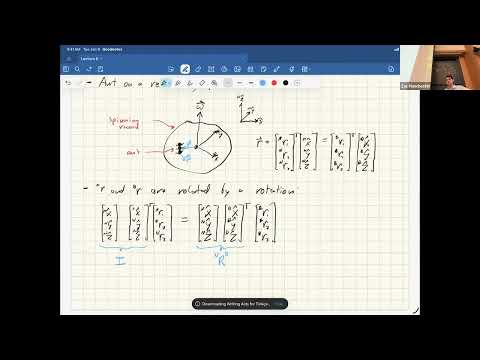
- An ant on a rotating record illustrates the inertial frame N and record-fixed body frame B, which share a z-axis.
- The ant's position is one geometric vector, but its components differ when expressed in N and B coordinates.
- The rotation matrix maps body-frame components into inertial-frame components; Manchester adopts this body-to-inertial convention.
- For an ant fixed relative to the record, its body-frame velocity is zero, yet its inertial velocity is not.
- The inertial velocity is ω × r, and rotating both vectors into body coordinates gives the corresponding body-frame expression.
- Differentiating the position relation exposes separate contributions from body-frame motion and frame rotation.
- The cross product ω × x can be represented as a matrix multiplying x, using the skew-symmetric matrix S(ω).
- S(ω) transposes to −S(ω), matching the sign reversal when the order of a cross product is swapped.
- For nonzero ω, the cross-product matrix has rank two and determinant zero, because its action removes the component parallel to ω.
- Equating the calculus and geometric velocity expressions yields the rotation-matrix kinematics equation: Ṙ = R S(ω), with ω expressed in B.
- A gyro mounted on a vehicle measures angular velocity in body coordinates, so this equation describes how to integrate its readings given an initial orientation.
- The matrix equation is the rotational counterpart of integrating measured linear velocity to obtain position.
- Allowing the ant to move on the record adds its body-frame velocity to the velocity of the rotating frame.
- The inertial velocity is R times the body-frame sum of ṙ and ω × r.
- This transport theorem converts velocities between rotating and inertial coordinates.
- Newton's F = ma applies in an inertial frame, so Manchester derives the rotating-frame equivalent using the Lagrangian.
- For the ant modeled as a point mass with zero potential energy, kinetic energy is one half m times the squared inertial speed.
- Substituting the transport theorem expresses that kinetic energy in record-frame coordinates and angular velocity.
- The kinetic energy expands into body-frame velocity, mixed rotation-velocity, and rotation-position terms.
- Manchester differentiates with respect to r and ṙ, using S(ω) to manage cross products and matrix transposes.
- The resulting Euler-Lagrange equation separates ordinary mass-acceleration from terms caused by rotation.
- The Coriolis acceleration is proportional to 2ω × ṙ, so it appears when the ant moves relative to the rotating record.
- The Euler or transverse term depends on angular acceleration ω̇ and corresponds to the backward push when a rotating platform starts up.
- The centrifugal term involves ω × (ω × r) and points outward from the rotation axis in the rotating-frame dynamics.
- A MATLAB simulation uses a record spinning at 33⅓ RPM, approximately 3.5 rad/s, and an ant initially 1 cm from its center.
- Without friction, the ant moves straight at constant velocity in the inertial frame but traces an outward spiral in record coordinates.
- Adding friction lets the record drag the ant into a curved path; the simulation treats the record as effectively infinite, so drag continues past the drawn edge.
- The frictionless ant's straight inertial trajectory and spiral record-frame trajectory describe the same physical motion.
- Coriolis and centrifugal effects account for how motion appears in rotating coordinates, rather than adding new physical interactions.
- Writing energy in the desired coordinates and applying the Lagrangian provides a systematic route to the rotating-frame equations.
- MEMS means microelectromechanical system; these chip-scale gyros are common in phones, drones, and other devices.
- A single-axis sensor is modeled as a two-dimensional mass connected to springs and dampers along x and y, with a drive force only along x.
- The x-axis is driven at its resonant frequency, ωₙ = √(k/m); three such sensing axes can measure rotation in three dimensions.
- For isotropic stiffness, the spring potential is one half k rᵀr, producing the restoring force −kr; isotropic damping contributes −cṙ.
- The device frame is the body frame, and the example measures rotation about z while assuming other angular-rate components are zero.
- The rotating-frame equation adds the gyro's spring, damper, and x-axis drive force to the previously derived inertial terms.
- The simplified sensor model ignores z dynamics and assumes ωz is much smaller than the oscillator frequency, typically around 20 kHz for a MEMS gyro.
- Assuming small ω̇z also removes the Euler and centrifugal contributions, leaving Coriolis coupling between the driven x motion and the y axis.
- A strong resonant x drive makes its motion known; rotation about z then creates a proportional y-axis response that can be measured to estimate ωz.
Transcript excerpt
0:00 Um so last time we talked about the cartpole. Um we talked about the manipulator equation, right? Which is basically just a an organizational sort of framework for grouping the terms in the orrange equation, right? And probably the most important term in there uh that shows up a lot is this mass matrix thing which or if you're being fancy this is called the generalized inertia tensor. Generalized as in generalized coordinates inertia as in you know sort of like mass tensor because it's technically a second rank tensor because of the way it transforms between coordinates. We'll just call it a mass matrix because I'm not that fancy. And then the last topic that we started uh from there was um we started
0:49 talking about rotating uh rotating frames which is mostly what we're going to talk about today. So I'm going to pretty much pick it up from scratch today um because we we got about 5 minutes into it last time and sort of abruptly stopped. Um so we'll pick it up there first. Any questions about any of that stuff from last time or anything at all? All right, cool. All right, so today we're going to pick up the rotating frame conversation and um hopefully get most of the way through that or hopefully all the way. We're going to talk a little bit about um rotation matrices, specifically what we'll call rotation matrix kinematics, which we'll do some
1:38 more of in a in another week or two, but we'll sort of start start teasing that now. What this is is how you integrate from omega, i.e. what you measure with a gyro into a rotation matrix. So just like you would ro like we can trivially integrate velocity. So if I measure velocity, I can trivially integrate that
This is the start of the transcript. Save this video free for the whole transcript, searchable and time-coded.
In this course
Related notes
Summary, takeaways, and chapters were generated by AI from the video's transcript and may contain errors. The video belongs to its creator, MIT Robotic Exploration Lab.