CSCD 420 Nov 18 2026
Overview
Chris Cain connects undecidability and computational complexity to practical software decisions, using the Post correspondence problem and context-free grammars to explain why some language questions have no general algorithm. He then introduces compiler architecture, tracing source code through scanning, parsing, type checking, intermediate code optimization, and target-code generation, with examples involving Java bytecode, the JVM, and DFA-based token recognition.
Key takeaways
- A reduction from an undecidable problem such as the Post correspondence problem proves that no algorithm can solve the target problem for every possible input.
- For infinite languages generated by arbitrary context-free grammars, finding a witness can settle some questions, but the absence of a witness after any finite search does not prove that none exists.
- Matching aⁿbⁿ takes O(n²) on the described single-tape Turing machine because each match requires repeated traversal, but O(n) with a second tape for parallel storage.
- Java bytecode separates compilation from machine-specific execution: the JVM provides the runtime layer that adapts bytecode to a particular platform.
- A compiler separates lexical, syntactic, semantic, and code-generation tasks so that source characters become tokens, tokens become a parse tree, and validated structure becomes optimized target instructions.
- A DFA can validate lexical patterns and delimit token boundaries, but token collection and keyword lookup require additional scanner logic beyond the automaton itself.
Chapters
- The course has an assignment due the next day, an exam after break, and a final project approaching.
- Turing machines cannot decide every language problem; the halting problem is the central example.
- Recognizing that a problem is undecidable, or NP-complete when discussing efficiency, helps establish when requirements need to be narrowed or handled with heuristics.
- The Post correspondence problem gives two lists of strings and asks whether some sequence of paired strings produces identical concatenations.
- A sample instance can match by using corresponding pairs in the order provided, though general instances may require searching different sequences.
- A restricted or modified version can require a prescribed first pair, making it useful for reductions from grammar problems.
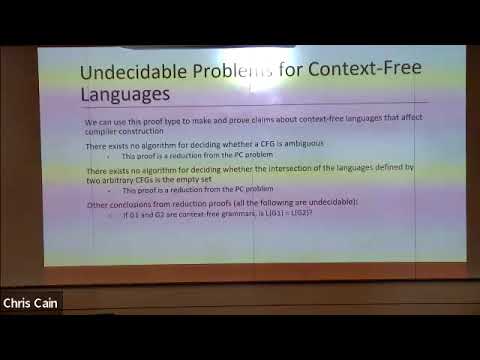
- A context-free grammar is ambiguous if two distinct parse trees derive the same string.
- Searching derivations can find evidence of ambiguity, but failing to find a collision after finitely many steps cannot prove that none exists.
- A reduction from the Post correspondence problem establishes that no general algorithm decides whether an arbitrary context-free grammar is ambiguous.
- For arbitrary context-free grammars, deciding whether two generated languages have an empty intersection is undecidable.
- Other general questions include language equivalence, subset containment, and whether a context-free language is regular.
- Enumeration can reveal a shared string or a counterexample, but an infinite search may never provide the evidence needed to settle the opposite case.
- On a single tape, matching each A with a B in aⁿbⁿ requires repeated scans across the input and takes O(n²) time.
- A two-tape machine can copy the A symbols onto a second tape, then match B symbols in one pass, reducing the work to O(n).
- The contrast illustrates how extra memory and parallelism can change the asymptotic cost of a computation.
- A compiler translates a human-oriented high-level language into a lower-level representation that a computer can execute.
- Compilers may target architecture-specific assembly, which an assembler converts to machine code, or target an intermediate format such as bytecode.
- Java bytecode supports platform independence: the Java Virtual Machine interprets or translates bytecode for the target machine.
- A scanner converts source characters into tokens, and a parser checks whether the token sequence follows the language grammar.
- A type checker performs semantic checks, after which an intermediate-code generator breaks complex statements into simpler instructions.
- An optimizer improves the intermediate representation for time or memory use, and a code generator maps it to assembly, bytecode, or machine instructions.
- Some stages can be combined, but omitting a stage shifts its work and complexity elsewhere in the compiler.
- Tokens are meaningful units such as keywords, identifiers, operators, punctuation, and numeric constants; whitespace or punctuation often separates them.
- In a C-style for loop, `for`, parentheses, an identifier, assignment operator, integer literal, semicolons, comparison operator, and increment operator are separate tokens.
- A token record can pair the lexeme with a type, distinguishing an integer constant from a variable name or a language keyword.
- A DFA can recognize regular token patterns, such as legal identifier forms, while invalid character sequences lead to rejection or an error state.
- The scanner reads characters until a token boundary, stores the recognized text, and looks up whether an identifier is a reserved keyword.
- A separate process collects accepted lexemes and token types because a DFA recognizes patterns but does not itself output a token stream.
- Whitespace and punctuation can mark boundaries, while Python indentation and line breaks carry structure that the scanner must preserve.
- The parser receives token-type pairs and tests whether the grammar can derive the entire program from its start nonterminal.
- Grammar terminals correspond to tokens, while nonterminals represent structures such as conditions, expressions, and statements.
- As production rules are applied, the parser builds a parse tree; failure to derive the token sequence produces a syntax error.
Transcript excerpt
0:03 All right, we're getting started. We have an assignment due tomorrow. We have a an exam coming up in the near future. I've released a study guide, but that will be for review for Monday and Tuesday of next week before we take an exam the day we get back from break. We're also barreling toward our final project. Remember that there will be one more project in here in addition to a final during violence week. So, there's a lot stacking up toward the end of the course. Be ready. Be prepared for a relatively busy last couple of weeks. Whatever you can do over break to get ahead, it'll serve you well before the end of the
0:51 quarter. questions about schedule before we dive into. All right, we last time were talking about undecidable problems. We had finished talking about really the halting problem and this idea of there are algorithms that touring machines can't solve. I guess algorithm is the wrong word here because algorithm is a recursive process. But there are languages out there that cannot be represented by touring machines. And one language would be touring machine string pairs where the string halts on that touring machine. And we found that we could reduce quite
1:40 a few other problems to the halting problem or similar problems. And we found out that a lot of interesting questions that we could ask about recursively innumerable languages were undecidable. Even the very basic questions like is this language empty or is the language finite? Questions that were very easy over every other language class that we've seen or talked about this quarter was impossible to answer for recursively innumerable languages. We're transitioning here into kind of why we care about those reductions because it seems like at this point in
This is the start of the transcript. Save this video free for the whole transcript, searchable and time-coded.
In this course
Related notes
Summary, takeaways, and chapters were generated by AI from the video's transcript and may contain errors. The video belongs to its creator, Chris Cain.