CHM101 Fa2026 Lecture 18
Overview
Sean Ryland connects solution stoichiometry to gas behavior, showing how a change table tracks every reactant and product before moving through Boyle’s, Charles’s, the combined, and Avogadro’s gas laws. He explains when to use Kelvin, how gas mixtures produce partial pressures, and how the ideal gas law, PV = nRT, can determine moles and support a lab measurement of R.
Key takeaways
- A change table tracks stoichiometric changes for every species with one variable: in CH4 + 2O2 → CO2 + 2H2O, 0.750 mol O2 gives x = 0.375 mol and leaves 0.125 mol CH4.
- When solutions are mixed, calculate final molarity using the combined volume: 250 mL plus 125 mL is 0.375 L, yielding 0.0267 M remaining NaHCO3 and 0.0384 M Na2SO4 in the example.
- Use Kelvin in Charles’s law and the combined gas law; converting 22 °C to 295 K and 51 °C to 324 K predicts a 10 L system expands to about 11.0 L.
- For an ideal gas mixture, partial pressure equals mole fraction times total pressure; air with an oxygen mole fraction of 0.20946 has an oxygen partial pressure of about 0.209 atm at 1 atm total pressure.
- The ideal gas law, PV = nRT, is especially useful when pressure, volume, and temperature are known: 1.05 atm, 5.00 L, and 295 K correspond to about 0.217 mol of gas.
- Gas-law calculations require consistent pressure and volume units, while the value of R must match those units; 0.08206 L·atm/(mol·K) pairs with liters, atmospheres, moles, and Kelvin.
Chapters
- Ryland says the concentration assessment question will resemble a stoichiometry problem, using solution concentrations instead of reactant masses.
- The goal is to calculate final concentrations or leftover reactant amounts after a reaction.
- Tracking all concentrations matters later because reaction equilibrium depends on the concentrations of multiple substances.
- The reaction is a gas-evolution reaction and, at its core, an acid-base reaction with no oxidation-state changes.
- Sulfuric acid adds H+ to hydrogen carbonate, producing carbonic acid, which breaks down into water and CO2.
- The same carbonic acid decomposition explains the bubbles formed when baking soda reacts with vinegar.
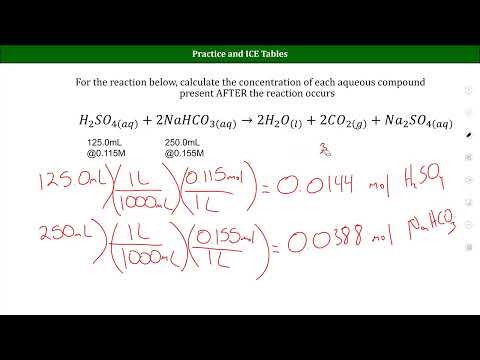
- The example starts with 0.0144 mol H2SO4 and 0.0388 mol sodium hydrogen carbonate.
- The balanced reaction uses 2 mol NaHCO3 per 1 mol H2SO4, so consuming all the acid requires 0.0288 mol bicarbonate.
- Because 0.0388 mol bicarbonate is available, H2SO4 is limiting and 0.0100 mol NaHCO3 remains.
- Mixing 250 mL and 125 mL solutions gives a final volume of 375 mL, or 0.375 L.
- The limiting H2SO4 is fully consumed, so its final concentration is zero under the class assumption of complete reaction.
- The remaining 0.0100 mol NaHCO3 gives 0.0267 M, while 0.0144 mol Na2SO4 gives 0.0384 M in the shared final volume.
- A change table has initial, change, and end rows for each compound, organizing all mole changes together.
- For the acid and bicarbonate reaction, the changes are −x for H2SO4, −2x for NaHCO3, +2x for CO2, +x for Na2SO4, and +2x for H2O.
- Setting the limiting reactant’s final amount to zero gives 0.0144 − x = 0, so x = 0.0144 mol.
- For CH4 + 2O2 → CO2 + 2H2O, the example begins with 0.500 mol CH4 and 0.750 mol O2.
- Oxygen is limiting, so 0.750 − 2x = 0 gives x = 0.375 mol.
- The end row gives 0.125 mol CH4, 0.375 mol CO2, and 0.750 mol H2O; summing gas moles can help determine a system’s total pressure.
- At constant temperature and number of gas molecules, Boyle’s law describes pressure as proportional to 1/V.
- Doubling volume halves pressure, so plotting pressure against inverse volume produces a straight-line relationship through the origin.
- Ryland explains that transforming data, such as plotting 1/V, can make it suitable for linear trend-line analysis.
- A sealed 2.00 L bottle begins at 760 torr and is compressed to 1.65 L at constant temperature.
- Using P1V1 = P2V2 gives a final pressure of about 921 torr.
- Pressure and volume units can vary, but each quantity must use consistent units on both sides of the equation.
- With pressure and amount of gas held constant, volume is proportional to absolute temperature.
- Charles’s law is V1/T1 = V2/T2, and its temperature values must be in Kelvin rather than Celsius.
- Kelvin starts at absolute zero, so negative Kelvin is not physically meaningful and the unit is written without a degree symbol.
- The example heats a 10 L system from 22 °C to 51 °C at constant pressure.
- Convert the temperatures to 295 K and 324 K before applying V2 = V1 × T2/T1.
- The new volume is approximately 11.0 L, reported to three significant figures.
- Ryland reminds students that Chemistry 103 section 1 is Tuesday-Thursday lab and section 2 is Monday-Wednesday lab, and urges students to verify their registration.
- The Monday-Wednesday section is open and includes research projects; Ryland encourages enrollment to balance lab sizes.
- During the break discussion, Ryland and students consider online-course interaction, research-career pressures, postdoctoral work, and academic publishing’s reliance on unpaid reviewing.
- The relationship between pressure, volume, and temperature can be combined into P1V1/T1 = P2V2/T2.
- The combined gas law applies when the number of moles remains constant.
- Temperatures must still be in Kelvin, while pressure and volume units must be consistent between initial and final conditions.
- The balloon example starts near 1.05 atm, 5.00 L, and 22 °C, then warms to 34 °C as its volume grows to about 5.08 L.
- Convert 22 °C and 34 °C to 295 K and 307 K, then substitute the values into the combined gas law.
- The resulting pressure is approximately 1.08 atm; other units are acceptable if they are used consistently.
- Avogadro’s law states that gas volume is proportional to the number of moles when pressure and temperature are held constant.
- Ryland presents a combined equation containing pressure, volume, temperature, and moles.
- Holding a variable constant allows it to cancel, reducing the combined expression to simpler laws such as P1V1 = P2V2.
- For a gas sample compressed from 13.9 L at 1.22 atm to 10.3 L, Ryland assumes both temperature and moles are constant.
- Those assumptions reduce the combined gas law to Boyle’s law, allowing the final pressure to be found from P1V1 = P2V2.
- A reliable first step is to identify which quantities are changing, infer unstated constants where reasonable, and recognize units such as liters and pascals.
- The ideal-gas model assumes gas particles have negligible volume and do not interact significantly.
- At ordinary conditions, widely spaced particles make the no-interaction approximation useful; Ryland illustrates their separation with a human-sized particle traveling toward Jupiter before a collision.
- Because ideal gas behavior depends on total moles rather than chemical identity, partial pressures of different gases can be added to obtain total pressure.
- At sea level, oxygen is about 20.946% of air by volume and mole, so its mole fraction is 0.20946.
- Dalton’s relationship gives partial pressure as mole fraction times total pressure: at 1 atm, oxygen contributes about 0.209 atm.
- For ideal gas mixtures, percent by volume, percent by mole, and percent by pressure correspond; percent by mass does not generally match.
- At Tahoe’s approximate atmospheric pressure of 0.8 atm, the same 20.946% oxygen fraction gives an oxygen partial pressure near 0.16 atm.
- Ryland discusses high-altitude training and notes that physiological adaptation takes time, distinguishing short-term conditioning from longer-term changes in hemoglobin oxygen binding.
- The lecture links the altitude discussion back to the partial-pressure calculation rather than a change in the percentage of oxygen in air.
- Combining pressure, volume, moles, and temperature gives PV/(nT) = R, where R is the gas constant.
- For pressure in atmospheres, volume in liters, amount in moles, and temperature in Kelvin, the commonly used R is about 0.08206 L·atm/(mol·K).
- The same underlying constant also appears in relationships involving molecular energy and probability, including the vapor-pressure equation.
- Multiplying through by nT gives the ideal gas law, PV = nRT, which can solve for any one variable when the other three are known.
- Ryland contrasts it with the before-and-after combined gas law, recommending PV = nRT when measured pressure, volume, and temperature allow the mole amount to be calculated.
- A gas at 1.05 atm, 5.00 L, and 295 K contains approximately 0.217 mol using R = 0.08206 L·atm/(mol·K).
- Ryland previews a lab reaction between magnesium and excess hydrochloric acid, which produces hydrogen gas.
- Students can predict hydrogen moles from the amount of magnesium, then measure gas volume, atmospheric pressure, and temperature.
- Those measurements allow an experimental value of R to be calculated from PV/(nT); Ryland closes by offering office hours and an assessment opportunity.
Transcript excerpt
0:07 It doesn't take much to get me to talk about my kids. They're pretty good kids. >> They seem good. >> All right. So here's the plan today. Um we're going to do some more practice with concentration that is going to be kind of similar to how I'm going to ask the concentration question. I decided on the on the uh assessment for the concentration um learning objective to basically make it another stoichiometry problem. Um so just one that's based on concentrations instead of being based on grams. Um so it's pretty straightforward. It's going to always look something like this. Um this version specifically says of each aqueous compound
0:55 um after the reaction occurs, but really I'm on the the uh assessment I'm just going to ask you about one of them. Um so either how much excess reactant is left over or how much products, what's the final concentration of product, something along those lines. Um but we'll find out that this is actually a really important um aspect of of um equilibrium and knowing how far reactions progress is all based on concentrations. And for the most part it's based on concentrations of everything. So we're going to practice finding concentrations of everything um and before the reaction starts and after the reaction starts. Um and then I'll that I got a good tool for this, but I'm going to give you a a
1:43 few minutes to practice this first and then we'll get started working on it. >> [clears throat] >> a note to myself so I don't forget in a
2:57 minute. >> And so first off, what type of reaction
5:03 is this? We did make CO2. I forgot that I wrote the complete one out. This one's a little bit tricky. This is a gas
This is the start of the transcript. Save this video free for the whole transcript, searchable and time-coded.
Related notes
Summary, takeaways, and chapters were generated by AI from the video's transcript and may contain errors. The video belongs to its creator, Sean Ryland.