Chem128BFA26 Chapter 23 Lecture 3
Overview
Dr Nicholas Corsepius explains how conjugated enones and enals support two kinds of nucleophilic attack, then develops Michael additions and Robinson annulations as connected carbonyl reactions. He contrasts hard Grignard attack at the carbonyl carbon with soft Gilman or resonance-stabilized donor attack at the beta carbon, and shows how a Michael addition followed by an intramolecular aldol condensation can form a six-membered ring.
Key takeaways
- Enone conjugation creates two electrophilic sites: the hard carbonyl carbon and the soft beta carbon.
- Grignard reagents preferentially attack an enone carbonyl carbon, while soft Gilman reagents preferentially attack its beta carbon.
- A Michael acceptor has a conjugated carbon-carbon double bond and an electron-withdrawing group; Michael addition creates a bond at the beta carbon.
- Michael donors include deprotonated compounds with two electron-withdrawing groups, Gilman reagents, nitro-stabilized anions, and enamines.
- Stork enamine synthesis lets a ketone or aldehyde act as a soft alpha-carbon donor; dilute acid hydrolyzes the intermediate back to a carbonyl.
- Robinson annulation combines Michael addition with intramolecular aldol condensation; a six-carbon separation between reactive centers leads to a six-membered ring.
Chapters
- An enone or enal contains a carbon-carbon double bond conjugated to a ketone or aldehyde carbonyl.
- The double bond lies between the alpha and beta carbons relative to the carbonyl.
- Aldol condensation reactions produce enones and enals, which can serve as starting materials for further reactions.
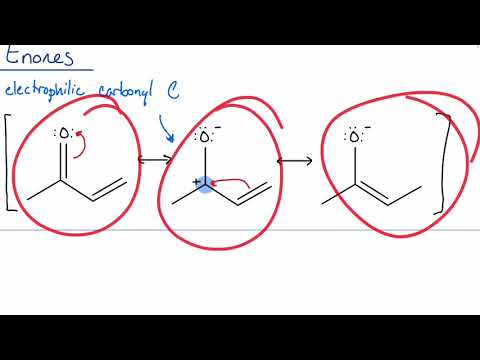
- A carbonyl resonance form places partial positive character on the carbonyl carbon, as in an ordinary ketone.
- Conjugation extends the resonance system to the beta carbon, which can also carry positive character.
- An enone therefore has electrophilic sites at both its carbonyl carbon and its beta carbon.
- A hard electrophile has concentrated charge density in a small volume, while a soft electrophile has more diffuse charge.
- The carbonyl carbon is the hard electrophilic site in an enone.
- Resonance distributes electrophilic character to the beta carbon, making it the soft site.
- Grignard reagents act as hard carbon nucleophiles and preferentially form a carbon-carbon bond at the enone carbonyl carbon.
- Gilman reagents, organocopper reagents containing copper and lithium, act as soft nucleophiles.
- Gilman reagents preferentially bond to the soft electrophilic beta carbon.
- A Michael acceptor has a carbon-carbon pi bond conjugated to an electron-withdrawing group.
- The electron-withdrawing group makes the beta carbon an electrophilic target for a soft nucleophile.
- Michael addition forms a new carbon-carbon bond at the beta position.
- Enones and enals are Michael acceptors because their carbonyl groups withdraw electron density through the conjugated pi system.
- Conjugated esters and nitriles can also act as Michael acceptors.
- A nitro group is another electron-withdrawing group that can activate a conjugated beta carbon.
- Many Michael donors have an acidic carbon between two electron-withdrawing groups, such as two aldehydes, ketones, esters, or nitriles.
- Base removes the acidic proton to create a nucleophile stabilized by resonance with both groups.
- An unsymmetrical donor can pair different groups, such as a ketone on one side and an ester on the other.
- Gilman reagents are soft nucleophilic Michael donors despite lacking two electron-withdrawing groups.
- A single nitro group can stabilize an alpha-carbon nucleophile sufficiently to make a Michael donor.
- Enamines formed from aldehydes or ketones and secondary amines are also soft nucleophiles at the alpha carbon.
- A secondary amine converts an aldehyde or ketone into an enamine with a nucleophilic alpha carbon.
- The enamine attacks the beta carbon of a Michael acceptor to form a new carbon-carbon bond.
- Dilute acid and water reverse enamine formation, replacing the nitrogen-containing group with the original carbonyl.
- For a donor flanked by two electron-withdrawing groups, base removes the acidic alpha proton to generate a resonance-stabilized nucleophile.
- The donor carbon attacks the enone beta carbon as the conjugated pi electrons shift toward oxygen.
- Acid workup protonates the resulting enolate, which tautomerizes to the carbonyl product; ordinary ketones instead require a secondary amine to form an enamine donor.
- A Robinson annulation begins with a Michael addition between a donor and an enone or enal acceptor.
- The Michael product can then undergo an intramolecular aldol condensation.
- Not every Michael product cyclizes: a nucleophilic alpha carbon must be six carbons away from an electrophilic carbonyl carbon.
- For a donor containing two electron-withdrawing groups, base generates the nucleophile before it attacks the acceptor's beta carbon.
- The Michael step forms the new carbon-carbon bond and removes the acceptor's carbon-carbon pi bond while retaining its carbonyl.
- The resulting molecule is checked for an alpha-carbon nucleophile positioned six carbons from a carbonyl electrophile.
- Under aldol conditions, including sodium hydroxide, ethanol, and heat, the eligible alpha carbon attacks the intramolecular carbonyl.
- The aldol addition product loses water under heat to form a carbon-carbon double bond conjugated with a carbonyl.
- The six-carbon spacing between reactive centers produces a new six-membered ring.
- Identify every alpha carbon and carbonyl carbon in the Michael product, then count for a six-carbon separation.
- Draw the six-membered ring first and number its atoms to preserve substituent positions and carbonyl groups.
- In the worked example, the bond between ring carbons 1 and 6 forms, and dehydration converts the aldol hydroxyl into a double bond.
Transcript excerpt
0:03 All right. So let's finish off this chapter on these carbonyl condensation reactions. All right. We have one more to go here what's called looking at these enones. All right. So we're going to talk about enone reactions. Okay. So just picking apart this word enone what do we think the en means? A carbon carbon double bond. And what does the one mean? Ketone or aldehyde. All right. Really if we're being good we
0:53 could have two separate words, an enone or an en al. An en al containing again a carbon carbon double bond but this one also containing an aldehyde. All right. So what we're talking about are these molecules where we have both our ketone or aldehyde functional group our carbonyl bond. All right. But then conjugated to that double bond I'm sorry, conjugated to that carbonyl bond is a carbon carbon double bond. All right.
1:42 These are also called so again an enone or what's also called an alpha beta aldehyde or ketone. All right. Alpha unsaturated because remember, from our carbonyl carbon, we start labeling these carbons. This is an alpha carbon. We actually got two alpha carbons, one on each side. All right. But we have this degree of unsaturation or this double bond between my alpha and my beta carbon. Okay? So, a more fancy word that we could name that we could use for these are alpha, beta unsaturated ketones or kind of the slang term an enone. Okay? And one of the other important
2:30 things that we want to note about this is this is the product. All right. So, we want to note that we do know how to make these. Okay? Because we're going to start talking about reactions of these. And these are the product of an other reaction that we've
This is the start of the transcript. Save this video free for the whole transcript, searchable and time-coded.
Related notes
Summary, takeaways, and chapters were generated by AI from the video's transcript and may contain errors. The video belongs to its creator, Dr Nicholas Corsepius.