Chem1AFA26CSU Chapter 5 Part 2 Lecture 3
 Watch on YouTube →
Overview
Dr Nicholas Corsepius explains how to estimate reaction enthalpy from bond dissociation energies by identifying bonds broken and formed in Lewis structures, then calculating the energy absorbed minus the energy released. Worked examples include H₂ + Cl₂ → 2HCl at −184 kJ/mol, an endothermic reaction at +484 kJ/mol, and reactions involving C=C and C≡C bonds; the method is flexible but approximate because bond energies vary with molecular environment.
Key takeaways
- Estimate reaction enthalpy from bond energies with ΔH ≈ Σ(bond energies broken) − Σ(bond energies formed); positive values indicate net absorption and negative values indicate net release.
- For H₂ + Cl₂ → 2HCl, breaking H–H and Cl–Cl requires 678 kJ/mol and forming two H–Cl bonds releases 862 kJ/mol, yielding approximately −184 kJ/mol.
- For the C–F/H–F example, breaking bonds costs 1,052 kJ/mol while forming C–H and F–F releases 568 kJ/mol, producing an endothermic ΔH of +484 kJ/mol.
- When a reaction changes a double or triple bond into a single bond, bond-energy bookkeeping can count the higher-order bond as broken and a single bond as reformed; this alternate path preserves the net enthalpy because enthalpy is a state function.
- Average bond dissociation energies make the method broadly applicable but approximate, since actual bond strengths depend on a molecule's structure and local chemical environment.
Chapters
- Dr Nicholas Corsepius reviews two earlier approaches: products-minus-reactants using standard enthalpies of formation, and Hess's law.
- The new approach estimates ΔH from bond dissociation energies by tracking bonds in reactant and product Lewis structures.
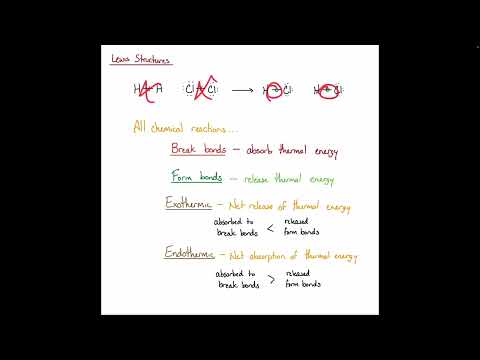
- Breaking H–H and Cl–Cl bonds absorbs thermal energy, while forming H–Cl bonds releases it.
- An exothermic reaction releases more energy making bonds than it absorbs breaking them; an endothermic reaction absorbs more than it releases.
- The tabulated bond energies are 436 kJ/mol for H–H, 242 kJ/mol for Cl–Cl, and 431 kJ/mol for H–Cl.
- Breaking bonds contributes positive energy and forming bonds contributes released energy, so use ΔH ≈ Σ(bonds broken) − Σ(bonds formed).
- The calculation 436 + 242 − 2(431) gives ΔH ≈ −184 kJ/mol, an exothermic reaction.
- Comparing Lewis structures identifies one C–F bond and one H–F bond to break; unchanged C–H bonds are not counted.
- Forming one new C–H bond and one F–F bond releases 413 and 155 kJ/mol, respectively.
- Breaking the C–F and H–F bonds takes 485 + 567 = 1,052 kJ/mol; forming the new bonds releases 568 kJ/mol, giving ΔH = +484 kJ/mol.
- The example reaction breaks a Cl–Cl bond, forms two C–Cl bonds, and changes a carbon–carbon double bond into a single bond.
- Because the tabulated bond energies cannot represent breaking only one component of the double bond, treat both C–C bonds as broken and reform one single bond.
- This hypothetical accounting gives the same net enthalpy because enthalpy is a state function and depends on initial and final states, not the path.
- The worked bond-energy totals are 856 kJ/mol absorbed to break bonds and 1,004 kJ/mol released when bonds form.
- The result is ΔH = 856 − 1,004 = −148 kJ/mol, so the reaction is exothermic.
- Corsepius introduces another practice problem using higher-order bonds before moving to a C≡C reaction with water.
- The accounting breaks a C≡C triple bond and two O–H bonds, then reforms a C–C single bond.
- New bonds include a C=O double bond and two C–H bonds; their energies are 799, 348, and 413 kJ/mol per C–H bond.
- Breaking requires 839 + 2(463) = 1,765 kJ/mol, while forming bonds releases 799 + 348 + 2(413) = 1,973 kJ/mol.
- The net result is ΔH = −208 kJ/mol, an exothermic reaction.
- Bond dissociation energies provide a physical picture of energy absorbed to break bonds and released when new bonds form.
- Unlike formation-enthalpy tables, bond-energy tables can estimate reactions even when specific compounds are not listed.
- The method is approximate because a tabulated average, such as 348 kJ/mol for a C–C single bond, cannot capture every molecule's bonding environment.
- Comparing the H₂ + Cl₂ estimate with a standard-enthalpy calculation gives close but not identical results.
Transcript excerpt
0:03 All right. So, let's continue with this discussion of enthalpy. All right, last week we covered two different ways to calculate the enthalpy of a reaction. The first was using those thermodynamic standards, our delta H of formation from our appendix page, combining those together using our formula, our products minus reactants formula, in order to get the delta H of our reaction. All right? And then we talked about using Hess's law, combining these known reactions, where we know their delta H's, to figure out the delta H of some unknown reaction. All right? Today, we're going to learn a third way to calculate delta H for a reaction, what's called using bond dissociation energies. All right.
1:03 Cool. Uh so, let's get an example down here. Okay. Let's look at a chemical equation. We're going to look All right, we can convert hydrogen gas react that with chlorine gas, and this will produce two equivalents of hydrogen chloride, HCl. Oops. All right. And we want the delta H of this reaction. Well, first of all, we could 100% use our
1:51 uh thermodynamic standards, right? We could go to our appendix, we could look up our reactants and our products delta H of formation and do that products minus reactants method, all right? But again, the whole point here is to use this new method using these bond dissociation energies. And in order to do to do that, we're not going to look at our chemical equation or we are, but we're going to look specifically at the Lewis structures of these reaction reactants and products. All right. So, remember our Lewis structures show our elements, shows our covalent bonds, and then we also have these non-bonding electrons lone pairs that are also represented. All right. So, here's a hydrogen
This is the start of the transcript. Save this video free for the whole transcript, searchable and time-coded.
Related notes
Summary, takeaways, and chapters were generated by AI from the video's transcript and may contain errors. The video belongs to its creator, Dr Nicholas Corsepius.