AU26 CHEM 2310 - Lecture 4 - September 3 - Quiz 1 - Gen Chem Review
 Watch on YouTube →
Overview
Jennifer Walters reviews the general-chemistry concepts CHEM 2310 students need for organic chemistry, connecting molecular shape and polarity to orbitals, hybridization, and bonding. The lecture covers five VSEPR geometries, four quantum numbers, sp3/sp2/sp hybridization, resonance, sigma and pi molecular orbitals, and line-structure conventions, with examples including CO2, BF3, ammonia, water, carbon, and hydrogen.
Key takeaways
- Molecular polarity depends on the vector sum of polar bonds in the molecule's three-dimensional geometry, not simply on the appearance of a flat Lewis structure.
- Hybridization maps directly to geometry and bonding: sp3 is tetrahedral, sp2 is trigonal planar, and sp is linear; double and triple bonds correspond to sp2 and sp centers, respectively.
- A lone pair on an atom that appears sp3 must be checked for resonance with a neighboring sp2 or sp atom; resonance requires an unhybridized p orbital, so a truly sp3 atom cannot participate.
- A double bond consists of one sigma and one pi bond, while a triple bond consists of one sigma and two perpendicular pi bonds; pi overlap is weaker and prevents free rotation.
- Bonding molecular orbitals are lower in energy than their antibonding partners; filling sigma-star or pi-star orbitals weakens or breaks the associated bond.
- In line diagrams, every vertex and line end represents carbon, while heteroatoms, their attached hydrogens, formal charges, and multiple bonds must be drawn explicitly.
Chapters
- Jennifer Walters offers students with obstructed seats a Zoom view of the slides, with audio disabled to prevent feedback.
- A TV is requested for the back of the classroom; the Top Hat code is 0093, with access closing around 1:00.
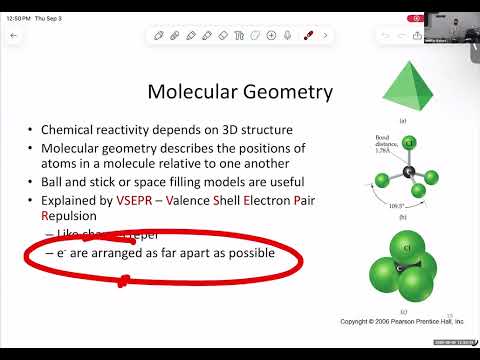
- VSEPR theory predicts that electron regions repel and arrange themselves to minimize molecular energy.
- The five geometries emphasized are linear at 180 degrees, trigonal planar at 120 degrees, tetrahedral at about 109.5 degrees, trigonal pyramidal, and bent at about 104.5 degrees.
- CO2 is linear, BF3 is trigonal planar, and carbon with four single bonds is tetrahedral; lone pairs make tetrahedral arrangements trigonal pyramidal or bent.
- A bond is treated as polar when its electronegativity difference is greater than 0.4; a molecule with only nonpolar bonds is nonpolar.
- One polar bond makes a molecule polar, while multiple polar bonds require checking whether their dipole vectors cancel in three dimensions.
- A flat Lewis drawing can mislead: a molecule's actual 3D geometry determines the net dipole, and ammonia and water are polar.
- The principal quantum number n is a positive whole number tied to the energy shell and approximate orbital size.
- The angular momentum number l ranges from 0 to n minus 1 and maps to s, p, d, and f orbital shapes.
- The magnetic quantum number m_l specifies orbital orientations: s has one, p has three, and d has five.
- The spin quantum number m_s is +1/2 or -1/2, allowing two electrons in each orbital.
- An s subshell holds 2 electrons, p holds 6, d holds 10, and f holds 14.
- The n = 1 shell holds 2 electrons; the n = 2 shell holds 8 because it includes one s and three p orbitals.
- Adding d and f orbitals raises shell capacities to 18 and 32, respectively; higher-n electrons are farther from the nucleus and typically more reactive.
- Atomic orbitals are probability distributions, but unmodified s and p orbitals do not adequately explain the observed bonding patterns of molecules.
- Hybridization mixes atomic orbitals into equivalent-energy, or degenerate, orbitals that better explain molecular bonding and geometry.
- The course focuses on sp3, sp2, and sp hybridization, mixing s and p orbitals.
- An unhybridized carbon valence configuration appears to have one paired 2s orbital, two unpaired 2p electrons, and one vacant p orbital, which does not explain four equivalent bonds.
- Promoting a 2s electron to a 2p orbital and mixing the orbitals produces four equivalent sp3 orbitals, each available for bonding.
- Hund's rule fills orbitals singly before pairing; the Pauli exclusion principle requires paired electrons in one orbital to have opposite spins.
- The Aufbau principle fills the lowest-energy orbitals first, such as 1s, then 2s, then 2p.
- Mixing one s orbital with three p orbitals gives four sp3 orbitals; the number of orbitals mixed equals the number produced.
- Mixing one s with two p orbitals gives three sp2 orbitals and leaves one unhybridized p orbital.
- Mixing one s with one p gives two sp orbitals and leaves two p orbitals unhybridized.
- The leftover p orbitals enable pi bonding: sp3 corresponds to tetrahedral regions, sp2 to trigonal planar regions, and sp to linear regions.
- Use the direct mappings single bond to sp3, double bond to sp2, and triple bond to sp.
- For an atom with a lone pair and only single bonds, stop and check neighboring atoms for an sp2 or sp atom that can participate in resonance.
- A lone-pair atom that appears sp3 becomes sp2 when adjacent to an sp2 or sp center; otherwise it remains sp3.
- Hybridized orbitals point along the internuclear axes where bonds are drawn.
- Students apply the bond-and-resonance method to assign hybridization to every carbon and oxygen in a provided structure.
- Walters asks students to compare answers with classmates and explain uncertain assignments before reviewing the example.
- The example's carbon in a double bond is sp2, both carbons in a triple bond are sp, and carbons with only single bonds are sp3.
- The oxygen attached to hydrogen and an sp2 carbon is sp2 because its lone pair can interact with the neighboring pi system.
- An oxygen flanked by sp3 centers remains sp3 because it has no adjacent p orbital available for resonance.
- Resonance requires unhybridized p orbitals, so Walters states that an sp3-hybridized atom cannot participate in resonance.
- Atomic and hybridized atomic orbitals describe individual atoms but do not explain electron delocalization across multiple atoms in resonance.
- Molecular orbital theory combines orbitals across atoms and introduces sigma, sigma-star, pi, and pi-star orbitals.
- Sigma electron density lies along the internuclear axis between nuclei.
- Sigma bonds form through head-on overlap, including combinations of atomic s or p orbitals and hybridized orbitals.
- Shading represents orbital phase; matching shading where orbitals meet indicates compatible overlap, while the specific shaded side is arbitrary.
- A pi bond forms only through side-on overlap of two parallel p orbitals, placing electron density above and below the internuclear axis.
- A single bond contains one sigma bond; a double bond contains one sigma and one pi; a triple bond contains one sigma and two pi bonds.
- Every bonding sigma or pi orbital has a corresponding antibonding sigma-star or pi-star orbital.
- Bonding orbitals are lower in energy, while antibonding orbitals are higher; occupying an antibonding orbital weakens or breaks the associated bond.
- Two hydrogen 1s orbitals combine to form a lower-energy sigma bonding orbital and a higher-energy sigma-star antibonding orbital.
- The two electrons in H2 fill the sigma orbital, leaving sigma-star empty, which supports the H-H bond.
- An electron entering sigma-star disrupts the bond; Walters connects this occupancy principle to bond breaking during chemical reactions.
- Sigma bonds are stronger than pi bonds because their head-on orbital overlap is greater.
- A double bond is stronger overall than a single bond because it contains both a sigma and a pi bond, even though the pi component is weaker.
- Sigma bonds allow rotation, producing conformational isomers; pi bonds restrict rotation because turning one p orbital out of alignment destroys side-on overlap.
- Triple bonds contain two pi bonds oriented perpendicular to each other around the sigma bond.
- Molecular formulas give element counts without connectivity; condensed formulas show some connectivity and are read from left to right.
- In condensed formulas, hydrogen is written next to the atom it is attached to, and implied bonds are inferred by filling carbon's four bonds and completing heteroatom octets.
- Line diagrams omit carbon labels and most carbon-bound hydrogens; each line end and vertex represents a carbon.
- Line diagrams must show heteroatoms, hydrogens attached to heteroatoms, formal charges, and all double or triple bonds; recitation will provide additional practice and answer checks.
Transcript excerpt
7:09 All right. Nope. Can't hear me. Can you hear me? Okay. Now, a little bit too much. Is that better? Okay. All right. So, for uh those of you in the back of the class, because I did not realize I knew it was not great to see, but I didn't realize exactly how bad it was uh until someone actually sent me a picture of like their view from the back of the class. And I was like, dang, when you have a full room, that is awful. So what I will do uh for today is those of you that are in the back of the class with obstructive views uh I will let you request to join the Zoom meeting make sure that the audio is not enabled so
7:56 that it doesn't create like that uh you know feedback going on but if you request uh into Zoom I will let you view the slides on Zoom that way. Um, and then, uh, what I'm also doing is asking that they install a TV in the back of the room so that way you can see the slides more clearly. Um, I have no clue how long that will take. So, until then, we will do this quick fix of I will let you into Zoom so that way you can use uh Zoom to see the slides and you can use your device. Okay. Uh also there were issues of uh not having the code when in case anyone comes in late which this is not helpful to you all because you all are not late but uh you
8:45 can pass little whispers. Um so what we're going to do is I will write the code on the board which again if you're in the back of the class not super
This is the start of the transcript. Save this video free for the whole transcript, searchable and time-coded.
Related notes
Summary, takeaways, and chapters were generated by AI from the video's transcript and may contain errors. The video belongs to its creator, Dr. Jennifer Walters.