AU26 CHEM 2310 - Lecture 3 - September 1 - Quiz 1 - Gen Chem Review
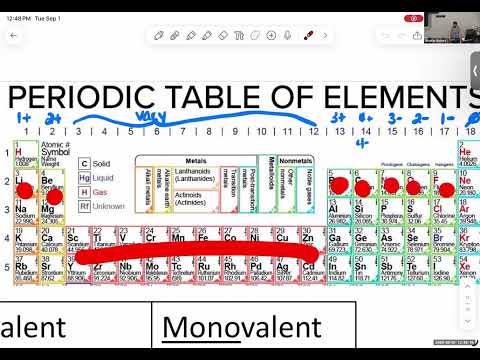 Watch on YouTube →
Overview
Jennifer Walters reviews general chemistry foundations for Quiz 1, then develops a step-by-step method for drawing Lewis structures, calculating formal charges, and evaluating resonance. The lecture emphasizes octets, electron bookkeeping, and curved-arrow rules, using CO₂ and nitrogen-oxygen structures to show how resonance contributors combine into a hybrid.
Key takeaways
- A Lewis structure must use exactly the molecule's available valence electrons; the proposed all-single-bond CO₂ drawing is invalid because it uses 20 electrons instead of 16.
- Formal charge can be calculated quickly as periodic-table valence electrons minus lone-pair dots minus bond lines, making oxygen with two bonds and two lone pairs neutral.
- Resonance evaluation follows a strict priority: satisfy octets first, minimize formal charges second, then favor negative charge on the more electronegative atom.
- Curved arrows track electron movement, not atom movement; for a lone pair adjacent to a pi bond, a second arrow is often needed to maintain carbon's octet.
- A resonance hybrid represents the molecule more realistically than any single contributor, using partial bonds and partial charges where electron placement varies.
Chapters
- Walters recommends restarting a device if campus Wi-Fi fails to connect it to the closest router.
- Students can photograph the Top Hat attendance code and email it to Walters as a backup attendance record.
- Ionic bonds involve electron transfer and ion formation, while covalent bonds involve electron sharing.
- Polar covalent bonds share electrons unequally, and the dipole arrow points toward the more electronegative atom.
- Typical neutral valencies are carbon four, nitrogen three, oxygen two, and hydrogen and halogens one.
- Elements from period 3 downward can sometimes exceed an octet; sulfur and phosphorus are common examples.
- Boron and aluminum often form three bonds without a full octet, making them hypovalent.
- Boron, aluminum, and transition metals are treated as Lewis acids because they can accept electron density.
- Each bond line represents two shared electrons, so single, double, and triple bonds share two, four, and six electrons.
- Bond length decreases and bond strength increases from single to triple bonds.
- Triple bonds are also higher-energy and more reactive because electron density is concentrated between the bonded atoms.
- Lewis structures model valence electrons and bonding but do not show molecular geometry or fully explain how bonds form.
- Walters calculates formal charge as valence electrons minus nonbonding dots minus bond lines.
- An oxygen with two bonds and two lone pairs has formal charge zero; a singly bonded hydrogen also has formal charge zero.
- A singly bonded oxygen needs three lone pairs to complete its octet.
- Using oxygen's six valence electrons, six dots, and one bond line gives a formal charge of −1.
- The example reinforces that formal charge depends on both lone-pair electrons and the number of bond lines.
- Neutral CO₂ has 16 valence electrons: four from carbon and six from each of two oxygen atoms.
- Walters places the less electronegative carbon in the center, with oxygen atoms terminal; hydrogen, when present, must be terminal because it forms one bond.
- After drawing the skeleton and completing terminal oxygen octets, the central carbon lacks an octet, so additional bonds are formed and the electron count is checked again.
- The CO₂ structure with two C=O double bonds gives every atom formal charge zero.
- A structure with one C≡O bond and one C−O bond is also valid, but has −1 on the singly bonded oxygen and +1 on the triple-bonded oxygen.
- A proposed structure with only single bonds and full octets uses 20 electrons, exceeding CO₂'s 16-electron total, so it is invalid.
- For charged structures, minimize the number of formal charges and place negative charge on the more electronegative atom when possible.
- Multiple valid Lewis structures for the same atom arrangement indicate resonance; the individual drawings are contributors, not independent real structures.
- A double-headed resonance arrow connects contributors, while curved arrows show electron flow from a lone pair or bond.
- Resonance moves electrons only, not atoms; an arrow from atom to atom would indicate bond formation in a reaction rather than resonance.
- When a positive charge is adjacent to a double or triple bond, move the pi electrons toward the positively charged atom.
- The arrow starts at the pi bond and ends at the neighboring bond, shifting the multiple bond and relocating the electron deficiency.
- Atoms and their attached hydrogens remain in place; only the bond order and formal-charge location change.
- For a lone pair or negative charge adjacent to a pi bond, start the arrow at the electron-rich atom and form a new bond toward the pi system.
- A second arrow moves the original pi electrons onto the far-end atom to prevent carbon from exceeding its octet.
- The resulting structure preserves the total charge, with the negative charge shifted to the atom receiving the electrons.
- If neither a positive charge nor an electron-rich atom is adjacent to a pi bond, move the pi electrons of a polar bond to its more electronegative atom.
- For a C=O bond, moving the pi pair to oxygen gives oxygen a negative charge and carbon a positive charge.
- Walters treats this pattern as a fallback because it can create charge separation and a less stable contributor, but it may enable further resonance.
- A cyclic alkene attached to a carbonyl group first uses the polar C=O bond pattern when no positive charge or lone pair is available beside the ring pi bond.
- That electron shift creates a positive charge next to the ring double bond, allowing the positive-charge-adjacent-to-pi-bond pattern to operate next.
- The sequence extends electron sharing across more atoms, which can stabilize the overall molecule even if an intermediate contributor is less stable.
- Walters gives a three-step ranking method: maximize octets, minimize the number of formal charges, then place negative charge on the more electronegative atom.
- In the nitrogen-oxygen exercise, both candidate structures complete octets and each has one positive and one negative charge.
- The structure with negative charge on oxygen is favored over the one with negative charge on nitrogen because oxygen is more electronegative.
- A resonance hybrid keeps atoms fixed and represents bonds that vary between contributors with dotted or partial bonds.
- For the nitrogen-oxygen example, a bond that is sometimes double and sometimes triple is drawn with a partial additional bond.
- A charge present in every contributor remains full, while charges appearing only in some contributors become partial; the nitrogen and oxygen share partial negative character.
- Walters distinguishes the three patterns by checking whether the relevant positive charge or lone pair is adjacent to, rather than located within, the pi bond.
- For the nitrogen-oxygen structure, the correct pattern starts at the terminal nitrogen lone pair and forms an N−N pi bond.
- A second arrow shifts the N=O pi electrons onto oxygen, preserving nitrogen's octet and producing the alternate resonance contributor.
- Walters closes by identifying molecular geometry, orbitals, and line diagrams as the remaining Quiz 1 topics.
- The class is expected to use the next meeting to finish Quiz 1 content, with Quiz 2 planned for the following Tuesday.
Transcript excerpt
7:03 All right. How is everyone doing today? Good, good, good. Does anyone have any questions before we get started? Still see some people enter in the top hat code. So, I'll give you another couple seconds. All right. So, , yeah, with the Wi-Fi, unfortunately, like the best recommendations that they have is to actually restart your device. , because the idea is that you might not actually be connected to the closest router even though it's supposed to automatically connect. So, their Recommendation is always just totally
7:53 restart your device and then that should connect you to the closest one and then it should actually load. That being Said, I, you know, this feels like such an IT answer of just turn it off and on again. but yeah, otherwise you just want to take a picture of the code and you can email it to me and I'll mark you as present. It's a good practice to always be in is just to kind of always have the pictures of the codes all semester just in case if for whatever reason Top Hat ever like deletes your attendance for some reason. which is not usually a thing but there has been a time. So, it's just a good backup to always have just because top hat sometimes has issues. Cool. Any other questions? Sweet. Then let's get back into our chemistry.
8:53 All right. So, we left off. We were looking at our electrons and we were saying where are they located? How do I know how they can come together to make bonds? So what were the two types of bonds that we had? One was transfer of electrons, one was sharing electrons, ionic and covalent. So ionic was our transfer of electrons that made ions. Covalent was our sharing of electrons. within covalent you had two types of
This is the start of the transcript. Save this video free for the whole transcript, searchable and time-coded.
Related notes
Summary, takeaways, and chapters were generated by AI from the video's transcript and may contain errors. The video belongs to its creator, Dr. Jennifer Walters.