CHEM 335 Lecture 11-18-2026. Continues C=O reduction & covers synthesis of organometallic reagents
Overview
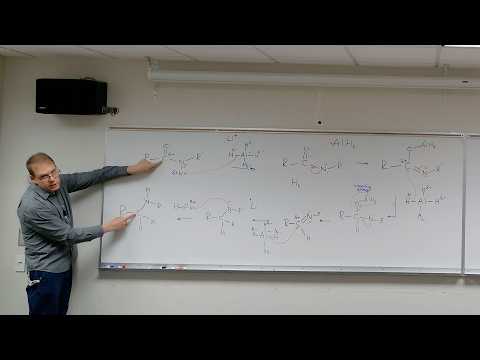
Brant Kedrowski completes carbonyl reduction chemistry: lithium aluminum hydride reduces esters and acid derivatives twice, converts amides to amines, while lithium aluminum tri-tert-butoxyhydride and DIBAL-H selectively reduce acid chlorides and esters to aldehydes. He then introduces organolithium reagents, Grignard reagents, and acetylide anions, explaining their preparation and their strong-base behavior, including how they form carbon-carbon bonds by attacking carbonyls.
Key takeaways
- LiAlH4 reduces esters and acid chlorides through two hydride additions, typically yielding primary alcohols; a lactone therefore opens to a diol after aqueous workup.
- LiAlH4 reduces amides differently from esters: the carbonyl oxygen is removed and replaced by two hydrogens while the nitrogen remains attached, producing an amine.
- Use lithium aluminum tri-tert-butoxyhydride to reduce acid chlorides to aldehydes, and DIBAL-H to reduce esters to aldehydes; both provide more controlled, single-hydride reduction than LiAlH4.
- Organolithium reagents form from organic halides and two lithium atoms, while Grignard reagents form by magnesium insertion in ether; both require moisture-free conditions.
- Organolithium, Grignard, and acetylide reagents behave as strong bases toward O-H and N-H groups, so protic compounds can consume the reagent before carbonyl addition.
- When an organometallic carbon attacks an aldehyde carbonyl, it forms a new carbon-carbon bond; aqueous workup then protonates the alkoxide product.
Chapters
- Friday office hours move to 10:20 to 11:20 a.m. on November 20, ahead of lecture; students can email to arrange another time.
- Exam 3 is scheduled for Monday, and the Canvas page includes practice exams and five molecules of the day.
- Testosterone contains both a carbonyl and a carbon-carbon double bond, illustrating how reagent choice can target one functional group while preserving another.
- A lactone is a cyclic ester, so lithium aluminum hydride (LiAlH4) follows the usual ester-reduction sequence.
- Hydride addition forms a tetrahedral intermediate; collapse ejects the ring oxygen as a leaving group and opens the ring to an aldehyde intermediate.
- A second hydride reduces the aldehyde, and water workup protonates both alkoxides to produce a diol with the original carbon skeleton.
- Hydrogen with palladium on carbon reduces the carbon-carbon double bond in the example while leaving the carbonyl largely intact when one equivalent of H2 is used.
- Sodium borohydride and LiAlH4 target carbonyl groups, while excess catalytic hydrogenation can reduce both double bonds.
- The reduction chart summarizes reagents for aldehydes, ketones, carboxylic acids, and their derivatives.
- Unlike esters and acid chlorides, amides retain the nitrogen substituent during LiAlH4 reduction.
- The net transformation replaces the carbonyl oxygen with two hydrogens, converting the amide carbonyl carbon into a methylene group.
- Oxygen leaves in association with aluminum; nitrogen is a poorer leaving group because a negatively charged nitrogen is a stronger base than a negatively charged oxygen.
- For an N-H amide, an initial LiAlH4 hydride acts as a base, removes the N-H proton, and releases hydrogen gas.
- Resonance and aluminum coordination form a strong aluminum-oxygen interaction, helping the oxygen leave as another hydride adds to the C=N intermediate.
- A further hydride addition followed by water workup gives the amine; students should be able to follow or complete parts of the mechanism, not necessarily reproduce it from memory.
- Lithium aluminum tri-tert-butoxyhydride has one reactive hydride and bulky tert-butoxy groups that temper its reactivity.
- It reduces an acid chloride by one hydride addition to an aldehyde rather than continuing to a primary alcohol.
- Water is added only after the reduction because it would quench the hydride reagent.
- Diisobutylaluminum hydride, abbreviated DIBAL-H, is a milder aluminum hydride with one hydride and two isobutyl groups.
- DIBAL-H reduces an ester selectively to an aldehyde after aqueous workup, unlike LiAlH4, which normally adds twice and yields a primary alcohol.
- The ester’s alkoxy group leaves during the process; the lecture also notes that aluminum-containing workup byproducts can be complex.
- The three classes introduced are organolithium reagents (C-Li), Grignard reagents (C-MgX), and acetylide anions derived from terminal alkynes.
- Because carbon is more electronegative than lithium or magnesium, the carbon-metal bonds are strongly polarized toward carbon, giving carbon substantial carbanion-like character.
- These reagents act as strong bases and strong nucleophiles; organolithiums are described as most reactive, organomagnesium reagents intermediate, and acetylides less reactive.
- Two equivalents of lithium metal react with an organic halide to form RLi and lithium halide.
- Organic halides can be aryl, vinyl, or alkyl; chlorine, bromine, and iodine are suitable, but fluorine does not work because the carbon-fluorine bond is too strong.
- Magnesium inserts into an organic carbon-halogen bond to form a Grignard reagent, RMgX, in an ether solvent such as diethyl ether.
- One magnesium atom supplies two valence electrons, whereas two lithium atoms are used because each lithium supplies one.
- A strong base such as sodium amide removes the weakly acidic terminal hydrogen from an alkyne, forming a sodium acetylide and ammonia.
- Organometallic reagents rapidly deprotonate O-H and N-H groups, so water, alcohols, and amines can quench them before they perform other reactions.
- A Grignard reagent exposed to water becomes a hydrocarbon, while an organolithium reagent deprotonating an N-H substrate forms an amide anion and an alkane.
- A carbon nucleophile such as methyllithium attacks the partially positive carbonyl carbon of an aldehyde, pushing the C=O electrons onto oxygen.
- The addition forms a new carbon-carbon bond; water workup protonates the resulting alkoxide to give an alcohol.
- Further reactions of organometallic reagents with carbonyl compounds are previewed for the next lecture.
Transcript excerpt
0:02 Good afternoon everybody. Welcome to lecture. I want to start off here with an announcement. I have an office hour change on Friday. So this typically isn't a real popular office hour. It's right after lecture usually. Um but we have an exam coming up and so I figured this could be a little bit more important than usual. Uh I need to change that office hour. I have a meeting that got scheduled in that time and um I need to go to it. So instead of after lecture, office hour will be before lecture 10:20 to 11:20 on Friday, this Friday the 20th. If that time doesn't work out for you and you were hoping to see me, make an appointment by email. Let me know. I'll find a time where we can meet. It'll be good. Just wanted to let everybody know so that you're um comfortable with that and aren't surprised when it's different.
0:52 We're going to go talk about the next thing. Now, this is the exam 3 info page on Canvas for the lecture course. And there are two new things here. So, two new molecules of the day. These are molecules of the day that'll round out the five that we're going to have on this exam that's coming up on Monday. That's the other thing that this page talks about is the exam is on Monday and uh the coverage. And the one we're going to talk about today is testosterone. So, this is a male sex hormone and it's also a steroid. So when you were in the lab and most people were in the lab, uh did the Percy Julian documentary, one of the things that was a big theme of that documentary was steroids um and some of the work that uh Percy Julian did to uh
This is the start of the transcript. Save this video free for the whole transcript, searchable and time-coded.
In this course
Related notes
Summary, takeaways, and chapters were generated by AI from the video's transcript and may contain errors. The video belongs to its creator, Brant Kedrowski.