CHEM 335 Lecture 10-28-2026. Covers charged aromatic & anti-aromatic rings, and carboxylic acids.
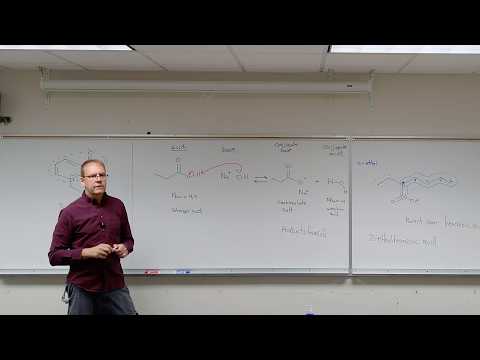 Watch on YouTube →
Overview
Brant Kedrowski reviews how to assess aromaticity in heterocycles and charged carbon rings, emphasizing conjugation, orbital participation, and Hückel electron counts. He then introduces carboxylic acid structures, naming rules, acid-base reactions, and the resonance stabilization that gives typical carboxylic acids a pKa near 4.9.
Key takeaways
- Aromaticity requires a cyclic, fully conjugated, planar system with 4n + 2 pi electrons; a planar 4n system is anti-aromatic, but a ring can pucker to break conjugation and become nonaromatic.
- For a carbocation in a conjugated ring, the empty p orbital maintains orbital overlap but contributes zero pi electrons; the cycloheptatrienyl cation therefore has six pi electrons and is aromatic.
- In oxygen- and sulfur-containing aromatic rings, only one lone pair typically occupies a p orbital and contributes to the pi count; indole reaches 10 pi electrons by including its pyrrole-like nitrogen lone pair.
- Aromatic stabilization can make deprotonation more favorable: removing a proton from cyclopentadiene forms the six-pi-electron cyclopentadienyl anion.
- Carboxylate resonance spreads negative charge across two oxygen atoms, stabilizing the conjugate base and helping explain why carboxylic acids typically have pKa values near 4.9.
- For naming a carboxylic acid, the parent chain must include the carboxyl carbon, numbering starts at that carbon, and a carboxyl group attached directly to a ring is named with the suffix carboxylic acid.
Chapters
- The upcoming Monday exam covers material taught since the previous exam, and practice exams are available on the course information page.
- Jasmonic acid helps regulate plant growth and stress responses, including defenses against insects.
- Plants can convert jasmonic acid into volatile methyl jasmonate, which can signal nearby tomato plants to activate defenses.
- Aromaticity analysis begins by checking that a ring is fully conjugated, with an sp2-hybridized orbital at each ring atom.
- In oxygen- and sulfur-containing rings, only one of the heteroatom's two lone pairs contributes to the pi system; the other remains in an sp2 orbital.
- Indole has 10 pi electrons: its double bonds contribute eight, and the pyrrole-like nitrogen lone pair contributes two.
- Indole is a core structure in tryptophan and signaling molecules such as serotonin and melatonin.
- A ring must be cyclic, fully conjugated, and planar to qualify as aromatic or anti-aromatic.
- The first survey example would have 4n pi electrons if flat, so it puckers to break conjugation and becomes nonaromatic.
- A second ring has 16 pi electrons when its carbon lone pair is included in the pi system, so it also puckers rather than remain anti-aromatic.
- A carbocation can remain part of a conjugated ring because its sp2-hybridized carbon has an empty p orbital.
- The cycloheptatrienyl, or tropylium, cation has six pi electrons from three double bonds; the cationic carbon contributes an empty orbital, not electrons.
- Its six-electron count fits the 4n + 2 pattern, making the seven-membered cation aromatic.
- The cyclopropenyl cation has two pi electrons and is aromatic by the 4n + 2 rule, despite the strain of its three-membered ring.
- Adding a lone pair to a conjugated three-membered ring can give four pi electrons, a 4n count associated with anti-aromaticity when planar.
- Anti-aromatic small rings are highly reactive and difficult to isolate under ordinary laboratory conditions.
- Positive charge alone does not determine aromaticity: a five-membered cation with four pi electrons is anti-aromatic.
- A radical contributes one electron from its singly occupied p orbital, which can produce a count that is neither 4n nor 4n + 2 and is classified as nonaromatic.
- The cyclopentadienyl anion has six pi electrons and is aromatic; deprotonation is unusually favorable because it forms this stable conjugate base.
- A ring atom that is sp3-hybridized interrupts conjugation, making the ring nonaromatic regardless of electron counting elsewhere.
- A carboxylic acid contains the carboxyl group, written as -COOH, with a carbonyl and hydroxyl attached to the same carbon.
- Condensed formulas may show the same group as RCO2H or COOH; the R group can be a carbon chain or hydrogen.
- Carboxylic acids are weak compared with mineral acids such as HCl, but are relatively acidic among common organic compounds.
- Choose the longest continuous carbon chain that includes the carboxyl carbon, even if another chain elsewhere appears longer.
- Numbering always starts at the carboxyl carbon, which is carbon 1; the parent name uses the suffix -oic acid.
- Name substituents with their positions and place them alphabetically before the parent acid name.
- When a carboxyl carbon is attached directly to a ring, name the ring first and add carboxylic acid, as in cyclohexanecarboxylic acid.
- A benzene ring bearing a carboxyl group has the retained parent name benzoic acid.
- Additional substituents on benzoic acid can be located with numbers or the familiar ortho, meta, and para descriptors.
- A base such as hydroxide removes the carboxylic acid proton, producing a carboxylate anion and water.
- The carboxylate anion pairs with a counterion, as in a sodium carboxylate salt.
- A typical carboxylic acid has a pKa near 4.9, while water has a pKa near 15.7; equilibrium favors the side with the weaker acid and base.
- Acid strength and conjugate-base strength are inversely related, so a stable carboxylate is a weak base.
- Unlike an alkoxide, whose negative charge is localized on one oxygen, a carboxylate distributes negative charge across two oxygens through resonance.
- The roughly 11-unit pKa difference between a carboxylic acid and a typical alcohol corresponds to a very large difference in acidity.
- Formic acid is the common name for methanoic acid, historically associated with ants.
- Acetic acid is the name commonly used for ethanoic acid, including in laboratory and biological settings.
- The next lecture will compare factors that make one carboxylic acid more acidic than another and may include exam review.
Transcript excerpt
0:30 Everybody lecture. So today we're going to finish up our discussion of aromatic and we're going to move on and talk about caroxilic acids and some of their fundamental behaviors. So just uh to give an announcement though exam is coming up. It's going to be on Monday. lecture and it's going to cover the material that we discussed since exam. This is the page that tells you all about it including content coverage, the resources you're going to get and a list of molecules of the day. I want to bring this up because there's one new one in here. Our last molecule today is acid. So this
1:25 is a molecule that's important in plant biology. So it's a molecule in plants that regulates growth and responses to stress. So plants may produce this compound to regulate their growth or respond to external stressors like say insects are eating it foliage or eating it foliage. They may produce this to help um regulate responses to try to prevent that from happening. So there's certain other molecules that plants can um produce that are defense mechanism type molecules that this could be a warning sign for. So for example um there's this interesting experiment where this molecule um there was a so the way people did it my understanding of this
2:11 experiment is they grew tomato plants next to another type of plant and um they basically um put like bugs on one of them or something. So started to eat the one plant and then This molecule gets produced but plants can make this volatile by putting a methyl group in place of the O that makes it into anatile float away and that becomes a floating signal to other plants that are nearby. So the nearby tomato plant got wind that
This is the start of the transcript. Save this video free for the whole transcript, searchable and time-coded.
Related notes
Summary, takeaways, and chapters were generated by AI from the video's transcript and may contain errors. The video belongs to its creator, Brant Kedrowski.