CHEM 335 Lecture 10-14-2026. Covers radical polymerization, conjugation and molecular orbitals.
 Watch on YouTube →
Overview
Brant Kedrowski finishes radical chemistry by tracing alkene monomers through free-radical chain growth into polymers such as polyethylene, PVC, polypropylene, and polystyrene, then shifts to conjugation and molecular orbitals. The lecture explains resonance as electron delocalization across overlapping p orbitals, using allylic radicals, 1,3-butadiene, isolated and cumulated dienes, and benzene to distinguish conjugated systems from nonconjugated ones.
Key takeaways
- An allylic radical must place the unpaired electron adjacent to a C=C bond; resonance can move the radical and π bond, but cannot relocate the radical across an intervening saturated carbon.
- Free-radical addition polymerization proceeds by initiator attack on an alkene, repeated addition of monomers at the radical chain end, and eventual termination.
- Resin codes distinguish common plastics: HDPE is 2, PVC is 3, LDPE is 4, polypropylene is 5, polystyrene is 6, and PET is 1; the code alone does not guarantee local recycling acceptance.
- Conjugation requires a continuous set of at least three aligned p orbitals, so the sp³ carbon in an isolated diene breaks electron delocalization.
- The two resonance drawings of an allylic carbocation are contributors to one delocalized structure, with partial charge at both terminal carbons and partial double-bond character across the system.
- Benzene’s six sp² carbons form a continuous ring of overlapping p orbitals, producing delocalized electron density above and below the ring.
Chapters
0:00
Allylic Bromination: Identify the Valid Radical Intermediates
- N-bromosuccinimide allylic bromination can abstract hydrogen from three allylic positions in the example alkene.
- Resonance forms A/B and C/E are valid; D is not because its radical is one carbon removed from the double bond.
- The missing intermediate comes from abstraction at the third allylic position; its two resonance drawings are equivalent by molecular symmetry.
6:00
Alkene Monomers, Radical Initiators, and Polymer Notation
- Polymers are large molecules assembled from repeating monomer units; natural examples include proteins, starch, cellulose, RNA, and DNA.
- Benzoyl peroxide can cleave its weak O–O bond homolytically under heat, generating radicals that initiate polymerization.
- Polymer notation places the smallest repeating unit in brackets with bonds extending beyond them and an n to indicate repetition.
11:00
Reading the Repeat Unit in an Addition Polymer
- Alkene polymerization converts the monomer’s C=C bond into C–C bonds that connect successive monomer-derived units.
- Brackets and n summarize a chain that may contain hundreds or thousands of repeat units without drawing every atom.
13:00
Everyday Polymers: Polyethylene, PVC, Polypropylene, and Polystyrene
- Polyethylene has hydrogen as its R group: HDPE is resin code 2, while LDPE is code 4; branching and structure affect rigidity and flexibility.
- PVC is code 3 and is used in plumbing pipes and some packaging; polypropylene is code 5 and is common in food containers and heat-resistant meal trays.
- Polystyrene is code 6 and appears in insulation, foam cups, disposable cutlery, and clear packaging such as CD jewel cases.
22:00
Plastic Resin Codes, Recycling, and PET Bottles
- Resin codes identify plastic types; the lecture notes that local recycling acceptance and economic value vary, with polystyrene often excluded.
- Code 1 PET, used in many clear single-use water bottles, is a polyester made by a different polymer-forming process than the radical addition polymers discussed here.
- HDPE and LDPE grocery bags illustrate how polymer structure can produce different properties and uses despite sharing polyethylene chemistry.
24:00
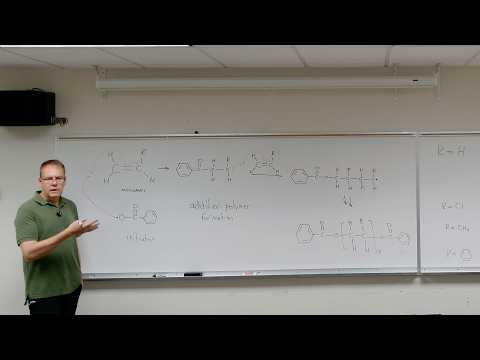
How Free-Radical Addition Polymerization Grows a Chain
- An initiator radical adds to an alkene’s π bond, forming a new C–C bond and placing the radical on the other alkene carbon.
- The chain-end radical adds to further monomers by the same pattern, extending the polymer one repeat unit at a time.
- Termination ends growth when radical chains combine or a chain reacts with another radical; initiator-derived groups can remain at chain ends.
29:00
Polymer Growth Direction, Branching, and Other Monomers
- Addition direction can favor a more substituted radical; a phenyl substituent can further stabilize a chain-end radical by resonance.
- Polymer samples contain chains of varied lengths and may include differently oriented units rather than one perfectly uniform structure.
- Radical transfer can create branches in polyethylene, contributing to the flexibility associated with LDPE; methyl methacrylate also polymerizes to acrylic material such as Plexiglas.
33:00
Resonance Hybrids and Delocalized Charge
- Two resonance structures represent one molecule, not structures that alternate in time.
- In the allylic carbocation example, shifting the π bond moves the positive charge between terminal carbons.
- The resonance hybrid has partial positive charge on both ends and partial double-bond character across both C–C bonds.
37:00
Conjugation Explained by Overlapping p Orbitals
- An empty p orbital adjacent to a π bond can overlap with the bond’s p orbitals, allowing electron density to spread across three carbon atoms.
- Conjugation requires three or more suitably aligned p orbitals that can overlap continuously.
- Delocalization stabilizes the structure and gives bonds partial character beyond the localized single- and double-bond drawings.
44:18
Conjugated, Isolated, and Cumulated Dienes
- In 1,3-butadiene, the sequence C=C–C=C provides four adjacent sp² carbons whose p orbitals overlap across the molecule.
- An isolated diene has an sp³-hybridized carbon between its double bonds, interrupting the p-orbital pathway and preventing conjugation.
- A cumulated diene has adjacent double bonds but is not conjugated because the relevant p orbitals are oriented approximately perpendicular to one another.
53:27
Benzene’s Continuous Ring of p Orbitals
- All six benzene carbons are sp²-hybridized, each contributing a p orbital to the ring-wide conjugated system.
- The overlapping orbitals create delocalized electron density above and below the carbon ring rather than isolated π bonds.
Summary, takeaways, and chapters were generated by AI from the video's transcript and may contain errors. The video belongs to its creator, Brant Kedrowski.