AU26 CHEM 2310 - Lecture 16 - October 20 - Review Quiz 6 + Continue Quiz 7 (needs transcript)
 Watch on YouTube →
Overview
Dr. Jennifer Walters reviews Quiz 6 stereochemistry, focusing on why students struggled more with isomer relationships than with identifying chiral centers. She then starts Quiz 7 by reviewing SN1 and SN2 mechanisms and guiding students through how substrate structure, nucleophile strength, solvent, regiochemistry, and stereochemistry help distinguish them.
Key takeaways
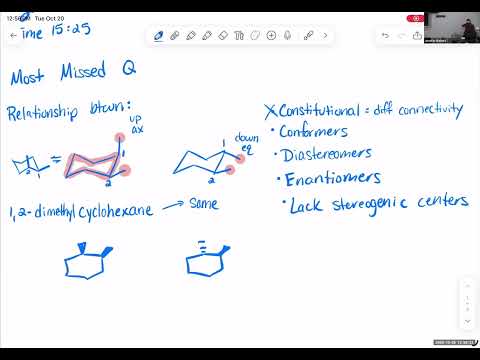
- To distinguish constitutional isomers from stereoisomers, first compare connectivity; identical 1,2-dimethylcyclohexane connectivity rules out constitutional isomerism.
- A cyclohexane chair flip changes axial to equatorial while preserving up/down orientation, whereas changing up to down at a fixed ring site inverts stereochemistry.
- When assigning R/S or E/Z, compare atoms outward one layer at a time and stop at the first difference; multiple bonds count as repeated attachments to the same atom.
- For substituted rings, cis/trans describes whether substituents share a face, while diastereomer describes the broader relationship when some but not all stereocenters differ.
- SN1 is favored by carbocation stability and proceeds through a planar intermediate; SN2 requires a strong nucleophile, an accessible substrate, and backside attack with inversion.
- Mechanism selection should start with substrate structure and nucleophile strength, then use solvent as a final check; an unstated solvent was unnecessary for the primary-bromide SN2 example.
Chapters
- Dr. Jennifer Walters notes that about half the class had taken Quiz 6 and the average was approximately 61%.
- The weekend retake period allows students to make first, second, or third attempts on their own schedule.
- Isomer relationships, rather than identifying chiral centers, were the most common source of errors.
- The largest ring is the parent backbone, so the six-carbon ring is named cyclohexane.
- Two one-carbon substituents produce a dimethyl name, with the example identified as 1,2-dimethylcyclohexane.
- Matching names indicate the two structures have the same connectivity, so they are not constitutional isomers.
- A cyclohexane chair flip exchanges axial and equatorial positions while keeping each substituent up or down.
- Changing an up substituent to down at the same ring site inverts that stereocenter; it is not simply a chair flip.
- The structures differ at one stereocenter while the other remains unchanged, making them diastereomers.
- Conformers arise from rotation around a single sigma bond and retain the same molecule and connectivity.
- A ring cannot rotate freely like an open-chain bond without breaking the ring, so its cis/trans arrangements are locked configurations.
- A stereogenic or chiral center has four different groups attached; those terms are treated as synonyms in this class.
- The screening method eliminates atoms in double or triple bonds, non-carbon/phosphorus/sulfur atoms, and CH2 or CH3 carbons.
- For each remaining substituted ring carbon, compare the two directions around the ring as separate groups.
- A methyl substituent makes the two ring paths different, giving each indicated carbon four distinct attachments.
- Hydrogen is the lowest-priority atom because its atomic number is 1, so priority comparisons focus on the atoms attached to competing carbons.
- At the first center, the right-hand path outranks the left because its next comparison encounters two carbons rather than one.
- Following priorities 1 to 2 to 3 gives a clockwise sequence, so the first indicated stereocenter is R.
- At the second center, the left ring path outranks the right, and the priority sequence runs counterclockwise, giving S.
- The first dimethylcyclohexane is assigned 1R,2S; flipping one substituent changes that center from R to S while the other remains S.
- The second structure is therefore 1S,2S, and the pair are diastereomers because only some stereocenters invert.
- Cis means substituents are on the same face of a ring; two wedges indicate the cis dimethylcyclohexane.
- A wedge and a dash place substituents on opposite faces, identifying the trans structure.
- The pair are both geometric isomers and diastereomers, but cis/trans is the clearer relationship label when ring numbering could be reversed.
- Rings use cis/trans descriptions, while carbon-carbon double bonds can use E/Z descriptors.
- Cis/trans is appropriate for an alkene only when each double-bond carbon has exactly one hydrogen.
- An alkene with three substituents requires E/Z rather than cis/trans.
- Assign priorities independently on each alkene carbon by comparing attached atoms outward until the first difference.
- In the example, oxygen outranks hydrogen on the right-hand substituent comparison, while carbon outranks hydrogen on the left.
- Extending the double bond as a reference line shows the two high-priority groups on the same side, which is Z.
- A double bond to oxygen counts as two attachments to oxygen in the comparison.
- A substitution reaction replaces one functional group with another: the nucleophile takes the place of the leaving group.
- The substitution changes the groups attached to the carbon without changing its pi bonds.
- The two mechanisms under review are SN1 and SN2.
- SN1 proceeds by leaving-group departure followed by nucleophile attack.
- Formation of the carbocation is the rate-determining step, so nucleophile strength does not determine the first step.
- Tertiary substrates favor SN1 over secondary substrates, while primary carbocations are too unstable for the class's SN1 conditions.
- SN2 is concerted: the nucleophile attacks as the leaving group departs.
- A strong nucleophile and an accessible primary substrate favor SN2; secondary substrates may also react.
- Tertiary substrates are too sterically hindered for SN2 backside attack.
- Backside attack inverts the stereochemistry at the reacting carbon.
- Protic solvents have a hydrogen bonded to an electronegative atom, with O-H and N-H given as useful indicators; aprotic solvents lack that feature.
- SN1 regiochemistry follows the carbocation, including any rearrangement, while SN2 attacks the alpha carbon bearing the leaving group.
- SN1 carbocations are sp2 and trigonal planar, allowing attack from either face and a racemic wedge/dash mixture in the class model.
- The solvent is considered last because substrate structure and nucleophile strength may already determine the mechanism.
- The oxygen nucleophile is O−, with lone pairs and a negative charge; sodium ethoxide separates into O− and Na+.
- The carbon bearing bromine is attached to one other carbon, so the alkyl bromide is primary.
- A strong nucleophile plus a primary substrate points to SN2; SN1 is ruled out because a primary carbocation is too unstable.
- When no solvent is listed, Walters says it is not needed to decide this example; the likely protic solvent would be ethanol.
- Students work in groups on problems B, C, and D, using the product and reactants to determine whether each follows SN1 or SN2.
- Walters circulates to support the group work after demonstrating problem A.
- The next class is scheduled to cover elimination reactions and, depending on time, bring the reaction material together.
Transcript excerpt
4:52 All right. Hello everyone. Sorry for the delay of lecture. All right. Do everyone end up having a fun fall break? It sound like a lot of you were doing good things. Yeah. Good. Does anyone have any questions before we get started? All right. Cool. So, quiz six. Uh, only about half of the class end up taking it. Totally understand. Your retake period is this weekend. So don't blame you that you know whatever you are doing you are the benefit of this class structure is you are in control of your own time so that you know you can pick when you take that first attempt so you
5:40 can do your first attempt this coming weekend you can also do second and third attempts um but looking at our average it was about a 61% uh which is pretty typical for stereochemistry it usually is you know kind of slightly on the lower end Uh what I was actually surprised about though was you weren't so much struggling or of those that took it didn't seem to be really struggling with identifying the chyal centers uh which is normally like that's usually the hard thing for students. Uh it was actually our isomer relationships is what was really getting us. Uh so I want to take some time we'll do this problem which is one of the most missed questions but I want to take a couple moments just to make sure that we're still remembering those isomer relationships that we had. So starting out when we're looking at
6:28 this molecule or these two molecules, we need to figure out what is our relationship. So the constitutional isomers, these are the ones that have those different connectivity. So if I was going to name the molecule on the left, what is the name for this
This is the start of the transcript. Save this video free for the whole transcript, searchable and time-coded.
Related notes
Summary, takeaways, and chapters were generated by AI from the video's transcript and may contain errors. The video belongs to its creator, Dr. Jennifer Walters.