CHEM 119 Fall 2026 - Mostly Chapter 4 with Chapter 7 Demo (10072026)
 Watch on YouTube →
Overview
Alicia Altemose finishes Chapter 4 by reviewing oxidation numbers, oxidizing and reducing agents, solution stoichiometry, precipitation reactions, and titration concepts. She then introduces Chapter 7’s atomic-structure unit with hydrogen, helium, and mercury emission spectra and a flame-color demonstration, linking electron energy changes to element-specific light.
Key takeaways
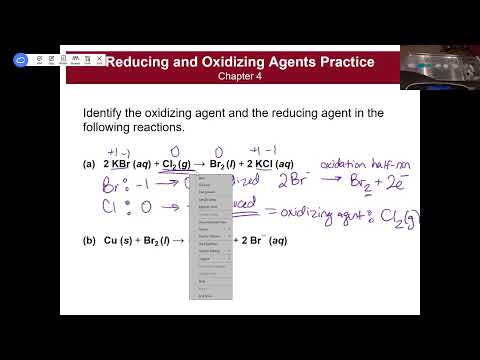
- An element whose oxidation number increases is oxidized, while the reactant whose element is reduced is the oxidizing agent; in the KBr and Cl₂ reaction, Cl₂ is the oxidizing agent and bromide is the reducing agent.
- Solution-stoichiometry problems follow a reliable path through moles: convert a given mass using molar mass or a solution volume using molarity, apply the balanced-equation mole ratio, then convert to the requested quantity.
- For 0.5 L of 2.0 M KCl mixed with 0.1 L of 0.175 M Pb(NO₃)₂, lead(II) nitrate limits formation to 0.0175 mol PbCl₂, approximately 4.87 g.
- A titration endpoint is an experimental indicator of the equivalence point, not a guarantee that the solution is exactly neutral; strong acid-strong base equivalence is near pH 7, while weak-acid or weak-base cases can differ.
- Electron transitions release light at specific energies, giving elements distinctive emission spectra; diffraction gratings separate those wavelengths into lines that can be used to identify elements.
Chapters
- Homework is due Monday nights; drop-in office hours follow class, with SI sessions scheduled for 7:30 that night and the next night.
- The exam average was 65%, about 20 students earned 100%, and the final can replace the lowest exam score.
- The exam answer key was expected by the end of the day, and an extra-credit survey was due Friday at 5:00 p.m.
- In the reaction of KBr with Cl₂, potassium remains +1 and is a spectator; bromide changes from -1 to 0 as Br₂ forms.
- Chlorine changes from 0 in Cl₂ to -1 in chloride, so chlorine is reduced and Br⁻ is oxidized.
- The reactant that is reduced is the oxidizing agent, so Cl₂ is the oxidizing agent; KBr, specifically its bromide, is the reducing agent.
- The oxidation half-reaction balances both atoms and charge: 2 Br⁻ → Br₂ + 2 e⁻.
- For a metal-displacement reaction involving zinc and copper(II) sulfate, identify the oxidation-state change before choosing an agent.
- Sulfate ions cancel from the net ionic equation as spectators, but the oxidizing agent must still be named as a reactant.
- The oxidizing agent is the reactant containing the element that is reduced; Altemose planned to revise the question to remove ambiguity from the spectator ion.
- For 5.6 g CaCO₃ reacting with 0.5 M HCl, convert grams of CaCO₃ to moles, use the balanced 1:2 CaCO₃:HCl ratio, then divide HCl moles by molarity.
- The required HCl amount is about 0.224 L, or 224 mL; liters and milliliters are both acceptable when the prompt does not specify units.
- The central step for mass-to-mass and volume-to-volume problems is using the balanced equation’s mole ratio, even when the ratio is 1:1.
- Predict the double-replacement products from ion charges: K⁺ and NO₃⁻ form KNO₃, while Pb²⁺ and Cl⁻ form PbCl₂.
- Balance the reaction as 2 KCl + Pb(NO₃)₂ → 2 KNO₃ + PbCl₂; PbCl₂ is the precipitate.
- The mixture contains 0.5 L of 2.0 M KCl and 0.1 L of 0.175 M Pb(NO₃)₂, so compare reactant moles against the balanced ratio.
- Pb(NO₃)₂ is limiting at 0.0175 mol; the 1:1 ratio produces 0.0175 mol PbCl₂, about 4.87 g using its molar mass.
- A titration uses a solution of known concentration, the titrant, to determine an unknown concentration in the analyte.
- In a common acid-base setup, base is delivered from a burette into acid in a flask, and phenolphthalein is colorless in acidic solution and pink in basic solution.
- Near the endpoint, add titrant dropwise and wait for a faint pink color to persist; overshooting reduces the accuracy of the calculated analyte concentration.
- The endpoint is the experimental estimate of the equivalence point, where acid and base have reacted in stoichiometric proportions; pH is near 7 for strong acid-strong base reactions but not necessarily for weak-acid or weak-base combinations.
- The next class begins with a titration and solution-stoichiometry review, including a clicker problem.
- Practice materials include problems using both known solid quantities and aqueous solutions with specified concentration and volume.
- Altemose recommends attempting the challenge problems because some may be difficult and may appear on a test.
- Chapter 7 examines atomic structure by considering where electrons are and how their wave properties help predict their behavior.
- Upcoming topics include electromagnetic radiation, visible and ultraviolet light, and the mathematical relationship between wavelength and frequency.
- The flame-color demonstration previews why different elements produce different colors when energized.
- Electrical energy excites atoms in emission tubes; electrons fall to lower energy levels and release light with specific energies.
- Hydrogen produces four distinct visible colors through a diffraction grating, while helium produces more colors and mercury shows several prominent spectral lines.
- Each element’s characteristic emission pattern can be used to identify it; spectral observations helped establish that the Sun is mostly hydrogen and helium.
- Altemose darkens the room for a flame test and asks students to observe the blue, green, and red colors clearly.
- The purple flame is harder to see from a distance but remains visible up close.
- The demonstration sets up the next class’s explanation of how energized electrons produce element-specific colors.
Transcript excerpt
0:45 Howdy. There, that's better. Okay. All right. So, just a reminder, homework due Monday nights. Uh as usual uh I have office hours, drop in hours after class, SI session tonight and tomorrow 7:30 and then we are going to finish up chapter 4 and start chapter 7 today. So hopefully you've downloaded those chapter 7 slides if you'd like to write on the slides. Um and the answer keys uh should be up for the exam by the end of today. Um, so I think we've got all of the makeups in that we're going to get. Um, I just have to post the answer key. And then there's that extra credit survey. Um, that one's
1:34 due by 5:00 p.m. on Friday. Any questions about anything coming up? So, I think I mentioned it in the group me. I don't know if I actually mentioned it in class. Um, the average was a 65 on the exam. 65%. Um, so you can use that to gauge uh where you're at. Uh, there were there were a good there were about 20 people that got a 100red. So it is possible. Um, it's not impossible. Hopefully that'll motivate you and not make you feel bad. Um, hopefully. But just know where you are in terms of the average and know that we can replace the lowest exam score with your final. So that's motivation to keep doing better
2:23 for the final. Right. Any questions or concerns? Okay. So here's a I don't know if I showed you this picture already, but here's a here's a cow picture. Um, so Yuki is one of our old ladies and in the middle, uh, he's not a baby anymore. Um, Vesper is now a pretty big boy. Uh, and Kora is our photo bomb.
This is the start of the transcript. Save this video free for the whole transcript, searchable and time-coded.
Related notes
Summary, takeaways, and chapters were generated by AI from the video's transcript and may contain errors. The video belongs to its creator, Alicia Altemose.