CHEM 119 Fall 2026 - Exam 2 Review #1 (Chapters 4 -8)
 Watch on YouTube →
Overview
Alicia Altemose reviews CHEM 119 Exam 2 material with worked problems on solution stoichiometry, precipitation, titrations, net ionic equations, redox, light, and quantum numbers. The examples show how to track units and reaction ratios, identify spectator ions and redox agents, apply the de Broglie equation, and determine which manganese electrons match specified quantum numbers.
Key takeaways
- When both reactant amounts are known, calculate moles and compare possible product yields using the balanced equation before identifying the limiting reactant.
- For leftover-ion concentration problems, account for reaction consumption, total mixed volume, and the number of ions contributed by each formula unit; CaCl₂ contributes two Cl⁻ ions.
- Aqueous substances do not all dissociate in net ionic equations: strong electrolytes separate, but weak acids such as H₃PO₄ remain molecular and water stays intact.
- Oxidation numbers reveal both redox roles and agents: the reactant containing the reduced element is the oxidizing agent, while the reactant containing the oxidized element is the reducing agent.
- Unit analysis provides a practical error check: the de Broglie equation λ = h/(mv) yields meters, and converting meters to nanometers multiplies the numerical value by 10⁹.
- For manganese with n = 3 and mₗ = +2, only a 3d orbital qualifies; its five 3d electrons occupy separate orbitals, so exactly one electron matches those quantum numbers.
Chapters
- Alicia Altemose offers to review the mock exam, homework, or extra practice slides based on students’ questions.
- The session is intended to cover Exam 2 material from Chapters 4 through 8, with some Chapter 8 content scheduled for the following class.
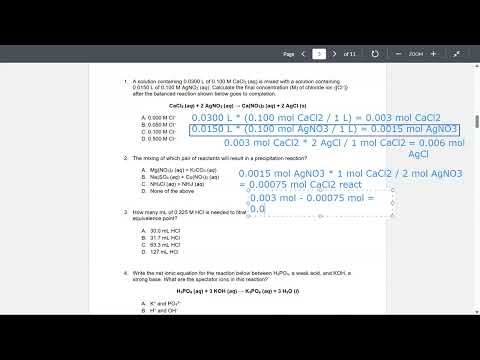
- For 0.00300 mol CaCl₂ and 0.00150 mol AgNO₃, compare the product each reactant can form using the balanced reaction’s 1:2 CaCl₂-to-AgNO₃ ratio.
- AgNO₃ is limiting, so 0.000750 mol CaCl₂ reacts and 0.00225 mol CaCl₂ remains.
- Divide leftover CaCl₂ by the combined solution volume, 0.04450 L, then multiply by 2 because each CaCl₂ unit supplies two chloride ions.
- The final chloride concentration is about 0.101 M; the key is to continue until the units describe the requested ion.
- Having both reactant volumes and molarities signals a limiting-reactant problem: convert each solution amount to moles before comparing reaction ratios.
- A problem with only one reactant’s amount may instead ask for the unknown concentration or volume using the balanced equation.
- The leftover-calcium-chloride calculation can convert to chloride moles before dividing by volume, or find CaCl₂ molarity first and then multiply by 2.
- For ionic reactants, exchange cations and anions, then pair each cation with the other reactant’s anion.
- Magnesium nitrate and potassium carbonate produce MgCO₃ and KNO₃; subscripts come from ion charges, while coefficients are used for balancing.
- Check the solubility table to identify a precipitate: magnesium carbonate is insoluble, while nitrates and potassium salts remain soluble.
- For product-identification questions, prioritize correct ion pairings and solubility; full balancing may not be required unless requested.
- Recognize Ba(OH)₂ plus HCl as an acid-base reaction that forms water and BaCl₂.
- The balanced equation is Ba(OH)₂ + 2 HCl → BaCl₂ + 2 H₂O, giving a 1:2 mole ratio of base to acid.
- Convert 30 mL Ba(OH)₂ to liters, calculate 0.01425 mol base, then use the mole ratio to obtain 0.0285 mol HCl.
- Use volume = moles ÷ molarity to find the HCl volume; writing units and converting milliliters to liters helps avoid unit errors.
- Alicia recommends reserving M₁V₁ = M₂V₂ primarily for dilution of the same substance.
- For a chemical reaction, use the balanced equation’s mole ratio, such as the 2:1 HCl-to-Ba(OH)₂ ratio in the titration example.
- The shortcut can work for a 1:1 reaction, but other ratios must be explicitly included.
- In the phosphoric acid and potassium hydroxide example, H₃PO₄ is a weak acid and stays together in the total ionic equation.
- Separate strong acids, strong bases, and soluble ionic compounds; aqueous state alone does not mean a substance dissociates.
- KOH and soluble K₃PO₄ separate into ions, while liquid water remains intact.
- K⁺ is the spectator ion; phosphate, H₃PO₄, and OH⁻ cannot be canceled because they do not appear in matching ionic forms on both sides.
- Use familiar periodic-table charges for Group 1 and Group 2 elements, and assign oxidation number 0 to an element in its uncombined form.
- Oxygen is usually −2 unless a peroxide is specified; hydrogen is usually +1 when bonded to nonmetals.
- The oxidation numbers in a neutral compound must sum to 0, while those in a polyatomic ion must sum to the ion’s charge.
- In Zn + H₂SO₄ → ZnSO₄ + H₂, elemental zinc starts at oxidation number 0 and becomes Zn²⁺.
- Hydrogen changes from +1 in H₂SO₄ to 0 in H₂ gas, while sulfur remains +6 and oxygen remains −2.
- Hydrogen is reduced because its oxidation number decreases; zinc is oxidized because its oxidation number increases.
- For the reaction involving Cl₂ and H₃AsO₄, assign oxidation numbers by summing each compound’s values to zero.
- Arsenic changes from +5 in H₃AsO₄ to +3 in the product, so arsenic is reduced; chlorine changes from 0 in Cl₂ to +1, so chlorine is oxidized.
- The reactant containing the reduced element is the oxidizing agent, making H₃AsO₄ the oxidizing agent and Cl₂ the reducing agent.
- Redox agents are reactants, not products; eliminate product choices when answering an agent question.
- For an electron’s wavelength when mass and velocity are known, use the de Broglie equation λ = h/(mv).
- Substitute Planck’s constant, electron mass 9.11 × 10⁻³¹ kg, and the given velocity in meters per second.
- Cancel units to confirm that the result is in meters, and enter scientific notation carefully in the calculator.
- The worked example gives a wavelength of about 6.49 × 10⁻¹¹ m.
- Use c = λν and rearrange to λ = c/ν for an X-ray with frequency 1.24 × 10¹⁷ Hz.
- With c = 3.00 × 10⁸ m/s, the calculated wavelength is 2.42 × 10⁻⁹ m.
- Convert meters to nanometers by multiplying by 10⁹, yielding 2.42 nm.
- A smaller unit produces a larger numerical value, so meters-to-nanometers conversion should increase the number.
- For n = 3, allowed l values are 0, 1, and 2, corresponding to the 3s, 3p, and 3d subshells.
- For each l value, mₗ ranges from −l to +l in whole-number steps; mₗ = +2 is available only in the 3d subshell.
- Manganese has atomic number 25 and five electrons in 3d; Hund’s rule places one electron in each of the five d orbitals before pairing.
- Only one manganese electron has both n = 3 and mₗ = +2, so the answer is one.
- The periodic table’s s block has one orbital per subshell and holds up to 2 electrons, matching its 2 columns.
- The p block has 3 orbitals and holds up to 6 electrons, matching its 6 columns.
- The d block has 5 orbitals and holds up to 10 electrons, matching the 10 transition-metal columns.
- For manganese, the five 3d electrons occupy the five orbitals singly before any pairing occurs.
- Orbital-occupancy questions become trickier when a subshell is partly filled beyond the one-electron-per-orbital stage; Alicia says these cases will receive practice.
- The next class will finish Chapter 7 and begin Chapter 8, while topics not reached, such as periodic trends or magnetism, may move to Exam 3.
- The mock exam contains 18 questions and is expected to have a similar distribution across Chapters 4, 7, and some Chapter 8 material.
- Alicia plans to post the recording and hold Tuesday review or drop-in hours from 10:30 a.m. to noon.
- Alicia plans another recorded Zoom review on Tuesday for students unable to attend in person.
- Students can bring mock-exam questions to office hours or drop-in hours before the test.
- The Tuesday review and drop-in session is scheduled for 10:30 a.m. to 12:00 p.m.
Transcript excerpt
0:21 Okay. So, Hannah, you're the only one online um for now. Can you hear me? I'll take your silence as a yes. >> [laughter] >> All right. So, there's a few people in person and one person online. Um what would we like to look at first? Did we get a chance to look at the mock exam at all yet? I know I posted it at like 11:30 at night, so you might not know it exists yet. >> I didn't know about that night. >> Uh-huh. [clears throat] >> [laughter] >> Yeah, I figured. Yeah, okay. I posted yeah. I don't know why like Microsoft Word was fighting
1:10 with me. I had to like reformat every question every time and it was took a long time to to put it up. Mhm. Oh, let's see. Yeah, most people probably didn't know about it until I posted that announcement if anybody looks at my announcements. >> No. >> So, yeah, we can look at the mock exam. We can look at um homework questions. We can look I have extra practice slides we can look at too. Whatever we want to do. Any particular topics you want to look at? >> Any questions?
2:01 >> Um, only let's see, let's count them. Um, so not on this page. One, two. Three, no, that's technically chapter seven, but three, four. I'd say four or five. Um but it should all be the content that we will get to tomorrow. >> So it's not going to be like all chapter eight. >> Probably not all of chapter eight, yeah. Um people started the homework already, so it's too late to break up the homework into different chunks. Um, but uh, yeah, so even if the homework is so I'm going to
2:48 announce it tomorrow home probably that
This is the start of the transcript. Save this video free for the whole transcript, searchable and time-coded.
Related notes
Summary, takeaways, and chapters were generated by AI from the video's transcript and may contain errors. The video belongs to its creator, Alicia Altemose.