CHEM 119 Fall 2026 - Chapters 4 and 7 (10092026)
 Watch on YouTube →
Overview
Alicia Altemose reviews solution stoichiometry, showing how balanced-equation mole ratios connect solution volumes, concentrations, and masses, then introduces Chapter 7’s treatment of electromagnetic waves and light energy. Worked examples include neutralizing 10.0 mL of 0.209 M perchloric acid with barium hydroxide, converting a UV frequency of 839 THz to wavelength, and explaining photon energy through the photoelectric effect and Planck’s constant.
Key takeaways
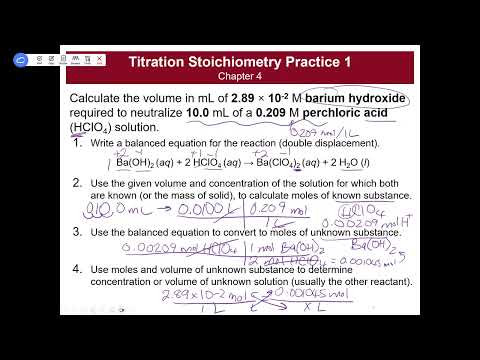
- Solution stoichiometry requires a balanced chemical equation: in the HClO₄ and Ba(OH)₂ example, the 2:1 acid-to-base ratio turns 0.00209 mol HClO₄ into 0.001045 mol Ba(OH)₂.
- M₁V₁ = M₂V₂ describes dilution, not general reaction stoichiometry; use balanced-equation mole ratios when converting between different reacting substances.
- At acid-base equivalence, the moles of H⁺ and OH⁻ are equal, even when the total moles of acid and base differ because of their formulas and reaction ratios.
- The electromagnetic spectrum runs from radio waves to gamma rays as frequency increases and wavelength decreases; visible light spans roughly 400 to 800 nm from violet to red.
- The equation c = λν links light’s wavelength and frequency, with c ≈ 3.00 × 10⁸ m/s and frequency in hertz; wavelength must be in meters for direct calculation.
- Photon energy follows E = hν = hc/λ, explaining why higher-frequency, shorter-wavelength light carries more energy and can eject electrons if it exceeds a metal’s work function.
Chapters
- A course survey was at about 31% completion, with 80% completion tied to additional extra credit.
- Exam 2 was less than two weeks away; the class planned to finish Chapter 4 and cover Chapters 7 and 8 the following week.
- Start with a balanced equation, then use volume and molarity or mass and molar mass to calculate moles of the known substance.
- Use the balanced equation’s mole ratio to find moles of the unknown substance, then calculate its concentration or volume.
- For the example, 10.0 mL of 0.209 M perchloric acid reacts with barium hydroxide, Ba(OH)₂, in a 2:1 acid-to-base mole ratio.
- For the perchloric acid example, 10.0 mL is 0.0100 L, giving 0.00209 mol HClO₄.
- The balanced equation requires half as many moles of Ba(OH)₂, or 0.001045 mol; at 0.0289 M, that is 0.0362 L, or 36.2 mL.
- Use M₁V₁ = M₂V₂ for dilution, where the amount of solute remains the same, not for reactions with different substances and potentially unequal mole ratios.
- In acid-base neutralization, moles of H⁺ and OH⁻ are equal at equivalence, while total acid and base moles need not be equal.
- The reaction of lead(II) acetate with sodium iodide has a 1:2 ratio of Pb(C₂H₃O₂)₂ to NaI.
- A 0.175 L sample of 0.100 M lead(II) acetate contains 0.0175 mol, requiring 0.0350 mol NaI.
- Convert the required NaI moles to solution volume by dividing by its molarity; unit cancellation confirms the result is in liters.
- Represent an unknown monoprotic acid as HA, a diprotic acid as H₂A, and a triprotic acid as H₃A when balancing reactions.
- A diprotic acid’s A ion has a 2− charge, so it forms Na₂A with sodium; a triprotic acid forms Na₃A.
- Potassium hydrogen phthalate (KHP) is monoprotic and reacts 1:1 with NaOH, making its mass-to-moles conversion useful for calculating NaOH concentration.
- With Ba(OH)₂, a monoprotic HA acid requires a 2:1 acid-to-base ratio because each barium hydroxide provides two hydroxide ions.
- Heating or electrically exciting atoms moves electrons to higher energy levels; when they fall back, energy is emitted as light or other electromagnetic radiation.
- Different elements emit characteristic colors; copper commonly appears blue or green, while strontium and lithium commonly produce red tones.
- Electromagnetic radiation has wave properties, including wavelength, measured between matching points such as crest to crest.
- From low to high frequency, the spectrum is radio waves, microwaves, infrared, visible light, ultraviolet, X-rays, and gamma rays.
- Wavelength and frequency are inversely related: radio waves have long wavelengths and low frequencies, while gamma rays have short wavelengths and high frequencies.
- Visible light is approximately 400 to 800 nm: violet and blue are near the short-wavelength end, while red is near the long-wavelength end.
- The speed of light relates wavelength and frequency through c = λν, with c approximately 3.00 × 10⁸ m/s.
- Wavelength λ must be in meters when using this form of the equation; convert nanometers to meters before calculating.
- Frequency ν is measured in hertz, equivalent to s⁻¹; rearrange to ν = c/λ or λ = c/ν.
- Convert 839 THz to 839 × 10¹² Hz before substituting into λ = c/ν.
- Using 3.00 × 10⁸ m/s gives a wavelength of approximately 3.58 × 10⁻⁷ m, or 358 nm.
- Track units and powers of ten carefully; the final wavelength is in meters until converted to nanometers.
- In the photoelectric effect, light ejects electrons from a metal when its energy meets or exceeds that metal’s binding energy, also called its work function.
- The effect is explained by photons, particles of light that carry discrete amounts of energy and can generate an electrical current by ejecting electrons.
- Photon energy follows E = hν, where Planck’s constant h is approximately 6.63 × 10⁻³⁴ J·s.
- Combining E = hν with ν = c/λ gives E = hc/λ, showing that photon energy increases with frequency and decreases with wavelength.
Transcript excerpt
0:00 key with the questions is on Canvas. And I didn't check this morning yet, but as of yesterday, we were at about 31% completion of that survey. So, if we can get to 80%, it'll be a little more extra credit for everyone. So, uh if you didn't do it yet, it's the same link as last time. It's due tonight at 5:00 pm. So, make sure you get that done. And then, heads up, exam two is actually coming up pretty soon. Exam two is less than two weeks away. So, we're pretty much done with chapter 4 now. We'll do chapter 7 and chapter eight next week. Chapter 8's really
0:49 short. Any questions on any of this? Okay, cool. All right, so I will have baby pictures, but for today I have puppy pictures. So, my little Zana likes to walk around with blankets on her, like a cape. Uh when she was when she was little, she had that gray one and she just like wrapped it around herself and held it closed with her mouth, which was kind of cute. All right. So, solutions do stochometry. We practiced one version yesterday or Wednesday and uh today we're going to do
1:39 a little more practice but then move on to chapter 7. So, um what you want to do for these usually it's an acidbased titration. So originally I had the slide saying balanced equation for the acid base reaction but it could be any double displacement reaction. So you want to write the balanced equation first just like any other stochometry problem. Then if it's if you're given a volume and a concentration for a solution, you're going to use those to find the moles of that substance. If you're given the mass, it's going to be like what we did in
This is the start of the transcript. Save this video free for the whole transcript, searchable and time-coded.
Related notes
Summary, takeaways, and chapters were generated by AI from the video's transcript and may contain errors. The video belongs to its creator, Alicia Altemose.