CHEM 119 Fall 2026 - Chapter 7 (10122026)
 Watch on YouTube →
Overview
Alicia Altemose connects photon frequency and wavelength to energy, then applies those relationships to the photoelectric effect, photon-count calculations, and electron transitions in atoms. Worked examples include a molybdenum electron ejected at 6.25 × 10^5 m/s, a 750 nm red photon with energy about 2.65 × 10^-19 J, and UV photon energy scaled to a mole; the lecture then defines absorption, emission, ground states, and excited states.
Key takeaways
- The combined photon equation E = hc/λ shows that shortening wavelength increases photon energy, while increasing frequency also increases energy through E = hν.
- Photoelectric electron motion depends on energy left after overcoming a metal’s work function: photon energy minus binding energy becomes ½mv².
- Light intensity and photon energy are different properties: brightness reflects amplitude, whereas color determines frequency and the energy of each photon.
- For many-photon problems, calculate the energy of one photon first, then multiply by Avogadro’s number for a mole or divide a total energy by per-photon energy to find a photon count.
- Atomic absorption raises electrons to higher discrete energy levels, and emission occurs when they descend; element-specific transitions create characteristic spectra.
- A higher-energy light transition corresponds to a shorter wavelength, and atomic energy levels are spaced more closely together at higher principal quantum numbers.
Chapters
- Exam 1 answer keys are posted, and the Canvas exam reflection survey offers about 3 extra-credit points when completed by the following Monday night.
- Exam 2 is scheduled for the next Wednesday, with a mock exam and practice quiz expected later in the week.
- Students can use SI sessions Tuesday through Thursday at 7:30 and the learning lab Monday through Thursday from 3 to 6 p.m.
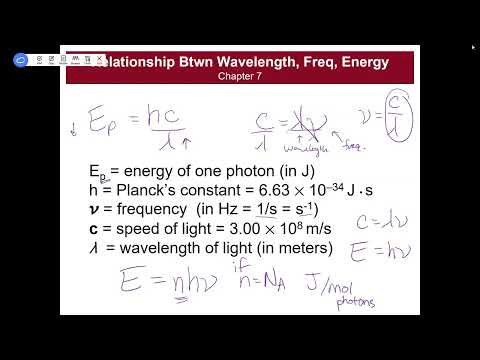
- Photon energy follows E = hν, while light frequency and wavelength follow c = λν; combining them gives E = hc/λ.
- Energy is directly proportional to frequency and inversely proportional to wavelength, so shorter wavelengths carry more energy.
- Use wavelength in meters in these equations; the lecture gives Planck’s constant as approximately 6.63 × 10^-34 J·s and the speed of light as 3 × 10^8 m/s.
- A metal’s binding energy, also called its work function, is the minimum energy needed to eject an electron; the photon must meet or exceed this threshold.
- For molybdenum with a threshold frequency of 1.09 × 10^15 Hz, the work function is about 7.23 × 10^-19 J.
- A 9.01 × 10^-19 J photon leaves about 1.78 × 10^-19 J as electron kinetic energy, producing an electron speed of approximately 6.25 × 10^5 m/s.
- The energy balance is photon energy = work function + ½mv²; an electron speed above the speed of light signals a calculation or unit error.
- Students submit name ideas for a male calf born on exam day, with a later poll planned to choose among five finalists.
- The unit check uses 1 J = 1 kg·m²/s²; dividing joules by electron mass in kilograms and taking a square root yields meters per second.
- Mass must be entered in kilograms, not grams, for the kinetic-energy calculation to produce consistent units.
- Green traffic-signal light has a higher frequency than red brake-light illumination because green lies at a shorter wavelength in the visible spectrum.
- Brightness describes light intensity and amplitude, not its frequency or the energy of an individual photon.
- A faint green light can therefore have higher-frequency photons than a bright red light.
- For red light at 750 nm, converting the wavelength to 7.50 × 10^-7 m and using E = hc/λ gives about 2.65 × 10^-19 J per photon.
- Visible-light wavelengths are roughly 300 to 800 nm, with frequencies around 10^14 to 10^15 Hz and photon energies on the order of 10^-19 J.
- A 25 nm UV photon has energy about 7.96 × 10^-18 J; multiplying by Avogadro’s number gives approximately 4.79 × 10^6 J per mole of photons.
- To find the photons needed for 25 J at 25 nm, divide 25 J by the energy per photon, giving about 3.14 × 10^18 photons.
- Emission occurs when excited electrons drop to lower energy levels and release light at element-specific wavelengths; absorption occurs when electrons take in matching light and move upward.
- Sodium’s relatively simple emission spectrum contributes to its characteristic orange-yellow flame, while strontium produces a bright red flame and potassium a faint purple one.
- Flame tests provide a basic identification method; atomic emission spectroscopy and atomic absorption spectroscopy are more sophisticated alternatives.
- Absorption moves an electron from a lower to a higher energy level, and emission returns it from a higher to a lower level.
- An initial energy level below the final level indicates absorption; an initial level above the final level indicates emission.
- Electrons can transition between levels such as n = 2 and n = 4, rather than only between the ground state and the next level.
- The ground state is the lowest allowed electron energy level, labeled n = 1; an excited state is any higher level with n greater than 1.
- Atomic energy levels are discrete rather than continuous, which explains why a given element produces a characteristic set of spectral colors.
- The lecture uses an orbit analogy to describe electrons farther from the nucleus at higher energy, while noting that the simplified picture is not a complete account of electron behavior.
- A transition across a larger energy difference releases or absorbs more energy than a smaller transition, such as n = 1 to n = 3 compared with n = 2 to n = 3.
- Higher-energy light has a shorter wavelength, while lower-energy light has a longer wavelength; the example contrasts orange and red light.
- Adjacent atomic energy levels become closer together at higher n, an important pattern for the chapter’s homework problems.
Transcript excerpt
0:16 Howdy. Good morning. How are we doing today? Good. Okay. Happy Monday. So, uh, a couple reminders for you. So, we're going to um finish up chapter 7, part one material pretty quickly today and then we'll start uh the rest of chapter 7 um and see how far we get. So, we should be starting chapter 8 on Wednesday. I will double check that those are posted by the end of the day today. Um and uh let's see. So, I drop in hours after class. SI sessions Tuesday, Wednesday, Thursday at 7:30. The learning lab is open from Monday through Thursday 3 to 6 p.m. to get extra practice worksheets or talk to the
1:05 tutors. Um, so I highly suggest checking it out if you haven't. Um, exam one answer keys are posted so you can see what you missed and what the correct answers were. Um, and there is another extra credit. So, I didn't check yet to see um how many people filled out the survey, but I'll let you know on Wednesday. But extra credit number three, that one does not depend on other people. That one is just you. So, extra credit number three, if you fill out that exam one reflection survey on Canvas, uh you will get I forget what I said, three points, I think. Um, so that is to reflect on your progress on exam one, reflect on your study strategies and revise those study strategies for next time and see what kind of resources
1:56 are out there that you may or may not have used yet. So check out that reflection survey. It is on Canvas under the um participation class participation um I think uh module. You can also see it in your like to-do list. Uh if you just
This is the start of the transcript. Save this video free for the whole transcript, searchable and time-coded.
Related notes
Summary, takeaways, and chapters were generated by AI from the video's transcript and may contain errors. The video belongs to its creator, Alicia Altemose.