CHEM 119 Fall 2026 - Chapter 4 (10052026)
 Watch on YouTube →
Overview
Alicia Altemose reviews net ionic equations and redox chemistry, then introduces solution stoichiometry through worked examples and demonstrations. Key techniques include keeping weak acids intact in ionic equations, assigning oxidation numbers by rule and charge balance, tracking electron transfer, and converting 5.6 g of calcium carbonate into the required volume of 0.5 M HCl.
Key takeaways
- Weak acids such as H3PO4 remain molecular in total and net ionic equations, while strong electrolytes such as aqueous KOH dissociate into ions.
- For a strong acid and strong base such as HCl and NaOH, the spectator ions cancel and the net ionic reaction is H+ + OH- → H2O.
- Oxidation numbers must sum to the overall charge: this makes carbon +4 in K2CO3 and nitrogen -3 in NH4+.
- Oxidation is electron loss and an increase in oxidation number; reduction is electron gain and a decrease, as shown by Zn becoming Zn2+ while Cu2+ becomes Cu.
- The reducing agent is oxidized and the oxidizing agent is reduced; identify each by tracking oxidation-number changes, not simply by checking whether its initial charge is nonzero.
- Solution stoichiometry combines mass-to-mole conversion, a balanced-equation mole ratio, and molarity: 5.6 g CaCO3 requires about 0.112 mol or 0.224 L of 0.5 M HCl.
Chapters
- Alicia Altemose introduces the Chemistry Learning Lab, which offers free peer tutoring for three hours a day, four days a week.
- Students can drop in briefly or stay for a full session, use faculty-made problem sets based on past exams, and study with classmates.
- Elizabeth, a former CHEM 119 and 120 student, recommends the lab because its worksheets and concepts resemble exam questions.
- A homework assignment of about 10 questions is due that evening, with Alicia Altemose available for drop-in help after class.
- Eric holds SI sessions Tuesday through Thursday, and Alicia offers Zoom office hours Tuesday at 10:30.
- Exam answer keys are expected by Wednesday after makeups; students who missed the exam should schedule a makeup.
- The second extra-credit survey is worth three points out of 1,000 and is due Friday at 5:00 PM if the class reaches 80% completion.
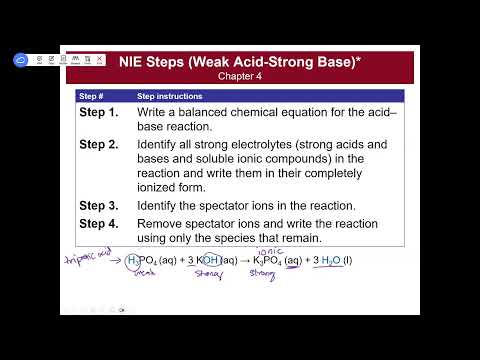
- Alicia Altemose uses phosphoric acid, H3PO4, and potassium hydroxide to review acid-base reaction balancing.
- The triprotic acid transfers three hydrogen ions, matching three hydroxide ions to form three water molecules.
- Because H3PO4 is weak, it remains intact in the total ionic equation; aqueous KOH and K3PO4 dissociate into ions.
- Potassium ions are spectators, leaving the reacting acid, hydroxide, water, and phosphate species in the net ionic equation.
- Students practice the reaction of strong acid HCl with strong base NaOH, with aqueous NaCl as the product.
- HCl, NaOH, and NaCl dissociate in the total ionic equation, so Na+ and Cl- cancel as spectator ions.
- The net ionic equation is H+ (aq) + OH- (aq) → H2O (l), the standard result for a strong acid reacting with a strong base.
- Alicia Altemose adds about 13.5 mL of sulfuric acid, then uses barium hydroxide and phenolphthalein to demonstrate titration and conductivity.
- The reaction forms a visible white barium sulfate precipitate as well as water, combining precipitation and acid-base chemistry.
- The conductivity bulb remains bright near the estimated equivalence point, and the apparatus begins smoking, so Alicia disconnects it and continues using the pink indicator endpoint.
- The solutions appear not to have the same concentration as expected, so the titration does not reach the anticipated endpoint volume.
- Alicia Altemose emphasizes that students need to memorize oxidation-number rules rather than rely on a provided chart.
- A pure element has oxidation number zero; monatomic ions use their charge, and oxidation numbers sum to the overall charge of a compound or polyatomic ion.
- Oxygen is usually -2 but is -1 in peroxides; hydrogen is usually +1 with nonmetals and -1 when bonded to metals.
- Halogens are generally -1, with exceptions when bonded to other halogens; weak acids and molecular substances can be aqueous without dissociating.
- For neutral K2CO3, two K atoms contribute +2 and three O atoms contribute -6, requiring carbon to be +4.
- For NH4+, four H atoms contribute +4 and the ion's total charge is +1, so nitrogen must be -3.
- The charge-balance method works for both neutral compounds and polyatomic ions by setting the oxidation-number sum equal to the species' total charge.
- Alicia Altemose reviews OIL RIG: oxidation is loss of electrons and an increase in oxidation number, while reduction is gain of electrons and a decrease.
- In the reaction Zn (s) + Cu2+ (aq) → Zn2+ (aq) + Cu (s), zinc changes from 0 to +2 and is oxidized.
- Copper changes from +2 to 0 and is reduced; nitrate ions are spectators in the corresponding copper nitrate reaction.
- The zinc-copper reaction explains how copper metal deposits while zinc dissolves, and how the blue copper-ion solution can become colorless.
- The zinc oxidation half-reaction is Zn (s) → Zn2+ (aq) + 2e-, while the copper reduction half-reaction is Cu2+ (aq) + 2e- → Cu (s).
- Electrons cancel when the half-reactions are added; the zinc reactant is the reducing agent because it is oxidized, and Cu2+ is the oxidizing agent because it is reduced.
- Alicia Altemose cautions that an initial nonzero charge alone does not identify an agent; the change in oxidation number determines oxidation or reduction.
- A separate silver nitrate and copper demonstration shows silver metal forming while copper enters solution as Cu2+, turning the solution slightly blue.
- The example asks for the volume of 0.5 M HCl needed to react completely with 5.6 g of CaCO3 using the balanced reaction with a 2:1 HCl-to-CaCO3 mole ratio.
- Using a CaCO3 molar mass of about 100.09 g/mol, 5.6 g corresponds to approximately 0.0559 mol CaCO3.
- The mole ratio gives about 0.112 mol HCl; dividing by 0.5 mol/L gives 0.224 L, or 224 mL.
- The calculation follows the sequence grams to moles, balanced-equation mole ratio, then moles to solution volume.
- Alicia Altemose closes after calculating that about 0.224 L of 0.5 M HCl is needed for 5.6 g of CaCO3.
- The next class will continue with titrations and begin Chapter 7.
Transcript excerpt
0:09 Howdy. All right, I know we have a few minutes, so uh don't worry. Um we're not starting just yet, but I wanted to remind you all about the chemistry learning lab. So, the chemistry learning lab is free peer tutoring. Uh we have tutors that took the class last year or two years ago. And uh it's three hours a day, four days a week. So hopefully that fits your schedule somewhat. You can stop in for five minutes, you can stay for three hours. It's up to you. Um we have facultymade problem sets. So problems that have been used on exams before. Um and you can also, you know, study with classmates or meet new people. um and uh to hear it from one of your own or at
0:57 least one of our tutors. Uh this is Elizabeth. She was in my 120 class last semester. Morning guys. So I took Dr. Altima's class last year for 120 and I also took 119. And I went to the chemistry learning lab last year and I found it really helpful as the worksheets. A lot of the questions and some of the concepts are really close to what are on your exams. And so I highly recommend you guys come visit. You don't have to stay long. You could also meet new peers too. But I recommend as this is like a free resource. You guys should try and check it out. >> All right. Thank you, Elizabeth. [laughter] All right. Goodbye, Elizabeth. Thank you.
1:43 All right, resume. Resume your normal behavior for two more minutes. Howdy. All right. Good morning. Now, we're gonna actually start. So, how are we doing today? We We won football, right? Woo! Football. Um, so that's exciting. Um, happy happy Monday. Um, after football
This is the start of the transcript. Save this video free for the whole transcript, searchable and time-coded.
Related notes
Summary, takeaways, and chapters were generated by AI from the video's transcript and may contain errors. The video belongs to its creator, Alicia Altemose.