CHEM 119 Fall 2026 - Chapter 8 (10192026)
 Watch on YouTube →
Overview
Alicia Altemose explains how to write electron configurations by applying orbital energy ordering, the Pauli exclusion principle, and Hund's rule. She connects configurations to periodic-table blocks, noble-gas shorthand, and valence electrons, then works through iodine, atomic number 53, and its iodide ion; transition-metal exceptions such as copper and chromium are excluded from the exam scope.
Key takeaways
- For multi-electron atoms, orbital energies split because of electron shielding, and the filling order can be determined with the periodic table or the n plus l rule, as shown by 4s filling before 3d.
- A ground-state configuration fills available orbitals from lowest to highest energy, while an excited state promotes electrons upward without violating the two-electron-per-orbital limit or opposite-spin requirement.
- Hund's rule requires electrons to occupy equal-energy orbitals singly before pairing, which gives carbon 1s² 2s² 2p² with its two 2p electrons in separate orbitals.
- Electron superscripts sum to the atom's electron count; the configuration 1s² 2s² 2p⁶ 3s² 3p⁴ identifies neutral sulfur because it totals 16 electrons.
- For main-group elements, valence electrons are identified from the occupied subshells with the highest n value; bromine's 4s² 4p⁵ gives seven, consistent with Group 17.
- Iodine's configuration is [Kr] 5s² 4d¹⁰ 5p⁵, and adding one electron for I⁻ completes the 5p subshell to 5p⁶.
Chapters
- Chapter 7 Part 2 homework is due that night; Altemose recommends Chapter 8 questions 1 through 8 and 10 through 13 for exam practice.
- Exam 2 is scheduled for October 21 and covers Chapters 4, 7, and some of Chapter 8.
- Altemose announces a Zoom review for 10:30 the next morning and points students to Canvas for Eric's tutoring locations and the practice quiz.
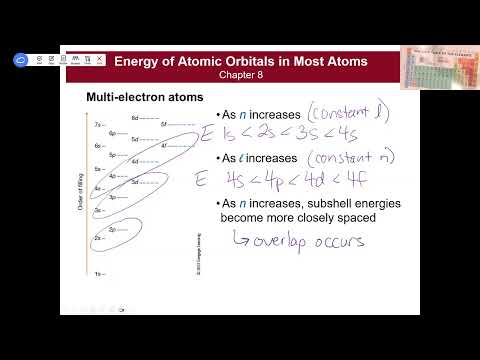
- In hydrogen and other one-electron atoms, orbitals with the same principal quantum number n have equal energy, such as 2s and 2p.
- In multi-electron atoms, electron shielding splits energy levels; for example, 3p is higher in energy than 3s.
- As n increases for the same orbital type, energy increases, and within a shell energy rises from s to p to d to f.
- The n plus l method explains why 4s fills before 3d: 4s has n + l = 4, while 3d has n + l = 5.
- The periodic table gives the filling sequence when read left to right and top to bottom, with 4s preceding the 3d block.
- The first d subshell is 3d and the first f subshell is 4f, based on the quantum-number rule that l must be less than n.
- An electron configuration records how electrons occupy orbitals; neutral carbon, for example, has six electrons to place.
- Each electron is described by four quantum numbers, and the Pauli exclusion principle requires every electron in an atom to have a unique four-number combination.
- A single orbital holds at most two electrons, which must have opposite spins, +1/2 and -1/2.
- A ground-state configuration is the lowest-energy arrangement, built by filling orbitals in increasing energy without skipping lower-energy orbitals.
- The periodic table supplies the filling order, including the less intuitive sequence where 4s fills before 3d.
- To identify an element from a configuration, add its electron superscripts or count its orbital arrows; 1s² 2s² 2p⁶ 3s² 3p⁴ totals 16 electrons, sulfur.
- Hund's rule says electrons occupy degenerate orbitals singly before pairing, provided there are empty orbitals of the same energy.
- Carbon's two 2p electrons occupy separate p orbitals in its ground state rather than pairing in one box.
- For sulfur's four 3p electrons, three occupy separate orbitals first and the fourth pairs; the same rule applies to d and f orbitals.
- Fluorine has nine electrons and the configuration 1s² 2s² 2p⁵; box notation makes the unpaired 2p electron visible.
- Noble-gas shorthand replaces a completed inner configuration with the preceding noble gas in brackets, such as [He] for lithium's 1s² core.
- Ground-state filling combines lowest-energy-first ordering, a maximum of two opposite-spin electrons per orbital, and Hund's rule.
- An excited-state configuration has the correct electron count but places one or more electrons in higher-energy orbitals before the ground-state filling pattern is complete.
- For carbon, placing two electrons in 3s instead of 2p is an excited arrangement; the ground state remains 1s² 2s² 2p².
- Excitation cannot put more than two electrons in one orbital or give two electrons in the same orbital identical spins.
- Calcium has atomic number 20, so its configuration is [Ar] 4s², using argon, atomic number 18, to represent the core.
- The commonly used noble-gas core electron counts are 2, 10, 18, 36, 54, and 86.
- Calcium's 4s² electrons are its two valence electrons and its highest-energy occupied electrons.
- Main-group elements in the same periodic-table group share a valence-electron pattern; Group 1 has ns¹ and Group 2 has ns².
- For bromine, the highest n value is 4, so 4s² 4p⁵ gives seven valence electrons, matching chlorine in Group 17.
- Altemose notes that d and f subshell electrons are not counted as valence electrons under the course convention, and that the highest-energy electron's subshell corresponds to the element's periodic-table block.
- Iodine has atomic number 53; after the [Kr] core, its 17 remaining electrons fill 5s², 4d¹⁰, and 5p⁵.
- The iodide ion, I⁻, has one additional electron, which completes the 5p subshell to 5p⁶.
- For ions, adjust the electron count and fill or remove electrons accordingly; copper and chromium configuration exceptions are not included on the exam.
Transcript excerpt
0:19 Howdy. Good morning. How are we doing today? Doing okay. Did you have a good weekend? Yeah. Okay. Good. I know it's Monday, so if you had a good weekend, that's good. All right. So, reminder for everybody, homework due tonight um is chapter 7 part two. That one was really short. And then chapter 8, uh I know that we did not get through any of it really. Um but uh we will do more of it today or most of it today. Um and anything that we don't get to, the homework will still be available all week. It's due tonight, but it'll be
1:06 available all week. Um, I would do questions one through eight and 10 through 13 for practice for the exam, but the other ones can wait if if needed. Um, I have my drop in hours after class where we can review or look at homework or whatever. um today and then Eric has a a session tomorrow which I assume will be some sort of review. Um so tomorrow at 7:30 uh I think it's in I don't know where it is tomorrow. It's on the Canvas calendar. I don't see him but it's probably here somewhere. Oh yeah. Where is it tomorrow, Eric? Okay, Tuesdays is the one in White Creek
1:58 Community Center. So, check out the Canvas calendar. Um, and that one will tell you where to go Tuesday. And then he does have sessions Wednesday and Thursday as well, although that's after the test. So, you know, you should go visit him anyway. Um, the chemistry learning lab is open again today from 3:00 to 6:00, tomorrow from 3:00 to 6:00, all week from 3:00 to 6:00. Um, though again, you probably won't go after Wednesday, but uh, stop by there and feel free to pick
This is the start of the transcript. Save this video free for the whole transcript, searchable and time-coded.
Related notes
Summary, takeaways, and chapters were generated by AI from the video's transcript and may contain errors. The video belongs to its creator, Alicia Altemose.