Calculus 1000- Implicit Differentiation II (Sec 007, October 27, 2026)
Overview
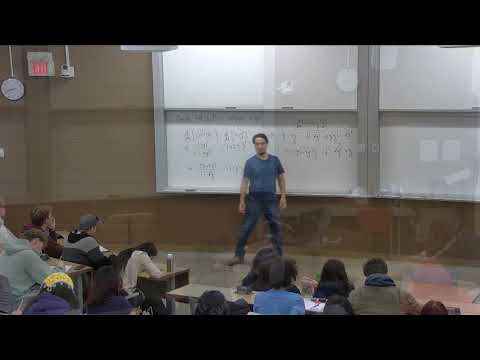
Asghar Ghorbanpour develops implicit differentiation through examples involving inverse cosine, tangent-line slopes, and second derivatives, emphasizing the chain rule and solving for derivatives in terms of x and y. He also shows how to find curve points with a specified tangent slope and how to handle tangent lines through a point that is not on the graph.
Key takeaways
- Implicit differentiation of arccos(xy) = x + y² requires both the inverse-cosine chain rule and the product-rule derivative y + xy′.
- To find points where a curve’s tangent is parallel to a given line, set the implicit derivative equal to that line’s slope and solve together with the curve equation.
- For x⁴ + y⁴ = 32, tangent slope 1 implies x = −y, producing exactly the points (−2, 2) and (2, −2).
- Higher implicit derivatives require differentiating the formula for y′ again, then substituting the first-derivative formula so the answer contains no y′.
- A proposed point must be checked against the graph before treating it as a tangent point; for f(x) = x³ − 3x + 1, (0,5) fails because f(0) = 1.
- For a tangent through an external point, equate the derivative slope at the unknown contact point with the secant slope connecting that point to the external point.
Chapters
- An implicit equation relates x and y without expressing y explicitly as a function of x.
- Differentiate both sides, apply chain and product rules, and retain y′ whenever differentiating a y-dependent expression.
- The resulting equation should be linear in y′, so collect its terms and solve.
- For arccos(xy) = x + y², the chain rule gives −(y + xy′)/√(1 − x²y²) = 1 + 2yy′.
- The derivative of xy is y + xy′, using the product rule and implicit differentiation.
- After clearing the radical denominator, collect the two terms containing y′ and isolate the derivative.
- To find curve points whose tangent is parallel to y = x + 1, match the tangent slope to the line’s slope, 1.
- Implicit differentiation of x⁴ + y⁴ = 32 gives 4x³ + 4y³y′ = 0.
- The task is to find all curve points where y′ equals 1, not merely to compute the derivative.
- From y′ = −x³/y³ = 1, the coordinates (a,b) must satisfy a = −b.
- Combining that relation with a⁴ + b⁴ = 32 gives 2b⁴ = 32, so b = ±2.
- The two points are (−2, 2) and (2, −2), and each has a tangent parallel to y = x + 1.
- A candidate tangent point must satisfy both the curve equation and the equation imposed by its tangent slope.
- The slope condition a = −b alone does not identify the points; substituting into a⁴ + b⁴ = 32 determines their coordinates.
- Writing down the goal and both equations helps organize nonlinear systems with two unknowns.
- For the circle relation, the first derivative is y′ = −x/y.
- Differentiate −x/y with the quotient rule to obtain y″ = (−y + xy′)/y².
- Substitute y′ = −x/y so the final second derivative is expressed using x and y, with no y′ remaining.
- Differentiating sin(x + y) = x gives cos(x + y)(1 + y′) = 1, so y′ = sec(x + y) − 1.
- Differentiate again using the derivative of secant and the inner derivative 1 + y′.
- Substituting y′ into the result simplifies the second derivative to sec²(x + y) tan(x + y).
- For f(x) = x³ − 3x + 1, the point (1, −1) lies on the graph because f(1) = −1.
- Since f′(x) = 3x² − 3, the tangent slope at x = 1 is 0, giving the horizontal tangent y = −1.
- The proposed point (0, 5) is not on the graph because f(0) = 1, so it cannot be used as a tangent point.
- Let (a,b) be a tangent point on the graph, so b = a³ − 3a + 1 and the tangent slope is f′(a) = 3a² − 3.
- A tangent through both (a,b) and (0,5) has slope (b − 5)/a; equate this with 3a² − 3.
- The resulting condition is 3a² − 3 = (a³ − 3a + 1 − 5)/a; solving it identifies the tangent contact point or points.
Transcript excerpt
0:01 Okay, hello everyone. Welcome back to calculus one class. Uh today we will continue as we had or um where we left yesterday. Basically, this is um a bit more examples. There are a few things that you have to see and I would like to write in and some examples for that um that in implicit differentiation, sometimes you should be able to do a little bit more with it and and the focus will be There's nothing new. There's nothing new that you haven't seen. The focus here is that do more examples to address a little bit more subtle points
0:50 uh in this section. Uh any questions or any comments before I start? Please keep in mind that if you have assignment-related question, you have to drop by my office, yes? It's not going to be answered through emails. Okay. So, uh yesterday we studied the um how to do implicit differentiation. The goal was that, okay, if some someone gives you an a function defined implicitly, in other words, instead of writing y in terms of an expression in x, you have an equation which involves both x and y.
1:38 And the hope is that you want to be able to find the derivative of such function without turning implicit equation to an explicit function. So, without going through that path, you want to do uh find the derivative. So, here, let's just start with an example uh example of find y prime if um I have cosine inverse of x squared equals to x plus y squared. And
2:25 just a quick recall from yesterday that when you do when you want to start implicit differentiation, you are trying to find derivative. Okay, I wrote y prime, but this is the same thing as that, yes? So
This is the start of the transcript. Save this video free for the whole transcript, searchable and time-coded.
In this course
Related notes
Summary, takeaways, and chapters were generated by AI from the video's transcript and may contain errors. The video belongs to its creator, Asghar Ghorbanpour.