Calculus 1000-Absolute extrema and optimization-(Section 007, November 12 Fall 2026)
Overview
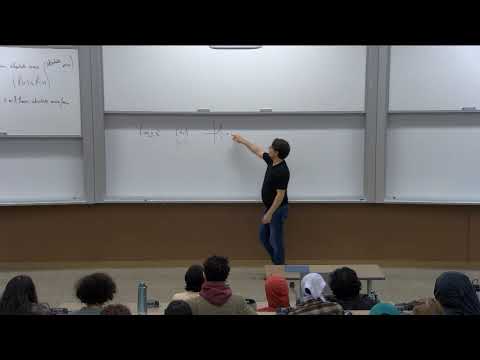
Asghar Ghorbanpour develops the method for finding absolute extrema: the Extreme Value Theorem guarantees a maximum and minimum for a continuous function on a closed interval, and candidates come from critical points and endpoints. He applies the method to polynomial and trigonometric examples, then introduces optimization as modeling a word problem, identifying an objective function and its physical domain, and comparing its critical-point and endpoint values.
Key takeaways
- A continuous function on a closed interval is guaranteed to attain both an absolute maximum and an absolute minimum by the Extreme Value Theorem.
- For a continuous function on [a,b], the complete candidate list consists of interior critical points and the two endpoints; evaluate the function at every candidate before choosing extrema.
- The interval matters: a critical point outside the specified interval is irrelevant, and changing the interval can change the absolute maximum or minimum.
- On [0,1), f(x)=x² has an absolute minimum at 0 but no absolute maximum because its values approach 1 without attaining it.
- Optimization problems require more than differentiation: define the objective, derive its physical domain from the setup, and compare its values at critical points and domain endpoints.
Chapters
- Absolute or global maximum means f(c) is greater than or equal to f(x) for every x in the specified domain D.
- Absolute or global minimum means f(c) is less than or equal to every function value on D.
- Unlike a local extremum, an absolute extremum compares against the function's entire specified domain.
- The Extreme Value Theorem guarantees both an absolute maximum and minimum when a function is continuous on a closed interval.
- For f(x)=x² on [0,1), the minimum is attained at 0, but the function approaches 1 without reaching it, so there is no absolute maximum.
- Including the endpoint 1 changes the example: the function reaches its maximum value there.
- For a continuous function on [a,b], absolute extrema occur among critical points inside the interval or at endpoints a and b.
- The candidate theorem identifies where to look but does not by itself say which candidate gives the maximum or minimum.
- The procedure relies on the interval being closed and the function being continuous there.
- Ghorbanpour checks that the polynomial is continuous on [0,4], so the Extreme Value Theorem guarantees absolute extrema.
- The derivative yields candidate values x=-2 and x=3; only x=3 lies inside [0,4].
- He compares the function values at x=3 and the endpoints x=0 and x=4 to select the absolute maximum and minimum.
- Find every critical point of f that lies in the specified interval [a,b].
- Evaluate f at those critical points and at both endpoints a and b.
- Choose the largest evaluated value for the absolute maximum and the smallest for the absolute minimum; results depend on the interval.
- For f(x)=x+2cos x, differentiating gives critical points where sin x=1/2, including π/6 and 5π/6 in the relevant interval.
- For the product involving (x-2)² and (2x+1)³, the derivative is factored to identify candidates x=2, x=-1/2, and x=1.
- Only critical points in the allowed interval are retained; function values at those points and the interval endpoints are compared.
- The trigonometric example compares candidate values such as π/6+√3, 5π/6-√3, and endpoint values.
- For the product-function example, Ghorbanpour checks values at critical points and endpoints, correcting an initial calculation during class.
- The decisive step is comparing the finite list of candidate values, not relying only on the derivative.
- Ghorbanpour defines optimization as finding an absolute maximum or minimum for a word problem after translating it into mathematics.
- The modeling process begins by identifying the quantities involved and assigning variables.
- A key modeling task is to specify which function of the variables is being maximized or minimized.
- Determine the physical domain of the objective function, including restrictions introduced by the real-world setup.
- After modeling, find the critical points and endpoints in the physical domain, then evaluate the objective at those points.
- Select the absolute maximum or minimum value that answers the optimization question; worked word-problem examples are scheduled for the next class.
Transcript excerpt
0:00 Okay, hello everyone. Welcome back to Calculus 1000. Uh today we are going to go through uh two things which will be kind of structured similar to what we had already. Um one and uh the basically the last story of max and min will be the absolute max, absolute min. We will see the theory behind it. We will try to work a little bit uh um on the examples. But but what we are
0:50 doing these for comes afterwards. This is now optimization. So we will bring now uh a bit of um modeling into our system or work and then we'll try to find absolute max or min in in the word problem, the real world examples of problems. Um that's the plan for today. Is there any questions or any comments? Okay. Okay, that's good. Okay. So we did study local max min. We did go through two different tests to identify
1:40 max min. Now we have what's called absolute um max min or how your book likes to say absolute extremals. Um well I sometimes will this other word, global. Global versus local and absolute versus relative. So those are the two word different wordings that you may see. What is the definition here? Well, now we want to get out of that that context that okay, we are only doing the local thing. We want we are interested in in the maximum value
2:30 if something is maximum around a point. We want to do okay, let f be defined on a given domain D. So somebody gives you an a function and somebody and gives you an a domain. So now this domain could be the whole domain of your function or it could be just an interval given to you. Then we say
This is the start of the transcript. Save this video free for the whole transcript, searchable and time-coded.
In this course
Related notes
Summary, takeaways, and chapters were generated by AI from the video's transcript and may contain errors. The video belongs to its creator, Asghar Ghorbanpour.