Calculus 1000- Implicit Differenitation I (Sec 007, October 26, 2026)
Overview
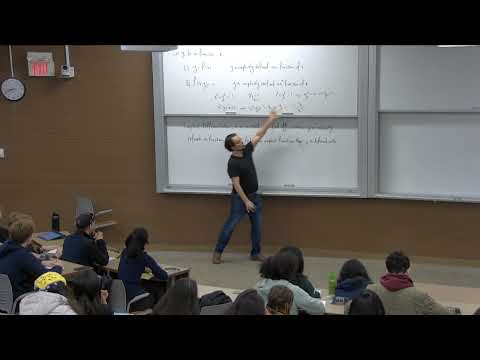
Asghar Ghorbanpour introduces implicit differentiation as a way to find dy/dx from an equation involving both x and y, without first solving explicitly for y. He develops a repeatable method using differentiation rules, chain rule, and algebraic isolation, then applies it to quotient and trigonometric-exponential examples and connects the resulting derivative to tangent-line slopes.
Key takeaways
- Implicit differentiation works by differentiating both sides with respect to x and treating y as a function of x, so derivatives of y introduce dy/dx.
- The chain rule gives d(yⁿ)/dx = n yⁿ⁻¹ dy/dx; for example, d(y²)/dx = 2y dy/dx.
- Correct implicit differentiation produces a linear equation in dy/dx, which can be solved by collecting derivative terms and dividing by their coefficient.
- For tan(y) = y eˣ, the derivative is dy/dx = y eˣ / (sec²(y) - eˣ), illustrating chain rule and product rule together.
- An implicitly defined curve's derivative gives its tangent slope at a point, but the coordinates must first satisfy the curve equation.
- The resulting dy/dx may depend on both x and y, because the original relation is not necessarily an explicit function of x alone.
Chapters
- Asghar Ghorbanpour introduces implicit differentiation as the final section planned for the Friday test.
- Assignment regrading requests must be discussed in person during office hours, not handled through email.
- An explicit function gives y directly as an expression in x, so a value of x can be substituted to calculate y.
- An implicit relation gives an equation involving x and y; finding y for a particular x requires solving that equation.
- Some implicit relations can be rearranged into explicit forms, but the lesson aims to differentiate without doing so.
- Ghorbanpour differentiates the entire equation with respect to x, converting an equation in x and y into one that also contains dy/dx.
- The product rule produces a dy/dx term when differentiating a product involving y.
- After differentiation, collect the dy/dx terms and isolate them by ordinary algebra.
- For xy + y² = x + y, differentiating xy uses the product rule and yields terms involving y and x dy/dx.
- Differentiating y² requires the chain rule, giving 2y dy/dx because y depends on x.
- The resulting equation is linear in dy/dx, so terms containing the derivative can be collected and solved.
- Step 1: differentiate both sides of the given equation with respect to x.
- Step 2: apply the relevant rules, writing dy/dx whenever differentiating y or an expression in y.
- Step 3: solve the resulting linear equation for dy/dx; Ghorbanpour emphasizes that the derivative should appear only to the first power.
- A quotient exercise requires the quotient rule rather than separately differentiating its numerator and denominator.
- Differentiating expressions such as x + y and x - y introduces dy/dx through the derivatives of y.
- After applying the quotient rule, clear the denominator and group all dy/dx terms before isolating the derivative.
- Ghorbanpour demonstrates factoring dy/dx out of multiple terms after expanding the quotient-rule expression.
- Terms without dy/dx are moved to the other side, leaving a coefficient multiplying the derivative.
- He addresses questions about the algebraic isolation process and distinguishes the numerator work from multiplying through by the denominator.
- Differentiating tan(y) gives sec²(y) dy/dx, since the inside function y depends on x.
- For a product involving y and eˣ, the product rule gives both a dy/dx term and a term containing y eˣ.
- The derivative can be isolated in the form dy/dx = y eˣ / (sec²(y) - eˣ).
- An equation F(x, y) = 0 describes a curve in the plane, even when it does not define one global function y of x.
- At a point on that curve, dy/dx gives the slope of the tangent line when the curve has a tangent there.
- Ghorbanpour notes that implicit equations commonly arise when solving differential equations and modeling real-world behavior.
- To find a tangent line, first verify that the stated coordinates satisfy the curve equation, then evaluate dy/dx at that point.
- Use the point-slope formula y - y₀ = m(x - x₀), where m is the evaluated implicit derivative.
- A student flags a mismatch between the displayed point and equation, prompting Ghorbanpour to stress checking the point before proceeding.
Transcript excerpt
0:01 Okay, hello everyone. Welcome back to Calculus 1000. I hope that you guys had a good weekend and relaxed a little bit because this week is going to be a an interesting week for you guys, yes? Yes. Um Yeah, I can wait, definitely. Okay. Uh so, the plan for today is to start the last part or the last section that is going to be included in the test this Friday. Uh this is implicit differentiation. Uh we will go into details of how to do
0:51 this, what does it mean, and then a whole bunch of examples will come out of it. Like the the content itself is not that complicated, but well, we need to practice and see it in different situations. That's what it will take a whole class today. The question is there any questions, any comments before I stop? One thing I noticed uh that I'm receiving some emails for uh assignment regrading. I'm not going to do any regrading through email request. You have to drop by, you have to come into my office, and you have to explain to me why you have regrading, and we have to go through it. Uh
1:38 if I don't reply back to those emails, this is the reason. Regrading requests for the assignments should be in person. Okay? Okay, let's just start. This is the topic we are covering today, implicit differentiation. >> Well, what has been um done so far is or was that we have a function and we differentiate or if I want to write it more precisely,
2:25 let y be a function. Well, here we're more interested in differentiable function, but that's okay if a function of x. Okay? When you hear this, so far, what we have in mind is this
This is the start of the transcript. Save this video free for the whole transcript, searchable and time-coded.
In this course
Related notes
Summary, takeaways, and chapters were generated by AI from the video's transcript and may contain errors. The video belongs to its creator, Asghar Ghorbanpour.