Calculus 1000-Related Rates-(Section 007, November 3 Fall 2026)
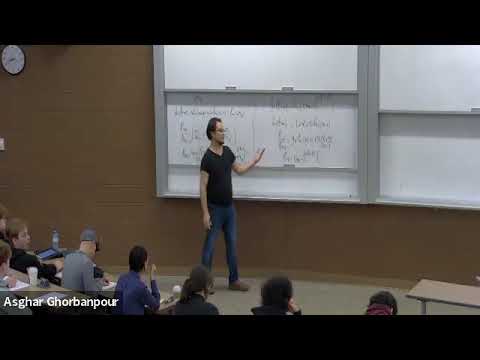 Watch on YouTube →
Overview
Asghar Ghorbanpour reviews logarithmic differentiation, then introduces related rates as a way to connect how quantities change with respect to time. He develops the method from an equation relating two time-dependent variables to a cube-growth word problem, emphasizing mathematical modeling, the chain rule, and checking units; for a cube whose side grows at 9 cm/min, the volume changes at 2700 cm³/min when the side is 10 cm.
Key takeaways
- Logarithmic differentiation is especially useful for variable-base, variable-exponent expressions; for f(x) = (3x − 1)^(2x² + 5), taking ln converts the exponent into a product that can be differentiated with the product rule.
- Related-rates problems treat both linked quantities as functions of time, so differentiating their equation with respect to t introduces derivatives such as dx/dt and dy/dt through the chain rule.
- Related rates and implicit differentiation may both use the chain rule, but they differ in the independent variable: related rates differentiates with respect to a third variable, usually time.
- Modeling a related-rates word problem means identifying changing quantities, translating the given and requested rates, and writing an equation connecting the quantities before differentiating.
- For a cube with side length growing at 9 cm/min, V = x³ implies dV/dt = 3x²(dx/dt), so at x = 10 cm the volume grows at 2700 cm³/min.
Chapters
- Ghorbanpour distinguishes functions that log differentiation merely simplifies from variable-base, variable-exponent functions that require the technique.
- The method takes the natural logarithm of both sides and uses logarithm properties to turn powers into products, products into sums, and quotients into differences.
- Students get time to work through two examples before reviewing the differentiation steps.
- For the first example, logarithm properties simplify a function containing powers, products, and a quotient before differentiating.
- The derivative rule used is d/dx[ln u] = u'/u; multiplying through by the original function isolates f'.
- For f(x) = (3x − 1)^(2x² + 5), logarithmic differentiation gives f'(x) = f(x)[4x ln(3x − 1) + 3(2x² + 5)/(3x − 1)].
- A student asks why the examples use ln rather than logarithm base 10.
- Ghorbanpour explains that any logarithm base works, but differentiating a general-base logarithm introduces a constant factor that cancels later.
- Using ln avoids that extra factor because d/dx[ln u] = u'/u.
- A rate of change is a derivative, and related rates concern two quantities linked by an equation while both depend on a third variable, usually time t.
- The goal is to relate derivatives such as dx/dt and dy/dt, rather than differentiate one quantity with respect to the other.
- Real-world influences such as changing mortgage rates or inflation illustrate why quantities can evolve as time passes.
- For an equation relating x and y, Ghorbanpour differentiates both sides with respect to t because both x and y are functions of time.
- The chain rule supplies time derivatives, for example d(x²)/dt = 2x(dx/dt), and likewise for expressions involving y.
- In the worked relation, collecting terms gives (1 + 2y)(dy/dt) = 2x(dx/dt); at x = 0, y = −1, and dx/dt = 2, it follows that dy/dt = 0.
- Related rates differs from ordinary implicit differentiation in the differentiation variable: implicit differentiation uses one of x or y, while related rates uses a third variable, typically t.
- The word problem describes a cube whose side length grows at 9 cm/min and asks for the volume's rate of change when the side is 10 cm.
- Ghorbanpour frames mathematical modeling as translating verbal information into variables, equations, and rates before doing calculus.
- He notes that the same modeling skill will also matter in later optimization problems.
- The changing side length and volume are the key quantities, assigned variables x and V; time remains the background variable.
- The given information becomes dx/dt = 9 cm/min, and the requested quantity is dV/dt when x = 10 cm.
- The geometric relationship V = x³ completes the model; a useful check is whether the words can be removed without losing any problem information.
- Differentiating V = x³ with respect to time and applying the chain rule gives dV/dt = 3x²(dx/dt).
- Substituting x = 10 cm and dx/dt = 9 cm/min gives dV/dt = 3(10)²(9) = 2700 cm³/min.
- Units provide a check: volume is measured in cubic centimeters, so its rate is cubic centimeters per minute.
- Ghorbanpour ends early because full related-rates problems take time to model and solve.
- The next class is scheduled to begin with two more related-rates examples, repeating the modeling process.
Transcript excerpt
0:02 Okay. Hello everyone. >> Welcome back to uh calculus uh 1000. Um today we will start with just uh one or two examples of u log differentiation example. This is just again there's nothing new here. we are just uh trying to do more examples for log differentiation. Um and and then uh I will move to what is called uh related rates. Uh a new concept or not new concept you almost know what it is but we have to put in the right contest u context to to understand it in a better
0:52 way. Before I start, is there any any questions, any comments? Okay. So then let me write these two examples on the board and I'll give you some time. It's very depreciate. So here is the first function. Uh and then the second function was um
2:10 okay. Uh I will I'll give you some time to go through this but just a quick reminder the uh log differentiation um is basically when you use a log or lawn function and its properties to simplify your uh der your function so that the derivative or taking derivative is easy. And in cases like this function which you can differentiate using regular rules, it would just simplify the steps. But for functions like this one, this is the only way for us to to find the derivative. And you have to be able to do law of differentiation. But it
2:58 uses the same idea that use properties of lawn simplify your function so that you can differentiate easily. Go ahead, please. I will give you 90 seconds. You're trying to focus on that example. Yes. Feel free to talk to the person sitting next to you. Obviously, as always, have a seat. >> There's another weird like
This is the start of the transcript. Save this video free for the whole transcript, searchable and time-coded.
Related notes
Summary, takeaways, and chapters were generated by AI from the video's transcript and may contain errors. The video belongs to its creator, Asghar Ghorbanpour.