Calculus 1000- Inverse Trig function derivatives (Sec 007, October 23, 2026)
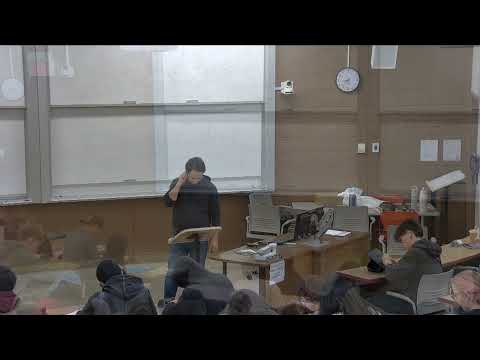 Watch on YouTube →
Overview
Asghar Ghorbanpour reviews the inverse-function derivative theorem, then derives inverse trigonometric derivatives and shows how to apply them with the chain, product, quotient, and power rules. Worked examples include derivatives involving e^x arcsin(x), (arcsec(x))^3, and arctan(x/(3x-1)); the class closes by distinguishing average from instantaneous rate of change and reviewing midterm coverage through implicit differentiation.
Key takeaways
- The inverse-function derivative formula is (f⁻¹)′(a)=1/f′(f⁻¹(a)); the derivative of f must be evaluated at the preimage, not at a.
- The principal-branch formulas include (arcsin u)′=u′/√(1−u²) and (arctan u)′=u′/(1+u²), with chain-rule factor u′.
- Inverse trigonometric derivatives can be combined with familiar rules: e^x arcsin(x) uses the product rule, while (arcsec(x))³ uses the power rule and arcsec derivative.
- For f(x)=arcsin(x/(3x−1)), the average rate of change on [0,1] is π/6, while the instantaneous rate at x=1 is −1/(2√3).
- The stated midterm scope extends through implicit differentiation, which Ghorbanpour expects to cover in the following Monday class.
Chapters
- Ghorbanpour frames inverse trigonometric derivatives as an application of the chain rule and an addition to the differentiation table.
- He says the midterm includes material through implicit differentiation, which the class expects to finish on Monday.
- For an invertible differentiable function, the derivative of the inverse at a is 1/f′(f⁻¹(a)), provided the denominator is nonzero.
- If f(6)=2 and f′(6)=1/3, then (f⁻¹)′(2)=3.
- If f(1)=0 and f′(1)=−2, then (f⁻¹)′(0)=−1/2.
- Apply the inverse-function formula to sine: the derivative of arcsin(x) is 1/cos(arcsin(x)).
- Set θ=arcsin(x), so sin(θ)=x; a right triangle with hypotenuse 1 gives cos(θ)=√(1−x²) on the principal arcsine range.
- The resulting rule is d/dx arcsin(x)=1/√(1−x²), and the chain-rule form is u′/√(1−u²).
- Using d/dx tan(x)=1+tan²(x) and tan(arctan(x))=x gives d/dx arctan(x)=1/(1+x²).
- Ghorbanpour adds inverse-trigonometric derivatives to the table, including negative signs for arccos, arccot, and arccsc.
- The standard chain-rule forms multiply each inverse-trigonometric derivative by u′; for example, d/dx arccos(u)=−u′/√(1−u²).
- For arcsec and arccsc, the standard denominator includes |u|√(u²−1), with a negative sign for arccsc.
- The class is asked to differentiate e^x arcsin(x), (arcsec(x))^3, and arctan((1−x)/(1+x)).
- Ghorbanpour adds a composite arccsc example with an exponential expression and corrects a missing inner derivative in the chain-rule table.
- He emphasizes completing every differentiation step rather than leaving an unevaluated prime such as u′.
- For e^x arcsin(x), the product rule gives e^x arcsin(x)+e^x/√(1−x²).
- For (arcsec(x))^3, the power rule and arcsec derivative produce 3(arcsec(x))²/(|x|√(x²−1)).
- For arctan((1−x)/(1+x)), the quotient rule gives an inner derivative of −2/(1+x)², and simplification yields −1/(1+x²) where defined.
- The composite example combines the arccsc derivative with the derivative of an input involving 2 raised to a polynomial in x.
- For 2^v, Ghorbanpour recalls d/dx(2^v)=v′ ln(2)·2^v.
- He applies the inner chain rule to the polynomial exponent and notes that the derivative must include its derivative rather than leave an unevaluated prime.
- The average rate of change on [0,1] is [f(1)−f(0)]/(1−0); here f(1)=arcsin(1/2)=π/6 and f(0)=0.
- An instantaneous rate of change at x=1 means evaluating f′(1), not computing another interval quotient.
- For f(x)=arcsin(x/(3x−1)), the quotient-rule derivative of the inner function is −1/(3x−1)².
- At x=1, the inner function is 1/2 and its derivative is −1/4, so f′(1)=−1/(2√3).
- Ghorbanpour reiterates that the midterm content is complete except for implicit differentiation, which remains for the next class.
- He plans to finish implicit differentiation on Monday and use later class time for review or additional examples.
Transcript excerpt
0:01 Okay, hello everyone. Welcome back to calculus 1000. Um Today we are working on one of our applications of basically the uh chain rule. Uh yesterday we saw kind of how chain rule works. We update actually there's the versions of chain rule, versions of differentiation, some of them are up here. But we were able actually to say more. We now have um the rule for differentiating a general base uh exponential function.
0:49 And my uh promise yesterday was that we would get to the point that we will find uh the derivative of inverse functions, yes? So inverse function formula we yesterday had, I'll start with that. Just do one example just to get to the right mood there. And then and then well uh the new rule. The new differentiation rule for today will be we'll be applying to find the derivative of uh inverse trig functions. And then well, I'll show you how to get those ones. But once we have them, you basically add new more items to your differentiation
1:36 table, yes? Um as you have been noticing, this is these sessions uh carry two different things. One, the concept, the theorem, the two the main tool, and then also as a side thing, we are developing more differentiation rules. So you have to be careful of uh both sides. You have to know how to differentiate different functions, different cases, how to apply rules, but also you have to know the concept, the main concept. For For For example, in this case, the the concept of the derivative of inverse function.
2:22 I have been receiving questions about the midterm. I thought that it's already posted that the midterm will go up until the end of implicit differentiation. And implicit differentiation, we are we need one more lecture to cover. In
This is the start of the transcript. Save this video free for the whole transcript, searchable and time-coded.
Related notes
Summary, takeaways, and chapters were generated by AI from the video's transcript and may contain errors. The video belongs to its creator, Asghar Ghorbanpour.