AU26 CHEM 2310 - Lecture 6 - September 10 - Quiz 2 - OChem Rxn Trends
 Watch on YouTube →
Overview
Dr. Jennifer Walters reviews organic reaction classification and curved-arrow logic, then teaches a qualitative method for comparing acid and base strength using charge, atom, resonance, induction, and hybridization. She applies those rules to examples and introduces major organic functional groups, including how ester groups distinguish morphine from diacetylmorphine, or heroin.
Key takeaways
- Classify organic reactions by structural change: substitution swaps a functional group, addition reduces pi bonds, elimination creates more pi bonds, and pure H+ transfer is acid-base chemistry.
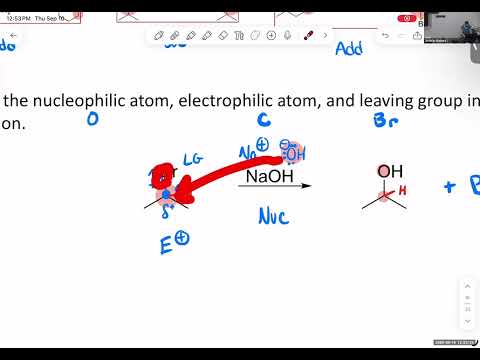
- Draw nucleophilic substitution arrows from the electron-rich nucleophile to the electrophilic carbon, then from the carbon-leaving-group bond to the leaving group to avoid exceeding carbon's octet.
- Compare acid strengths using charge, atom, resonance, induction, and hybridization in that order; stronger acids form more stable, weaker conjugate bases.
- Inductive electron withdrawal strengthens acids when electronegative atoms are closer to the acidic proton, more electronegative, or more numerous; chloroacetic acid, pKa about 2.9, is stronger than acetic acid, pKa about 4.7.
- For hybridized carbon acids, greater s character increases acidity: sp is stronger than sp2, which is stronger than sp3; base-strength trends reverse.
- Functional-group recognition depends on connectivity: a carbonyl plus C-O-C identifies an ester, while an ether has C-O-C without a carbonyl.
Chapters
- Attendance is recorded at the start; students must attend at least 85% of lecture to qualify for participation extra credit.
- Dr. Jennifer Walters says she will not routinely take attendance again at the end, but may check randomly if students leave early.
- Substitution replaces one functional group, addition reduces the number of pi bonds, and elimination increases the number of pi bonds.
- A reaction that only transfers H+ is Brønsted-Lowry acid-base chemistry.
- In the NaOH and alkyl bromide example, oxygen is the nucleophile and the partially positive carbon bonded to bromine is the electrophile.
- Draw an arrow from oxygen to carbon and a second arrow from the carbon-bromine bond to bromine to preserve carbon's octet.
- Brønsted-Lowry acids donate protons and bases accept protons; Lewis acids accept electron pairs and Lewis bases donate them.
- Lewis acids include electron-deficient boron, aluminum, and transition-metal compounds.
- BF3 is a Lewis acid because boron can accept electrons, but it is not a Brønsted-Lowry acid because it has no hydrogen to donate.
- In this course, acid-base refers to proton transfer, while nucleophile and electrophile refer to Lewis electron-pair behavior.
- When an acid donates H+, it forms its conjugate base; a base that accepts H+ becomes its conjugate acid.
- Equilibrium expressions use products over reactants and omit pure liquids such as water.
- A larger Ka means more proton donation and a stronger acid, while pKa equals negative log Ka and therefore decreases as acid strength increases.
- The course emphasizes qualitative comparisons rather than calculating numerical pH or pKa values.
- Compare acids in order: charge, atom, resonance, induction, then hybridization; stop once the first meaningful difference is found.
- A stronger acid has a more stable, weaker conjugate base, so acid strength can be judged by how well the conjugate base accommodates electron density.
- For charge, a positively charged acid is generally stronger than a neutral acid, which is stronger than a negatively charged acid.
- When comparing atoms, use size for elements in the same group and electronegativity for elements in the same period.
- H3O+ is a stronger acid than H2O because it produces a neutral conjugate base rather than a negatively charged one.
- H2S is more acidic than H2O because the larger sulfur atom better accommodates negative charge in HS−.
- H2O is more acidic than NH3 because oxygen is more electronegative than nitrogen and stabilizes the conjugate base more effectively.
- A carboxylic acid is more acidic than an alcohol because its carboxylate conjugate base delocalizes charge across two oxygen atoms.
- Inductive effects transmit electron-withdrawing influence through sigma bonds and stabilize a conjugate base when electronegative atoms pull electron density away from the acidic proton.
- Acetic acid has a pKa of about 4.7, while chloroacetic acid has a pKa of about 2.9, making chloroacetic acid stronger.
- Inductive effects become stronger when an electronegative atom is closer to the acidic site, when the atom is more electronegative, or when more such atoms are present.
- Induction is weaker than resonance and diminishes with distance along the carbon chain.
- The acid-strength trend is sp greater than sp2 greater than sp3, corresponding to 50%, about 33%, and 25% s character.
- Greater s character holds electron density closer to the nucleus and stabilizes a conjugate base.
- A terminal alkyne is more acidic than an alkene or alkane, although its pKa of roughly 25 still means a very strong base is needed to remove its proton.
- Strong acids have negative pKa values, while carboxylic acids are commonly around pKa 5.
- Phenols, water, alcohols, thiols, and alkynes fall broadly among weak acids, with approximate pKa values in the 10 to 25 range.
- Amines and alkenes are extremely weak acids and tend to behave as bases; alkanes have pKa values near 55 and are not ordinarily treated as acids or bases.
- Memorizing approximate pKa values is optional because the five-factor comparison method can establish relative strength.
- Base comparisons use the same factor order as acid comparisons, but the conclusions reverse because stronger bases are less stable and more reactive.
- A negative charge, smaller atom, lower electronegativity, less resonance, weaker induction, and less s character generally favor stronger bases.
- For hybridization, the base-strength trend is sp3 greater than sp2 greater than sp.
- Boron, aluminum, and transition metals are useful signals of Lewis-acidic sites that can accept an electron-pair arrow.
- Functional groups are recurring atom-connectivity patterns that give molecules distinctive chemical and physical properties.
- Morphine and diacetylmorphine differ at two oxygen-containing groups; the ester groups on diacetylmorphine can be broken down in the body to produce morphine.
- Diacetylmorphine is heroin and acts as a prodrug, while unregulated purity and dosage create serious overdose risks.
- The comparison illustrates why changing a small number of functional groups can alter a molecule's behavior and how the body processes it.
- Hydrocarbons contain only carbon and hydrogen; an alkane is the saturated baseline for organic compounds rather than a functional group in this classification.
- Alkenes contain carbon-carbon double bonds and alkynes contain carbon-carbon triple bonds; the naming sequence follows A, E, Y.
- R conventionally represents a carbon-and-hydrogen group, while a squiggly bond means any substituent may be attached.
- Benzene's alternating double and single bonds in a six-membered ring are introduced as the aromatic pattern.
- An alcohol has an sp3 oxygen bonded to carbon and hydrogen; classify it as primary, secondary, or tertiary by counting carbons on the carbon attached to oxygen.
- An ether has an sp3 oxygen bonded to carbon groups on both sides, written R-O-R.
- A benzene ring bonded to oxygen is classified separately as a phenol because its structure and behavior differ from an ordinary alcohol or ether.
- A carbon attached to four other carbons cannot also bond to oxygen, so a tertiary alcohol has no quaternary counterpart.
- A carbonyl is a carbon-oxygen double bond; hydrogen on one or both sides identifies an aldehyde, while carbon groups on both sides identify a ketone.
- A carboxylic acid has a carbonyl carbon bonded to OH; replacing that OH hydrogen with carbon gives an ester.
- An ester contains a carbonyl and a C-O-C linkage, distinguishing it from an ether, which has no carbonyl.
- The class identifies examples of carboxylic acids, esters, ketones, aldehydes, and alkenes by their connectivity.
- Amines are classified by the number of carbon groups attached to nitrogen; four carbon attachments give a positively charged quaternary ammonium ion.
- A nitrile, also called a cyano group, contains a carbon-nitrogen triple bond; an amide contains a carbonyl bonded to nitrogen.
- Thiols contain an S-H bond, while thioethers have carbon groups on both sides of sulfur, written R-S-R.
- A haloalkane contains a fluorine, chlorine, bromine, or iodine substituent; an acyl halide has a carbonyl carbon bonded to a halogen.
Transcript excerpt
2:40 Good afternoon everyone. How are you all doing today? Is that better? Can you hear me now? >> Now, can you hear me? Is that better? Yeah, I know. It's just a little back and forth. Back and forth. Yeah. Actually, let me make sure. I think I hear the microphone picking me up. Yeah, microphone's picking me up. All right. Can everyone in the back hear me? Yes. Okay. All right. How is everyone doing today? >> Good. Okay. >> Tired. >> Tired. I feel that. >> At least tomorrow's Friday.
3:32 >> All right. Does anyone have any questions before we get started? All right. So, uh, there were some questions about the attendance and I have settled on I do not want there to be that feels like way too much. I'm going to pull back. Uh, I don't want there to be a like detriment to you all who are physically here. So, we're not going to do an interruption to take attendance at the end of lecture. Uh, with that, what I will say is I will just trust you. I will trust you to make sure that we are following the rules. If there comes a day where I feel like I can't trust you, then I reserve the right to randomly take attendance at the end of lecture to check and then the
4:20 students that have dipped out will get reported to COM and we'll just keep doing that process. So, uh remember it's for extra credit. Like the idea is if you're here, you're participating, you get extra credit. So only those that are here and participating should be the ones getting the extra credit. So that's just how we're going to do it. So we'll do the attendance at the beginning like
This is the start of the transcript. Save this video free for the whole transcript, searchable and time-coded.
Related notes
Summary, takeaways, and chapters were generated by AI from the video's transcript and may contain errors. The video belongs to its creator, Dr. Jennifer Walters.