Epoxide Ring Opening & Alkynes Made Easy! | Acidity, Nomenclature & Synthesis
Overview
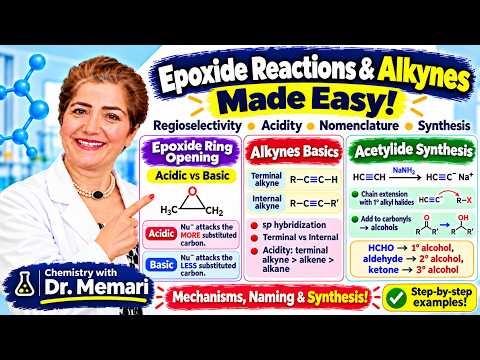
The lesson explains how epoxide ring-opening regioselectivity changes with conditions, then builds alkyne chemistry from sp hybridization and terminal-alkyne acidity to IUPAC naming and synthesis. It shows how sodium amide forms acetylide ions for SN2 carbon-chain extension and for additions to formaldehyde, aldehydes, and ketones that produce primary, secondary, and tertiary alcohols.
Key takeaways
- Acidic epoxide opening begins with oxygen protonation and favors nucleophilic attack at the more substituted carbon; basic opening instead favors SN2 attack at the less substituted carbon.
- Both acidic and basic epoxide openings involve backside attack, so the nucleophile and the epoxide oxygen-derived substituent end up anti to one another.
- A terminal alkyne's sp C–H bond is more acidic than sp² or sp³ C–H bonds, allowing NaNH₂ to generate an acetylide nucleophile for carbon–carbon bond formation.
- Acetylide alkylation with an alkyl halide proceeds by SN2, making the alkyl-halide fragment a practical way to choose how many carbons to add to an alkyne.
- Acetylide addition to formaldehyde, an aldehyde, or a ketone yields a primary, secondary, or tertiary alcohol, respectively, after protonation.
- A target molecule can be planned backward by separating its acetylene-derived triple-bond fragment, alkyl-halide substituents, and carbonyl-derived alcohol portion.
Chapters
- H⁺ protonates the epoxide oxygen before water attacks, activating the ring toward opening.
- For an unsymmetrical epoxide, the nucleophile attacks the more substituted carbon, where positive-charge character is better stabilized.
- Backside attack opens the ring with anti stereochemistry; deprotonation of the oxonium intermediate gives a glycol when water is the nucleophile.
- Under basic conditions, methoxide attacks the less substituted epoxide carbon by an SN2-like backside displacement.
- Breaking the carbon–oxygen bond leaves an alkoxide on the other carbon, which is protonated to form an alcohol.
- Both acidic and basic openings proceed with anti addition, but the attack site changes: more substituted in acid, less substituted in base.
- An alkyne contains a carbon–carbon triple bond; its carbons are sp-hybridized and have linear geometry.
- A terminal alkyne has a hydrogen directly attached to a triple-bond carbon, while an internal alkyne has carbon groups at both ends.
- Greater s-character stabilizes the conjugate base: an sp C–H bond is more acidic than sp² or sp³ C–H bonds, making terminal-alkyne hydrogen removable with a strong base.
- Alkynes are generally nonpolar, have dispersion forces as their main intermolecular attraction, and are poorly soluble in water.
- IUPAC naming starts by selecting the longest chain containing the triple bond and numbering to give the multiple bond the appropriate low locant.
- Name substituents with their positions, then use the alkyne ending, such as the demonstrated 2-methyl-3-hexyne example.
- When a parent chain contains both a double bond and a triple bond, numbering and suffix choices must account for both unsaturations.
- An alcohol takes naming priority over an alkyne, so the chain is named with the alcohol as the principal suffix and the triple bond receives a locant.
- The five-carbon example is described as a pentanol with the OH at carbon 2 and the alkyne at carbon 3.
- Calcium carbide reacts with water to produce acetylene and calcium hydroxide; the lesson presents carbide formation from calcium oxide and carbon as the preceding step.
- Sodium amide, NaNH₂, removes a terminal-alkyne hydrogen to form an acetylide ion, a strong carbon nucleophile.
- Acetylide ions react with alkyl halides by SN2 substitution, replacing the halide and extending the carbon chain; methyl bromide and propyl iodide are discussed as examples.
- To build an unsymmetrical alkyne from acetylene, add NaNH₂, react the acetylide with the alkyl halide for the first side chain, then deprotonate the remaining terminal alkyne.
- A second SN2 reaction with a selected alkyl halide adds the other side chain; the example uses ethyl bromide followed by propyl bromide.
- Retrosynthesis helps identify which carbon fragments must come from each alkyl halide before choosing the reaction sequence.
- An acetylide attacks the electrophilic carbonyl carbon; the carbonyl pi bond moves onto oxygen, and protonation converts the alkoxide into an alcohol.
- Addition to formaldehyde gives a primary alcohol, addition to an aldehyde gives a secondary alcohol, and addition to a ketone gives a tertiary alcohol.
- The alcohol class follows the number of carbon groups attached to the carbon bearing OH: one for primary, two for secondary, and three for tertiary.
- For a target built from acetylene, identify the triple-bond fragment first, then use NaNH₂ and an appropriately sized alkyl halide to add a carbon chain.
- To make a secondary alcohol, form the acetylide and add an aldehyde whose carbon substituent matches the target; protonate the resulting alkoxide.
- For a tertiary alcohol, add a ketone with the two carbon groups required by the target, since those groups remain attached to the carbonyl carbon during acetylide addition.
Transcript excerpt
0:01 Okay, one left over reaction from unit eight. Ring opening up epoxide. It depends if we are in acidic [laughter] or basic solution. Basically, if we have the electrophile coming in first or the nucleophile coming first. Which one is going to attack first on the first reaction? H2O or H plus? >> H plus. >> H plus because that's the chemical that is not supposed to. And this H plus is going to protonate the oxygen, right? It's going to protonate the oxygen and when the oxygen is protonated here, what happens to the plus charge? Oxygen is being protonated, what happens to that plus charge? The plus charge
0:48 is going to be shared, right? Is not being canceled. There is no negative charge, so it's going to come in here. The plus charge appears in the ring or inside the ring. And what happens next? What comes in next? >> H2O. >> H2O, right? H2O, would the H two O attack carbon one or carbon two? >> Two. Or one. >> One or two. >> Two. >> Two? >> One. >> Why would be two and not one? >> The plus on the water is stable. >> There is a plus charge in the ring. It's going to be leaning toward carbon one or carbon two?
1:35 >> Carbon two. >> Carbon two, so it's a stable and because it's a stable on carbon two, carbon two is more substituted. So if we try to be like correct here, we drop the or we make this plus charge closer to the carbon two, so H2O is going to come and attack carbon two. Will it attack from the same side as the triangle or the opposite side? >> Opposite. >> From the opposite because of the steric hindrance. So
This is the start of the transcript. Save this video free for the whole transcript, searchable and time-coded.
In this course
Related notes
Summary, takeaways, and chapters were generated by AI from the video's transcript and may contain errors. The video belongs to its creator, Chemistry with Dr. Memari.