Alkene Reaction Practice Problems | Predict the Products! Organic Chemistry 1
Overview
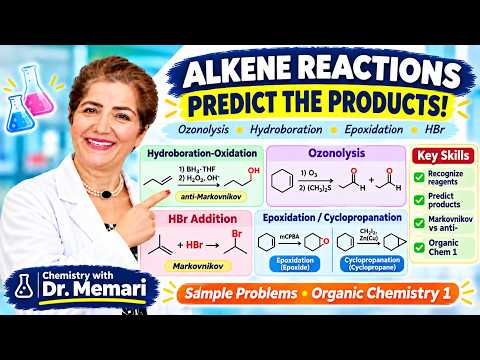
Alkene product prediction is organized around recognizing reagents and deciding what changes: addition across the double bond, cyclization, or cleavage. Worked examples distinguish anti-Markovnikov HBr with peroxides from Markovnikov HBr without peroxides, then cover acid-catalyzed methanol addition, Simmons-Smith cyclopropanation, mCPBA epoxidation, ozonolysis with dimethyl sulfide, and hydroboration-oxidation.
Key takeaways
- HBr regiochemistry depends on conditions: peroxide gives anti-Markovnikov radical addition, while HBr alone gives Markovnikov carbocation addition.
- Carbocation pathways, such as acid-catalyzed alcohol addition and HBr addition without peroxide, are neither syn-specific nor anti-specific and can allow rearrangements.
- Simmons-Smith reagents CH2I2 and Zn(Cu) add a CH2 unit across an alkene to form a cyclopropane through stereospecific syn addition.
- mCPBA converts an alkene into an epoxide by inserting oxygen across the former double bond.
- O3 followed by dimethyl sulfide cleaves an alkene into carbonyl compounds; this reductive workup allows aldehydes to remain aldehydes.
- Hydroboration-oxidation gives syn, anti-Markovnikov hydration, with OH on the less substituted alkene carbon and no carbocation rearrangement.
Chapters
- HBr with peroxide gives anti-Markovnikov addition through a free-radical pathway, placing Br on the less substituted alkene carbon in the example.
- The radical HBr addition is not stereospecific, and carbocation rearrangement does not apply because no carbocation forms.
- Acid-catalyzed addition of methanol is Markovnikov: H and OCH3 add across the double bond, with OCH3 on the more substituted carbon.
- Alcohol addition proceeds through a carbocation, explaining its Markovnikov regiochemistry and lack of syn or anti stereospecificity.
- CH2I2 and zinc-copper generate a carbenoid that transfers CH2 across an alkene to form a cyclopropane ring.
- Simmons-Smith cyclopropanation preserves the alkene substituent relationships through syn, stereospecific addition.
- mCPBA transfers an oxygen atom to the alkene, forming an epoxide with an oxygen bonded to both former alkene carbons.
- Recognizing CH2I2/Zn(Cu) or mCPBA is enough to identify the corresponding cyclopropanation or epoxidation product.
- HBr without peroxide follows Markovnikov addition through a carbocation; the example places Br on the more substituted alkene carbon, with no stereochemical restriction.
- O3 followed by dimethyl sulfide cleaves the carbon-carbon double bond, producing aldehyde and ketone carbonyls while retaining the aldehyde rather than oxidizing it to a carboxylic acid.
- Hydroboration-oxidation adds H and OH across the double bond in anti-Markovnikov fashion, placing OH on the less substituted carbon in the example.
- Hydroboration-oxidation is syn addition and avoids carbocation rearrangements because its pathway does not form a carbocation.
Transcript excerpt
0:02 Okay, let's do a couple of problems here. What would be the product of this reaction here? What type of reaction is this? Addition reaction. What are we adding? H and Br. So, what is the question? How is added, right? We know that one is going to be added to carbon carrying the double bond. The other one is going to be added to the other carbon carrying the double bond, right? So, our question is that this addition is Markovnikov addition or anti-Markovnikov addition? How do we know? It's basically the prior knowledge we just covered the reaction map for alkene, and we know that this
0:49 combination is going to give us anti-Markovnikov. With anti-Markovnikov product, how would the product look like? If I were to call this one carbon 1 2 3, tell me. What should they add? To this to finish up. Br is added to carbon number Yes, two. And H is added to carbon one. Is this syn addition or anti addition or neither? Neither. Carbocation the the free radical is forming, and free radical hybridization is sp2. What do we get? Anti-Markovnikov addition. Do we have rearrangement? Possibility for rearrangement? Possibility for rearrangement is only
1:37 discussed when we have carbocation. Is it carbocation rearrangement? Since this is a free radical, not applicable, right? Uh what would be the product of this reaction? The backbone of the molecule stays or destroyed? What happens? Stays, right? We are not cleaning up any bond here. So, what should they add? Am I adding OH? Am I adding water or alcohol? I'm adding alcohol, not water. It's the acid catalyzed addition of alcohol. Will the product be Markovnikov or anti-Markovnikov? It's going to be Markovnikov. What does that mean? When you're adding water,
2:23 you're adding H add H and add OH, right?
This is the start of the transcript. Save this video free for the whole transcript, searchable and time-coded.
In this course
Related notes
Summary, takeaways, and chapters were generated by AI from the video's transcript and may contain errors. The video belongs to its creator, Chemistry with Dr. Memari.