Some Alkene Addition Reactions | Markovnikov vs. Anti-Markovnikov | Organic Chemistry
 Watch on YouTube →
Overview
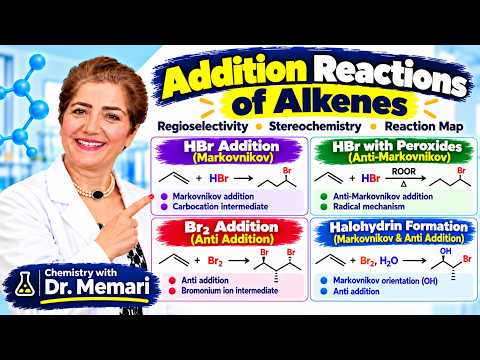
Alkene additions are explained through electron-pushing mechanisms, with product ratios determined by the stability of carbocation or radical intermediates. The lesson distinguishes Markovnikov regiochemistry from syn or anti stereochemistry, covering HBr addition, acid-catalyzed hydration, peroxide-initiated anti-Markovnikov HBr addition, and halogen and halohydrin formation through halonium ions.
Key takeaways
- For ordinary HBr addition to an unsymmetrical alkene, protonation that forms the more stable carbocation usually determines the major product: H goes to the less substituted carbon and Br to the more substituted carbon.
- Carbocation rearrangements can change the carbon skeleton of an HBr addition product; a hydride shift toward a neighboring tertiary center can turn a less stable carbocation into a tertiary one before bromide attacks.
- Acid-catalyzed hydration proceeds through a carbocation, so it usually produces a Markovnikov alcohol and may undergo rearrangements.
- Peroxides change HBr addition from a carbocation mechanism to a radical chain; Br radical addition leaves the more substituted carbon radical, producing an anti-Markovnikov bromoalkane.
- Br2 addition forms a bridged bromonium ion, and backside attack opens it to give anti addition; Br2 and water similarly produce anti bromohydrins.
- Markovnikov describes regiochemistry, while syn and anti describe stereochemistry; an addition can be both Markovnikov and anti, as in bromohydrin formation from an unsymmetrical alkene.
Chapters
- Alkene addition breaks the carbon-carbon pi bond and forms two new sigma bonds, the reverse bond-forming pattern of elimination.
- For HBr addition, the alkene pi bond attacks H+, then Br- attacks the carbocation.
- Regioisomer formation depends on which carbon receives H: the pathway producing a secondary carbocation is favored over one producing a primary carbocation.
- For an unsymmetrical alkene, Markovnikov HBr addition places H on the less substituted carbon, which generally has more hydrogens, and Br on the more substituted carbon.
- The more substituted carbocation intermediate is generally more stable, making its pathway the major product route.
- When a primary carbocation forms next to a tertiary carbon, a hydride shift can create a more stable tertiary carbocation before Br- attacks.
- Carbocation rearrangements can change the product skeleton, so check for hydride or alkyl shifts whenever a carbocation intermediate forms.
- Acid-catalyzed hydration adds H and OH across an alkene, with H+ protonating the pi bond before water attacks the carbocation.
- Water bonds through oxygen; deprotonation then produces a neutral alcohol and regenerates the acid catalyst.
- The more stable carbocation pathway usually makes the Markovnikov alcohol the major product, with OH on the more substituted carbon.
- The alternative regioisomer can form through a less stable carbocation and is generally minor; this mechanism can also allow rearrangements.
- Peroxide O-O bond homolysis initiates a radical chain, generating radicals that convert HBr into Br radicals.
- A Br radical adds to the alkene in the direction that leaves the more substituted, more stable carbon radical.
- The carbon radical abstracts H from HBr, yielding the anti-Markovnikov product: Br on the less substituted carbon and H on the more substituted carbon.
- Intermediate stability still predicts the major product, but the relevant intermediate is a radical rather than a carbocation.
- Use H2O with acid for Markovnikov hydration, and use HBr with peroxide when the target is anti-Markovnikov bromination.
- HBr without peroxide gives the usual carbocation pathway and Markovnikov orientation.
- Markovnikov versus anti-Markovnikov describes which alkene carbon receives each group; syn versus anti describes whether groups add from the same or opposite faces.
- Carbocations and radicals are planar intermediates, so attack can occur from either face and may produce racemic mixtures at a stereogenic center.
- Br2 reacts with an alkene to form a three-membered bromonium ion and Br- rather than a free carbocation.
- The bromonium bridge blocks one face of the molecule, so Br- attacks from the opposite face and opens the strained ring.
- The result is anti addition, with the two bromines on opposite faces of the former double bond.
- For symmetrical ethene, Markovnikov orientation does not apply because the two alkene carbons and the two added bromines are equivalent.
- Adding water alongside Br2 lets H2O compete with Br- to open the bromonium ion.
- Water attacks from the face opposite the bromonium bridge; deprotonation then gives a bromohydrin containing Br and OH.
- The bromohydrin forms by anti addition because the incoming water attacks opposite the bridged bromine.
- With a symmetrical alkene, such as ethene, there is no meaningful Markovnikov preference between equivalent carbons.
- In an unsymmetrical alkene, the bromonium ion has greater carbocation-like character at the more substituted carbon.
- Water attacks that more substituted carbon, while Br remains attached to the less substituted carbon; deprotonation completes the product.
- The halohydrin is therefore Markovnikov in regiochemistry and anti in stereochemistry, two independent descriptions.
- Markovnikov terminology is not useful when the two alkene carbons or the two added groups are equivalent, but syn or anti stereochemistry can still be specified.
Transcript excerpt
0:01 So, when we're dealing with reactions of alkene that's in this unit, reactions of alkene, our reactant is alkene, we are going to add Yeah, this type of reactions, anything I have on the board so far is type of addition reaction. So, what's happening in addition reaction is the opposite to elimination reaction. In elimination, halide was leaving as a acting as a leaving group, a hydrogen from adjacent carbon was removed by a base, and a pi bond was formed. What would be the opposite process? >> Pi bond would be broken. >> Pi bond needs to be broken, pi bond is broken, and you add electrophile, you add a nucleophile. So, each of these carbon would take uh would form a new um sigma bond. Mechanism for this reaction, if I bring
0:48 H and Br, this is going to basically split as a H+ and a Br-. Which one should react with alkene first? If you're dealing with alkene, we are dealing with high density of electron in our CC double bond. So, we have high density of electron here. Which one is desired to bring in or react first, the H+ or the Br-? >> H+. >> H+ because we have high density of electrons here. So, if I'm going to draw an arrow that is basically showing of attack, what should I start, where should it land, the arrow? I'm going to make the H+ to come in. I need I want to draw an arrow. Where should I start? >> H+. >> From nucleophile to electrophile or you could just say from electron rich to
1:36 electron poor. So, where should I start with? What is coming in, the H+? That was the first question. Should I bring the H+ first or the Br-? Okay, if I have electron rich area here,
This is the start of the transcript. Save this video free for the whole transcript, searchable and time-coded.
Related notes
Summary, takeaways, and chapters were generated by AI from the video's transcript and may contain errors. The video belongs to its creator, Chemistry with Dr. Memari.