Alkyne Reactions Made Easy! | Hydrogenation, Halogenation & Hydration
Overview
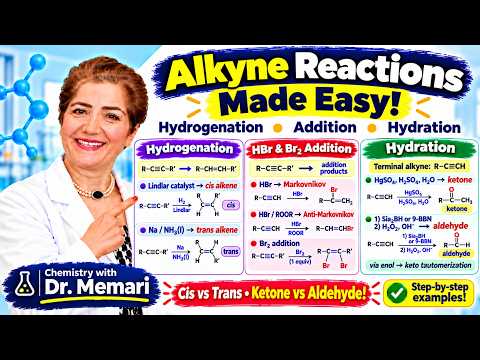
Alkyne addition reactions are organized by reagent choice, reaction conditions, and the number of equivalents: hydrogenation can stop at a cis or trans alkene, while HBr and Br₂ produce distinct addition products. Hydration with HgSO₄ or hydroboration-oxidation first forms an enol, which tautomerizes to a ketone or, for terminal alkynes under anti-Markovnikov hydration, an aldehyde.
Key takeaways
- Use H₂ with Lindlar catalyst to stop alkyne reduction at a cis (Z) alkene; the catalyst's reduced activity prevents further hydrogenation.
- Use sodium or potassium in liquid NH₃ for dissolving-metal reduction to a trans (E) alkene through successive electron and proton transfers.
- For terminal alkynes, HBr without peroxides gives Markovnikov addition, while HBr with ROOR gives anti-Markovnikov radical addition; two equivalents of HBr form a geminal dibromide.
- Oxidative outcomes depend on conditions: cold KMnO₄ forms an α-diketone, whereas hot acidic KMnO₄ or O₃ followed by H₂O cleaves the alkyne into carboxylic acids.
- Alkyne hydration initially forms an enol, not the final carbonyl product; HgSO₄/H₂SO₄/H₂O leads to a methyl ketone from a terminal alkyne, while hydroboration-oxidation leads to an aldehyde.
Chapters
- Complete hydrogenation adds two equivalents of H₂ to an alkyne, breaking both π bonds and producing an alkane.
- To stop after adding one equivalent of H₂, use poisoned palladium on barium sulfate, known as Lindlar catalyst.
- Lindlar-catalyzed surface hydrogenation adds both hydrogens from the same side, producing a cis (Z) alkene.
- Dissolving-metal reduction uses sodium or potassium in liquid NH₃ to partially reduce an alkyne.
- The reaction proceeds through electron transfer from the metal and protonation by ammonia, followed by a second electron and proton transfer.
- For 2-butyne, the overall anti addition gives trans-2-butene, in contrast to the cis product from Lindlar catalyst.
- Cold KMnO₄ oxidizes an internal alkyne to an α-diketone while retaining the carbon-carbon bond.
- Hot, concentrated KMnO₄ in acidic solution cleaves an alkyne into carboxylic acid products.
- O₃ followed by H₂O also causes oxidative cleavage; the lesson contrasts this workup with milder ozonolysis conditions.
- One equivalent of HBr without peroxides adds Markovnikov to a terminal alkyne, forming a vinyl bromide; two equivalents produce a geminal dibromide.
- HBr with ROOR switches to a radical pathway and gives anti-Markovnikov addition, placing Br on the less substituted carbon.
- One equivalent of Br₂ in an inert solvent such as CH₂Cl₂ gives a dibromoalkene, with anti addition presented as the major pathway at about a 75:25 ratio.
- Additional Br₂ can add across the remaining π bond to produce a tetrabromoalkane.
- HgSO₄, H₂SO₄, and H₂O hydrate an alkyne with Markovnikov regiochemistry, placing OH on the more substituted alkyne carbon.
- The initial enol is unstable and undergoes keto-enol tautomerization, shifting a hydrogen and converting C–OH into C=O.
- Hydration of a terminal alkyne by this route yields a methyl ketone after tautomerization.
- Hydroboration-oxidation gives anti-Markovnikov hydration, placing OH on the less substituted carbon of the alkyne.
- A bulky borane, such as a disiamylborane reagent, helps limit addition to one π bond.
- The resulting enol tautomerizes: a terminal alkyne gives an aldehyde, contrasting with the methyl ketone from HgSO₄-catalyzed hydration.
Transcript excerpt
0:00 So, if you're trying to go from that to alkene, what should they add? You add hydrogen. You hydrogenate. What's hydrogenation? It's adding two hydrogens. And if you add two hydrogen, every time you add two hydrogens, what are you breaking? >> Pi bond. >> One pi bond. So, how many hydrogens should they break should they add? >> Four. >> Four. And hydrogen comes in form of two, right? So, it's two H2 molecules. Can I just add the hydrogens or do I need the catalyst? For hydrogenation, do I need the catalyst? Yes. What's the name of the catalyst? Either one, right?
0:48 Either one of those three can work. If you want to complete hydrogenation, you can use any of those. And then you cannot stop. Any pi bond out, break. So, that reaction is called hydrogenation or saturation of the alkyne. When you saturate alkyne, you add hydrogen. Every time you add two hydrogen, you break one pi bond. Every pi bond replaces two hydrogen. But every pi bond represents missing two missing hydrogens or missing of two hydrogens. So, you could actually you don't have to deal with the triple bond all the time. That's that part is easy. Just add hydrogens. And you can change it can saturate it.
1:36 But if you want to go from alkyne to alkene, when from alkyne to alkene, can you use the same catalyst? >> What should I add first of all? >> H2. >> H2. How many H2? One H2 or two H2? >> Just one. >> One H2. Can I just add H2 without the catalyst? >> No. >> It will not work. Which catalyst should I use? Would it work? Can I stop here because that way I'm
2:25 going to have to end up with a double
This is the start of the transcript. Save this video free for the whole transcript, searchable and time-coded.
In this course
Related notes
Summary, takeaways, and chapters were generated by AI from the video's transcript and may contain errors. The video belongs to its creator, Chemistry with Dr. Memari.