Alcohols Part 3 Made Easy! 🧪 | Retrosynthesis & Grignard–Epoxide Reactions
Overview
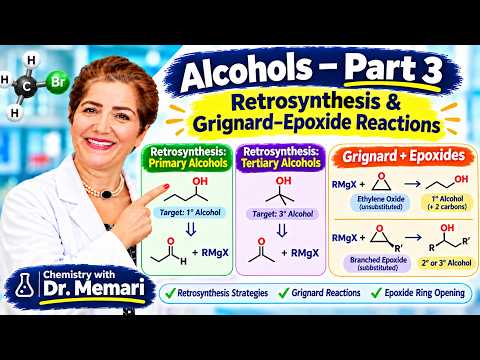
The lesson works backward from 3-methylpentan-3-ol to compare ketone, acid chloride, and ester routes using Grignard reagents, then explains Grignard ring opening of epoxides. It applies the rules to a four-carbon primary alcohol: propylmagnesium bromide plus formaldehyde or ethylmagnesium bromide plus ethylene oxide.
Key takeaways
- In ketone-based retrosynthesis, the Grignard reagent supplies one alkyl group attached to the alcohol-bearing carbon, while the ketone supplies the carbonyl carbon and its other substituents.
- Tertiary alcohol formation from an ester or acid chloride requires two equivalents of Grignard reagent, producing two identical alkyl groups at the alcohol-bearing carbon.
- Acid chlorides generally react faster than esters with Grignard reagents because chloride is a better leaving group than an alkoxy group.
- Grignard addition to ethylene oxide adds a two-carbon unit and yields a primary alcohol after protonation of the alkoxide.
- For a substituted epoxide under these conditions, Grignard attack occurs at the less substituted carbon; the epoxide substituent therefore determines whether the resulting alcohol is secondary or tertiary.
- A four-carbon primary alcohol can be designed either with propylmagnesium bromide plus formaldehyde or with ethylmagnesium bromide plus ethylene oxide.
Chapters
- For the ketone route, disconnect one ethyl group from the alcohol carbon and pair ethylmagnesium bromide with butan-2-one.
- The acid chloride and ester routes use two equivalents of ethyl Grignard, which add identical ethyl groups to form the tertiary alcohol.
- Acetyl chloride supplies the remaining two-carbon acyl fragment; its chloride leaving group makes it more reactive than an ester with an alkoxy leaving group.
- The Grignard alkyl group attacks an epoxide carbon, the carbon-oxygen bond opens, and acidic workup protonates the resulting alkoxide.
- Ethylene oxide contributes two carbons, so reaction with a Grignard reagent extends the carbon chain by two and produces a primary alcohol.
- With a substituted epoxide, the nucleophile attacks the less substituted carbon; a methyl-substituted example produces a secondary alcohol after workup.
- First classify the target alcohol: the practice target is primary, narrowing the choices to formaldehyde or ethylene oxide routes.
- Formaldehyde contributes one carbon, so propylmagnesium bromide supplies the other three carbons and forms a four-carbon primary alcohol.
- Ethylene oxide contributes two carbons, so ethylmagnesium bromide supplies the other two to reach the same four-carbon alcohol.
Transcript excerpt
0:00 Methyl pentane two or three old. You want to Can you propose like two different methods? What would you what could you use to make this? Mm? Using Grignard reagents. So let's limit Grignard which Grignard? So we when we have the product we cannot use any Grignard. We have to use either methyl Grignard, ethyl Grignard, propyl Grignard, which Grignard should I use? Ethyl Grignard? Okay. I can use if I use ethyl Grignard that means I'm taking one of these groups because remember what comes from the Grignard is just the alkyl group not the carbinol or carbonyl group, right? So this part if it's coming from
0:50 Grignard what should be this side? >> Ketone. >> Ketone. So that would be one, right? So one method would be use ethyl Grignard plus how many carbons should come from the ketone? What should be the structure for the ketone? Four carbons. And the ketone should be on carbon number two. So if this side is coming from the carbon that carries the OH it used to carry the C O double bond. Is attached to two other group. So this part is coming from ketone. This side is coming from Grignard. So that's one method. Can you give me a second method? >> Add it to the ester.
1:38 >> You add to ester. What should I add? What should be my Grignard? Should I use methyl Grignard or ethyl Grignard? What was unique about the tertiary alcohol that was coming from ester and Grignard? >> You have two same groups. >> Two same group, two alkyl group that was coming from Grignard because we use two moles of Grignard. So these two are identical so my Grignard has to be ethyl Grignard then. Right? So if I'm using two
This is the start of the transcript. Save this video free for the whole transcript, searchable and time-coded.
In this course
Related notes
Summary, takeaways, and chapters were generated by AI from the video's transcript and may contain errors. The video belongs to its creator, Chemistry with Dr. Memari.