Advanced Dynamics Exam 2 Review... Again
Overview
Christian Hubicki reviews an advanced dynamics practice exam spanning constrained Lagrangian mechanics, Atwood machines, impact equations, and rigid-body rotation. He demonstrates how to form Jacobians and augmented constraint systems, apply Baumgarte stabilization, derive generalized forces, and use impact maps, while clarifying that the actual exam will not require solving differential equations or large matrix systems from scratch.
Key takeaways
- For the ladder constraint x²+y²−L²=0, J=[2x,2y] and J̇q̇=2(ẋ²+ẏ²); these terms supply the acceleration-level constraint row.
- Baumgarte stabilization reduces constraint drift by adding position and velocity feedback; critical damping at ωₙ=10 rad/s uses α=β=10.
- Pulley rotation contributes an effective inertia I/R² to an Atwood machine, while a bearing torque −Bθ̇ maps to generalized force −B ẏ/R² under θ̇=ẏ/R.
- At the dome impact point (3,4), the contact Jacobian is [6,8]; the example's supplied velocities yield an impulse of 0.6 N·s and restitution coefficient e=0.5.
- The impact example loses 6 J of kinetic energy while preserving the tangential velocity component, illustrating that normal impact behavior can change while tangential motion remains unchanged.
- For the given inertia tensor and ω=(2,0,0), angular momentum is (6,0,−2), rotational kinetic energy is 6 J, and the gyroscopic torque is (0,4,0) N·m.
Chapters
- Christian Hubicki introduces practice exam E as a review of the methods and problem types expected on the advanced dynamics exam.
- The exam has four problems, each with a graduate-level component rather than a separate extra problem.
- Hubicki notes that practice exam F became longer than intended and that some of its added work exceeds the actual exam scope.
- The ladder is modeled as a massless rod of length L with equal point masses m at its ends, using generalized coordinates q=(x,y).
- The holonomic constraint is F(x,y)=x²+y²−L²=0, which keeps the two masses L apart.
- Differentiating F gives the Jacobian J=[2x, 2y], and J̇q̇=2ẋ²+2ẏ².
- Hubicki assembles the constrained equations using the mass matrix, J, −Jᵀ, accelerations, and the Lagrange multiplier λ.
- For two masses of mass m, the mass matrix is diagonal with entries m, and the force vector is (0,−mg).
- The constraint row uses −J̇q̇=−2(ẋ²+ẏ²) as its right-hand side.
- Baumgarte stabilization adds position- and velocity-error feedback to reduce numerical drift in the rod-length constraint.
- For critical damping with natural frequency ωₙ=10 rad/s, Hubicki sets α=β=10.
- The corrected constraint right-hand side combines −J̇q̇, −2αJq̇, and −β²F(q), with F(q)=x²+y²−L².
- For the graduate check, the ladder starts from rest at x=0.8, y=0.6, with L=1, m=1, and g=10.
- The supplied accelerations ẍ=4.8 and ÿ=−6.4 satisfy the acceleration-level constraint because 2x ẍ+2y ÿ=0.
- Substitution into the vertical mass row gives λ=6 N; Hubicki interprets the positive constraint force as compression for this setup.
- The Atwood system has masses m₁ and m₂, a pulley with radius R and inertia I, and a single coordinate y.
- The no-slip relation θ̇= ẏ/R adds pulley rotation to the translational kinetic energy.
- The total kinetic energy is T=½(m₁+m₂+I/R²)ẏ², while the stated height convention gives V=(m₂−m₁)gy.
- A viscous bearing torque −Bθ̇ acts on the pulley, and the generalized force for coordinate y is Qᵧ=−B ẏ/R².
- Applying d/dt(∂L/∂ẏ)−∂L/∂y=Qᵧ gives (m₁+m₂+I/R²)ÿ+(m₂−m₁)g=−B ẏ/R².
- Hubicki says the exam assesses setting up T, V, Qᵧ, and the equation of motion, not solving the added first-order differential equation.
- With coordinates (y₁,y₂,θ), Hubicki gives constraints f₁=y₂−Rθ and f₂=y₁+Rθ.
- Differentiating with respect to (y₁,y₂,θ) produces J=[[0,1,−R],[1,0,R]].
- The example emphasizes forming the constraint Jacobian from the supplied equations before using the mass rows and pulley row.
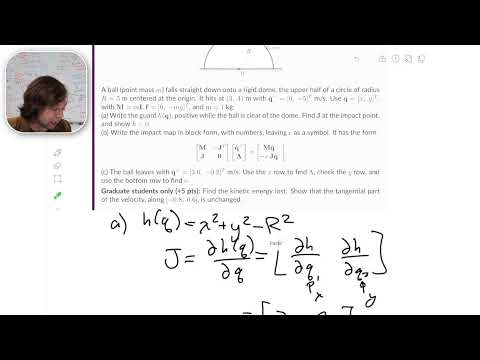
- A ball strikes a rigid semicircular dome of radius 5 m, with the impact point at (3,4).
- The guard function is H(x,y)=x²+y²−R², zero at contact and positive outside the dome.
- Its Jacobian is J=[2x,2y], which evaluates to [6,8] at the impact point.
- The impact system uses the block matrix with mass matrix M, contact Jacobian J, and its transpose to relate pre-impact and post-impact velocities.
- For a unit mass, M is the 2×2 identity; the pre-impact velocity is q̇⁻=(0,−5) m/s.
- The restitution term retains the coefficient e symbolically, and the contact impulse is represented by the Lagrange multiplier λ.
- Using the supplied post-impact velocity q̇⁺=(3.6,−0.2) m/s, the x row gives λ=0.6 N·s.
- The remaining contact equation, 6ẋ⁺+8ẏ⁺=40e, gives a coefficient of restitution e=0.5.
- Hubicki notes that the practice solution contained a coordinate transcription error, and the intended impact point is (3,4) m.
- For a unit-mass ball with pre-impact velocity (0,−5) m/s, kinetic energy falls from 12.5 J to 6.5 J, a loss of 6 J.
- The tangent direction at the impact point is represented by (−0.8,0.6).
- Dot products with that tangent give −3 m/s before and after impact, showing that the tangential velocity is unchanged.
- For I_G=[[3,0,−1],[0,2,0],[−1,0,3]] and ω=(2,0,0), angular momentum H_G=I_Gω=(6,0,−2).
- Rotational kinetic energy is ½ωᵀH_G=6 J; the graduate extension computes the steady-spin torque ω×H_G=(0,4,0) N·m.
- Hubicki's exam guidance prioritizes Jacobians, constraint rows, Baumgarte substitution, and energy or momentum calculations; the exam will not require solving large matrix systems or differential equations from scratch.
- He recommends bringing a calculator for numerical substitutions and matrix calculations.
Transcript excerpt
0:04 Hello folks. I hope we're doing well. I hope honest to goodness this is the last attempt at an exam review. [crying] Things just keep going wrong. So I have managed to jury rake my setup and hopefully does not catch fire here. This so many things are plugged in other things. Uh but uh so I'm running off of a completely different computer uh but same camera setup. So hopefully this all works out well and there's not an issue. There might be some distractions, but hopefully we get through this. This is this is this is going through to explain how to do exam pro exam review practice problems. E let me show you exactly what I'm talking Oh, that's the wrong one. There we go. There. Fantastic. Great. We are connected in. I managed to all
0:52 because one dongle would not behave with my iPad. My iPad would not was not behaving before. As a result, it was losing power and I couldn't charge it and didn't get all the way through the exam. Not even close. So, I'm trying to give you one clean advanced dynamics review off of practice exam E. I will include a link for the class on Canvas through practice exam F, which was way more time than I expected it to be. I just figured I would add a few more parts to give a broader range of how many parts I could add. So that way I have something that really spans the difficulty of what you could get even though you didn't get that on your exam on your actual exam. It was too much. So I'll include those in two parts because I have one in one interruption due to family stuff. Anyway, let's begin. Welcome. I know you can't I can't
This is the start of the transcript. Save this video free for the whole transcript, searchable and time-coded.
In this course
Related notes
Summary, takeaways, and chapters were generated by AI from the video's transcript and may contain errors. The video belongs to its creator, Christian Hubicki.