Dynamics (MIT 16.07) - Lecture 13: Mid-Term Review, Newton-Euler Dynamics, and Quadrotors
 Watch on YouTube →
Overview
The lecture reviews the MIT 16.07 midterm scope and logistics, then develops Newton-Euler rigid-body dynamics using body-frame translational velocity and angular velocity. It applies that formulation to a four-motor quadrotor, deriving thrust and torque maps and showing how RK4 simulation, quaternion normalization, and an LQR controller produce a practical model that can also be flown with keyboard inputs.
Key takeaways
- A quadrotor model needs only a rigid-body mass and inertia model plus the net forces and torques produced by its four propellers.
- Expressing both translational velocity and angular velocity in the body frame adds the term minus omega cross v to translational acceleration, but keeps vehicle forces and actuator maps simple and constant.
- Counter-rotating propeller pairs cancel reaction torque in balanced hover; changing their relative motor commands creates yaw control without requiring a large change in total thrust.
- The quadrotor state stores 13 values when attitude uses a four-component quaternion, and numerical integration must preserve the quaternion's unit norm.
- The exam emphasizes derivation and analysis over coding: students should be ready for a Lagrangian problem, a tumbling rigid-body problem, and conceptual questions drawn from problem sets and quizzes.
Chapters
- Quaternion multiplication, inversion, normalization, and rotation-matrix analogies were reviewed.
- The quaternion kinematics map angular velocity into quaternion derivative, allowing numerical integration of attitude.
- The quaternion exponential represents axis-angle rotation, with scalar part cos(theta/2) and vector part equal to the axis times sin(theta/2).
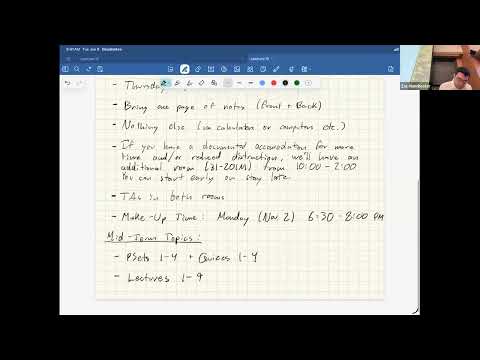
- The in-class midterm is Thursday, October 29, in room 33-225, with about 90 minutes and a recommendation to arrive near 11:00.
- Students may bring one double-sided notes page and writing materials; calculators and computers are not allowed.
- Official accommodations include time and a half or a reduced-distraction room, 31-201M, available from 10:00 to 14:00.
- The alternate exam is planned for Monday, November 2, from 18:30 to 20:00, with the room to be announced.
- Coverage is problem sets and quizzes 1 through 4, approximately lectures 1 through 9; Newton's second law in Cartesian and polar coordinates will not be directly tested.
- Students should derive kinetic energy from inertial-frame particle velocities and body-frame angular velocity, and express gravity and spring potential energy in generalized coordinates.
- The Euler-Lagrange equations convert the Lagrangian, kinetic energy minus potential energy, into equations of motion and generalized forces.
- The manipulator equation groups dynamics into a mass matrix, Coriolis terms, potential or gravity terms, and generalized force; the mass matrix must be positive definite.
- The velocity transport theorem follows by differentiating a rotation-matrix mapping between body and inertial coordinates, producing an angular-velocity cross-product term.
- Power is force dotted with velocity, and work is its time integral; ideal constraint forces do no work because their direction is perpendicular to allowed velocity.
- Rigid-body inertia is a positive-definite rotational mass matrix, with positive eigenvalues for a body with nonzero mass distribution.
- The parallel-axis theorem combines component centers of mass and inertia to calculate properties of composite bodies.
- Euler's rotational equation is expressed in the body frame; the review includes principal-axis equilibria, stability, energy, and angular-momentum conservation.
- Linearization uses first-order approximations such as sin(theta) approximately theta and cos(theta) approximately 1; a quadratic approximation of the Lagrangian yields linear equations of motion.
- For a linear system, stability depends on Jacobian eigenvalues: strictly negative real parts imply decay, while a positive real part implies instability.
- A Lyapunov function shaped like an energy bowl has V(x) positive away from equilibrium; V-dot less than or equal to zero indicates stability, while strictly negative V-dot supports asymptotic stability.
- The exam has two long calculations: one deriving motion with the Lagrangian method and one on a tumbling rigid body.
- About 10 short conceptual or multiple-choice questions resemble quiz questions; the approximate grading split is 35% per long problem and 30% for short questions.
- The instructor recommends independently reworking all four problem sets and quizzes from scratch rather than relying only on posted solutions.
- Simulation coding is excluded, though students should recognize qualitative numerical issues such as rotation matrices drifting from orthogonality during naive integration.
- Newton-Euler dynamics combines translational F=ma with Euler's rotational equation for a rigid body.
- The same framework applies to airplanes, drones, rockets, satellites, underwater vehicles, and quadruped robots.
- Across these systems, the main modeling task is to calculate the forces and torques generated by actuators or contacts.
- A straightforward state uses inertial-frame position and velocity, a body-to-inertial quaternion, and body-frame angular velocity.
- The resulting state has 13 stored components: position, four quaternion values, velocity, and angular velocity, with a unit-norm constraint on the quaternion.
- Its derivatives combine position rate equal to inertial velocity, quaternion kinematics, inertial-frame force divided by mass, and Euler's rotational equation.
- An alternative state keeps position and attitude as before but expresses translational velocity and angular velocity in the body frame.
- The transport theorem applied to inertial velocity v_N = Qv_B gives v-dot_B = Q-transpose times v-dot_N minus omega_B cross v_B.
- Newton's law then becomes body-frame force divided by mass minus the rotational cross-product term, while quaternion kinematics and Euler's equation remain in their established forms.
- Propeller thrust, engine forces, wing lift and drag, and their moments are naturally specified in coordinates attached to the vehicle.
- Gravity is the main force typically supplied in the inertial frame, so it can be rotated into body coordinates with Q-transpose.
- Body-frame actuator maps remain constant rather than requiring attitude-dependent rotations at every step.
- Body-frame formulation also makes small-angle linearization and control laws more useful across yaw changes, because actuator inputs do not acquire extra attitude-dependent rotations.
- The quadrotor is modeled as a rigid body with mass M, inertia J, four arms of length L, and body axes X, Y, and Z.
- Each of the four motors produces thrust along body Z, modeled as the thrust coefficient K_F times its motor command.
- The four motor commands form a four-dimensional input vector; their thrusts add to create the net body-Z force.
- Roll and pitch torques come from each motor's arm offset and thrust, using the moment-arm relation r cross F with arm length L.
- Each propeller also generates a body-Z reaction torque proportional to its motor command through a torque coefficient.
- Two propellers spin in each direction, giving alternating reaction-torque signs that cancel during balanced hover.
- Increasing one counter-rotating pair while decreasing the other can preserve total thrust while producing yaw torque.
- The GitHub implementation expresses the model as f(x,u), with a thrust map and torque map that match the derived four-motor equations.
- The continuous dynamics combine Euler's equation with body-frame translational dynamics and gravity rotated from the inertial frame.
- Simulation uses fixed-step fourth-order Runge-Kutta integration rather than adaptive error control such as ODE45.
- The code normalizes the quaternion after every RK4 step to restore unit norm; this projection is described as retaining RK4's fourth-order accuracy.
- An LQR controller drives randomized initial states toward a hover target about 0.01 m above the ground.
- The controller is presented as a linear feedback method similar in spirit to PD control, with trajectories and motor commands available for inspection.
- Using body-frame dynamics supports robust control across yaw angles because actuator inputs remain in the body frame during linearization.
- A keyboard interface commands pitch and roll with arrow keys, vertical motion with A and S, and yaw rate with additional keys.
- The keyboard inputs become velocity or yaw-rate references for the controller rather than direct motor commands.
- The same LQR controller has been flown on Crazyflie drones in the lab, making the simulated model relevant to real hardware.
Transcript excerpt
0:00 Okay. So, start. Just kind of go through the usual thing. So, last time we talked about um quaternion stuff. So, we did kind of quaternion algebra. Showed you how to multiply them, invert them, that's what the identity is, how to normalize, all that kind of good stuff so that you got to the point where you could operate with them the same way you can with rotation matrices. Then we did the quaternion kinematic stuff. And talked about how to map, you know, like omega into Q dot so you can integrate and get Q of T just like we had before with rotation matrices. So,
0:47 now we're in a position to like actually simulate these things, uh which we'll do today some more, hopefully, and then the next couple lectures. Uh and then the last thing we did was the quaternion exponential, which it turns out was just the the thing we'd seen all along where you take the axis angle and it's like a cosine theta over two for the scalar part and then the axis times sine theta over two for the vector part. And this is what you get if you rotate about a constant axis at a constant angular velocity, right? If you write that down, it's a linear first-order ODE and the closed-form solution is the exponential. Um and that's useful for going back and forth between axis angles and quaternions just like you can use the
1:34 matrix exponential to go back and forth between axis angles and rotation matrices via the skew-symmetric matrix. And then we did this like table with kind of all the back and forth kind of matching uh analogies between quaternions and rotation matrices. Questions about any of that stuff? So, we'll do a little bit more of that
This is the start of the transcript. Save this video free for the whole transcript, searchable and time-coded.
Related notes
Summary, takeaways, and chapters were generated by AI from the video's transcript and may contain errors. The video belongs to its creator, MIT Robotic Exploration Lab.