Acid-Catalyzed Hydration of Alkenes: Mechanism, Rearrangements, Regio & Stereochemistry
Overview
Acid-catalyzed hydration adds water across an alkene through hydronium protonation, a carbocation intermediate, water attack, and deprotonation that regenerates the acid catalyst. The mechanism explains Markovnikov regiochemistry through formation of the more stable carbocation, while also allowing carbocation rearrangements and attack from either face; these pathways can produce multiple alcohols and racemic mixtures.
Key takeaways
- Hydronium protonates the alkene π bond, and the more favorable protonation pathway forms the more stable carbocation, accounting for Markovnikov regiochemistry.
- Because hydration proceeds through a carbocation, a neighboring 1,2-hydride or 1,2-alkyl shift can change the carbon skeleton before water attacks.
- Water attack on a carbocation produces an oxonium ion; deprotonation then forms the alcohol and restores the acid catalyst.
- A planar carbocation can be attacked from either face, producing a racemic mixture when the resulting alcohol contains a newly formed chiral center.
- Adding water favors alkene hydration at equilibrium, while removing water favors the reverse elimination that regenerates the alkene.
- Rearrangement-prone alkenes can give mixtures of alcohol products, so acid-catalyzed hydration is less selective for synthesis when carbocation shifts are available.
Chapters
- The alkene π bond acts as a Lewis base and attacks a hydrogen on hydronium, the electrophile formed when acid is added to water.
- Protonation places the positive charge on the more substituted carbon when that choice gives a more stable carbocation, favoring the Markovnikov pathway.
- Carbocation formation is the key regiochemistry-determining step; the more stable carbocation corresponds to the favored pathway.
- Before water attacks, consider whether a 1,2-methyl shift can produce a more stable carbocation; rearranged and unrearranged products can both form.
- Water attacks the carbocation to make an oxonium ion, which is positively charged because the attacking nucleophile is neutral water.
- The carbocation is planar, so water can attack from either face; if this creates a chiral center, both configurations form as a racemic mixture.
- Deprotonation of the oxonium ion yields the alcohol and regenerates hydronium.
- Acid-catalyzed hydration converts an alkene into an alcohol by adding H and OH across the double bond, with OH on the more substituted alkene carbon.
- Increasing water concentration shifts the equilibrium toward alcohol; removing water or increasing temperature can favor the reverse elimination to form an alkene.
- Carbocation rearrangements can yield a mixture of alcohols, limiting synthetic usefulness when shifts are possible; hydration is more practical when the alkene cannot rearrange.
Transcript excerpt
0:00 instead of using a highly HI, let's try the another reaction. Sorry. Now instead of using a highly HI, let's use water in acid medium. So with a few drops of acids you should acid catalyze reaction. Okay, so who is the Lewis base here in
0:59 this reaction? Who is acting as a Lewis base? >> Alkene. >> The alkene is a Lewis base, right? That's a nucleophile. We know is the the pi bond what makes the So look at what I'm using in this reaction is water with acid catalysis, right? So is water a good electrophile? You guys remember a few minutes ago we discussed that? Is water a good electrophile? >> No. >> No, why not? Because hydroxide is a very bad leaving group, right?
1:46 So if we mix water with a drop of acid, what are we forming there? Hydronium ion, right? And hydronium is a great electrophile because now the leaving group they were an arch, which is highly stable. So the nucleophile in my reaction is the alkene and the electrophile in my in my reaction is the hydronium ion. This is so important to you guys to reason the reactions like it's very who is the electrophile, who is the nucleophile, who is reacting with who and how, right? So what makes the alkene uh nucleophilic is the pi bond.
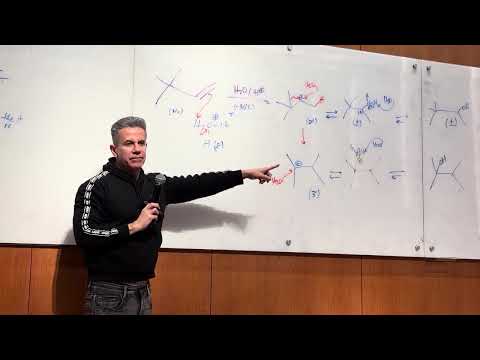
2:36 The highest are electron deficient, so that's the electrophilic center in hydronium. So the arrows is departing from the double bond ending on the hydrogen and the water is the leaving group. And we already know about the hydrogen will be added to the carbon on the right side because that will be forming a secondary carbocation, which is more stable than a primary carbocation. The reaction is once again regioselective.
3:25 Only the most stable carbocation is
This is the start of the transcript. Save this video free for the whole transcript, searchable and time-coded.
In this course
Related notes
Summary, takeaways, and chapters were generated by AI from the video's transcript and may contain errors. The video belongs to its creator, Organic Chemistry by Prof Gerona-Navarro.