7.3 Simplify Complex Rational Expressions --Lesson 6--FA26
 Watch on YouTube →
Overview
Rachel Soyk explains two methods for simplifying complex rational expressions: rewrite the expression as division and use keep-change-flip, or find the LCD and clear the component fractions. Worked examples use factoring, common denominators, cancellation, and domain restrictions, including results such as 2(x + 4), (n + 1)(n - 5)/2, and (x - 6)/(2(x + 5)).
Key takeaways
- A complex rational expression can be simplified by treating its numerator and denominator as two expressions being divided, then applying keep-change-flip.
- Combining component fractions with their LCD before the outer division often makes matching denominators cancel immediately.
- Factoring is essential after clearing denominators: identities such as x² - y² = (x + y)(x - y) expose factors that can cancel.
- Common-factor cancellation applies to factors, not isolated terms; the n example requires factoring n² + n as n(n + 1) before canceling n.
- Canceled factors do not remove restrictions from the original expression; the final example still excludes x = 6 and x = -6.
Chapters
- For (3/5) ÷ (9/10), keep 3/5, change division to multiplication, and flip 9/10 to 10/9.
- Cancel common factors before multiplying: the warm-up reduces to 2/3.
- For complex numerical fractions, simplify the numerator and denominator with common denominators first; the example 9/10 ÷ 3/10 equals 3.
- A complex rational expression has a rational expression in its numerator, denominator, or both, so it can be treated as a fraction divided by a fraction.
- Rachel Soyk's procedure is to simplify the numerator and denominator when possible, then apply keep-change-flip.
- In (6/(x - 4)) ÷ (3/(x² - 16)), factor x² - 16 as (x + 4)(x - 4), cancel common factors, and obtain 2(x + 4).
- For the numerical example, use 6 as the LCD for component fractions with denominators 2 and 3; after combining, matching denominators cancel and the result is 3.
- For the variable example, use xy to combine component fractions, then cancel the matching xy denominators in the outer division.
- Factor x² - y² as (x + y)(x - y); cancel the shared x + y factor to reach 1/(x - y).
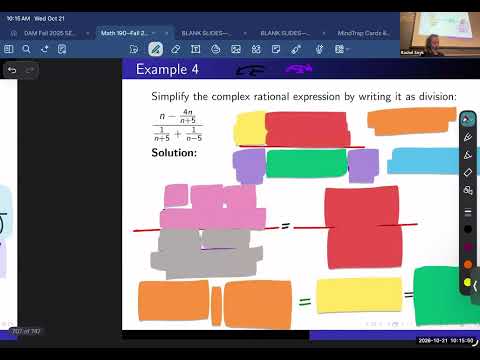
- In the n example, combining terms produces n² + n in the numerator and 2n in the denominator after the outer division; factoring and cancellation yield (n + 1)(n - 5)/2.
- The second method finds the LCD of the component fractions, multiplies through to clear their denominators, and then simplifies.
- For the expression involving 1/x + 1/y and x/y + y/x, use xy as the LCD; clearing the fractions gives (x + y)/(x² - y²).
- Factoring x² - y² into (x + y)(x - y) and canceling x + y gives 1/(x - y), matching the division method.
- In the final example, factor x² - 36 into (x + 6)(x - 6) to identify the LCD for the denominator's component fractions.
- Multiply the numerator and denominator through by the LCD, then simplify the resulting expressions to (2x - 12)/(4x + 20).
- Factor out common factors and reduce to (x - 6)/(2(x + 5)).
- The original denominators require x ≠ 6 and x ≠ -6; those restrictions remain even when a factor cancels.
Transcript excerpt
0:03 Right, 7.3, simplifying complex rational expressions. So, only two learning objectives in this section. We are going to simplify a complex rational expression by writing it as division. And then we are going to simplify a complex rational expression by using the LCD. So, two different ways at arriving at the same result. Let's first start with some warm-up problems. Going back into just dividing fractions by one another, and then dividing complex fractions by one another.
0:51 So, in this first example, we have 3/5 divided by 9/10. And I know it looks a little tricky, but what I like to do is I like to make that middle division a little longer. So, that you know that you're dealing with a keep change flip, right? Or keeping that first fraction exactly the same. We're changing the division sign into multiplication. And then we're flipping that denominator. So, instead of it being 9/10, we have 10/9. And then yeah, we can multiply straight across and then simplify, but let's utilize some number sense here. And what I see is I see that
1:41 three and nine share a factor of three. How many times does three go into three? >> Once. >> Once. And then how many times does three go into nine? >> Three times. >> Yep. And then 5 and 10 also share a factor. They share a factor of 5. How many times does 5 go into 5? And how many times does 5 go into 10? Good. So now we're dealing with much smaller numbers, makes our life a little easier. And so multiply straight across, 1 * 2 gives you 2 and then 1 * 3 gives you Yeah. Which means our simplified result is just 2/3.
2:32 Let's go ahead and move on to our warm-up question number two.
This is the start of the transcript. Save this video free for the whole transcript, searchable and time-coded.
Related notes
Summary, takeaways, and chapters were generated by AI from the video's transcript and may contain errors. The video belongs to its creator, Rachel Soyk.