5.3 Multiply Polynomials --Lesson 18--FA26
 Watch on YouTube →
Overview
Rachel Soyk teaches the six objectives of polynomial multiplication: multiplying monomials, distributing a monomial, multiplying binomials with distribution or FOIL, multiplying larger polynomials, recognizing special products, and multiplying polynomial functions. Examples show how to combine coefficients and add exponents, combine like terms, apply the three special-product formulas, and evaluate a product function at an input.
Key takeaways
- When multiplying monomials, multiply their coefficients and add exponents for each matching variable, as in 3x² · (−4x³) = −12x⁵.
- The distributive property handles products beyond two binomials by pairing each term in one polynomial with every term in the other.
- FOIL is a shortcut specifically for two binomials, and products may retain four terms when no like terms can be combined.
- Conjugate factors (a + b)(a − b) eliminate their middle terms and produce the difference of squares, a² − b².
- Binomial squares retain a middle term: it equals +2ab for a sum and −2ab for a difference.
- To evaluate a product of polynomial functions at an input, first form and simplify the product, then substitute the input; here (x + 2)(x² − 3x − 4) evaluates to −24 at x = 2.
Chapters
- For 3x² · (−4x³), multiply coefficients and add exponents to get −12x⁵.
- For (5x³y/6) · (12xy²), simplify 12/6 first, then multiply to get 10x⁴y³.
- The examples establish the core rule: multiply numerical factors and add exponents on matching variables.
- Distributing −2y across 4y² + 3y − 5 gives −8y³ − 6y² + 10y.
- Distributing 3x³y across a trinomial means multiplying it separately by all three terms and adding exponents of matching variables.
- The distributive property applies to every term inside the parentheses, including negative terms.
- Soyk first expands (y + 5)(y + 8) by distributing one binomial, then distributes again to get y² + 13y + 40.
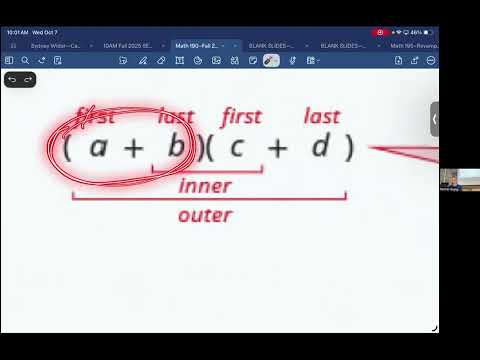
- FOIL names the four binomial pairings: first, outer, inner, and last; the same example produces y² + 8y + 5y + 40.
- For (4y + 3)(2y − 5), the middle terms combine to −14y, giving 8y² − 14y − 15.
- Not every binomial product simplifies to a trinomial: (n² + 4)(n − 1) yields four terms, n³ − n² + 4n − 4.
- FOIL is limited to multiplying two binomials; a binomial times a trinomial requires distributing each term across all three terms.
- Expanding (b + 3)(2b² − 5b + 8) produces six terms before simplification.
- Combining −5b² with 6b² and 8b with −15b gives 2b³ + b² − 7b + 24.
- The sum-and-difference formula (a + b)(a − b) = a² − b² works because the opposite middle terms cancel; these factors are also called conjugates.
- A squared sum follows (a + b)² = a² + 2ab + b², while a squared difference follows (a − b)² = a² − 2ab + b².
- Examples include (2x + 5)(2x − 5) = 4x² − 25 and (x + 5)² = x² + 10x + 25.
- In (2x − 3y)², the two equal cross-products are each −6xy, so their sum is −12xy and the result is 4x² − 12xy + 9y².
- Given f(x) = x + 2 and g(x) = x² − 3x − 4, distribute to expand f(x)g(x).
- Combining like terms gives the product function x³ − x² − 10x − 8.
- Evaluating at x = 2 gives 8 − 4 − 20 − 8 = −24.
Transcript excerpt
0:02 And so now we are on section 5.3, which is multiplying polynomials. And so we have six objectives in this section. A lot of multiplication where they have to deal with multiplying by monomials, monomials and a polynomial, binomial and a binomial where we'll be introduced to our foil method, fancy form of distributive property, polynomial by a polynomial, and then jumping into our special product formulas, um as well as now dealing with
0:50 multiplying polynomials from a function notation standpoint. Maybe I'll have a volunteer to read this for me. Um Mohammed. >> Now ready to perform operations on polynomials. Since monomials are algebraic expressions, we can use the properties of exponents to multiply monomials. >> Yeah. >> Yeah. Yeah. >> So let's jump into our first example. Part A, we have 3x squared times -4x to the third. And so first, let's multiply those
1:38 coefficients. 3 * -4 is -12, and x squared times x to the third is just x to the fifth. That sounds right. You're right. Uh so -12x to the fifth will give you your final result. Okay. Let me make that work. Part B, 5 x ^ 3 * y is the same as 5 x ^ 3 y all over 6. And then 12 x y ^ 2 as a fraction is just 12 x y ^ 2 over 1. And then when we multiply across, we can utilize the numbers signs here
2:26 because how many times does 6 go into 12? Twice. And then we multiply straight across cuz now we're no longer dealing with fraction. 5 * 2 gives you 10. x ^ 3 * x is just x ^ 4. 4. And y * y ^ 2 is just y ^ 3. 3. So, final result, 10 x ^ 4 y ^ 3.
This is the start of the transcript. Save this video free for the whole transcript, searchable and time-coded.
Related notes
Summary, takeaways, and chapters were generated by AI from the video's transcript and may contain errors. The video belongs to its creator, Rachel Soyk.