5.1 Add and Subtract Polynomials --Lesson 16--FA26
 Watch on YouTube →
Overview
Rachel Soyk introduces polynomial vocabulary and degree, then demonstrates how to add and subtract polynomials by combining like terms and distributing negatives across parentheses. She also evaluates polynomial functions by substitution and combines function notation expressions, including calculating their sum at x = 3 and difference at x = -2.
Key takeaways
- Polynomial degree is determined by the highest-degree term, and exponents of multiplied variables add within a single term, so a⁴b² has degree 6.
- Only terms with identical variable parts and exponents can be combined; the operation changes coefficients, not the shared variable factors.
- Subtracting a polynomial means distributing -1 to every term inside it before combining like terms.
- Polynomial function evaluation follows substitution and order of operations; negative inputs should be enclosed in parentheses before exponentiation.
- For f(x) = 3x² - 5x + 7 and g(x) = x² - 4x - 3, f + g = 4x² - 9x + 4 and f - g = 2x² - x + 10.
- The ball-height calculation using h(t) = -16t² + 250 gives h(2) = 186 feet, correcting the transcript's stated result of 86.
Chapters
- A term is a constant or a product of a constant and variables; addition and subtraction signs separate terms.
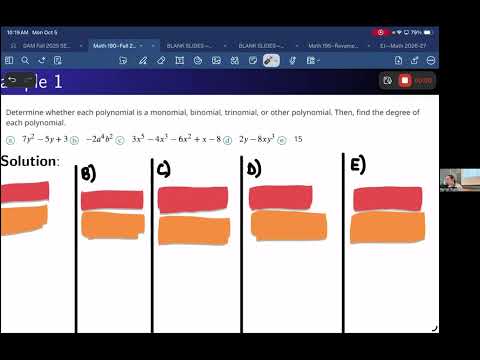
- A monomial has one term, a binomial has two, and a trinomial has three; expressions with more terms are also polynomials.
- Expressions such as 2x² + x - 10 have three terms, while 10 and x⁵⁰⁰⁰ are monomials.
- A nonzero constant has degree 0; for a polynomial, the degree is the highest degree among its terms.
- For variables multiplied within one term, add their exponents: 8ab² has degree 1 + 2 = 3, and a⁴b² has degree 6.
- Write final polynomial answers in descending degree order, with any constant term last.
- Practice examples classify polynomials by term count and identify degrees, including a degree-0 constant.
- Like terms must have the same variables raised to the same exponents; add or subtract only their coefficients.
- Combining 25y² and 15y² gives 40y², while 16pqr³ and 7pqr³ give 23pqr³.
- In an expression such as a² + 7b² - 6a², combine the a² terms to get -5a² and leave 7b² separate.
- Terms with different variable parts, such as u² and uv, cannot be combined.
- When adding parenthesized polynomials, remove the parentheses and group like terms; 7y² - 2y + 9 plus 4y² - 8y - 7 simplifies to 11y² - 10y + 2.
- When subtracting a polynomial, distribute the negative to every term inside its parentheses before combining like terms.
- The expression (9w² - 7w + 5) - (2w² - 4) becomes 7w² - 7w + 9 after distributing the negative and combining terms.
- Subtracting p² + 10pq - 2q² from p² + q² yields 3q² - 10pq; terms in a³ and b³ remain uncombined in a separate example.
- For f(x) = 5x² - 8x + 4, substitution gives f(4) = 52, f(-2) = 40, and f(0) = 4.
- Use parentheses around negative inputs before applying order of operations, so squaring -2 produces positive 4.
- For a ball-height model h(t) = -16t² + 250, substituting t = 2 gives 186 feet; the spoken result of 86 does not match the arithmetic.
- With f(x) = 3x² - 5x + 7 and g(x) = x² - 4x - 3, their sum is 4x² - 9x + 4.
- Evaluating the sum at x = 3 gives 36 - 27 + 4 = 13.
- Subtracting g(x) from f(x) requires distributing the negative; the difference simplifies to 2x² - x + 10.
- Evaluating that difference at x = -2 gives 8 + 2 + 10 = 20.
Transcript excerpt
0:05 Section 5.1 adding and subtracting polomials. Four learning objectives. In this section, we're going to learn how to properly determine degrees of polomials. Uh be able to add and subtract them. uh to evaluate a polomial function. So think of function notation uh and then adding subtracting polomial functions. Two and four objectives are almost identical. The only difference is four is just in function notation format whereas two is not. And so some quick notes have some new
0:57 vocabulary on this slide. Uh what a term is. We've learned that the term or a term is a constant or the product of a constant and one or more variables. Uh if you're looking at like uh 2x^2ar plus 1x - 10. You determine how many terms you have uh by the separation between uh positive and negative signs. Not the separation between multiplication and division only addition and subtraction signs. So in
1:46 this circumstance, how many terms do we have here? Three, right? Monomial. Monomial. We're only honing in on exactly one term. It's an algebraic expression with only one term. So 2x^2, that's a monomial. 10, that's a monomial. x^ 5000. That's a monomial. And so it's always going to be in the form of a x to the n power. But now let's step it up. We have monomials. If we're dealing with two monomials uh that are separated by an addition or a subtraction, that's known as a
2:35 binomial. So exactly two terms. a tromial exactly three terms. So we have specific names for one term, two term, three terms but then anything beyond that we just categorize that as a polomial. Polomials uh deal with everything. You can call a monomial a polomial. Uh but you can call uh an expression that has 10 terms a polomial.
This is the start of the transcript. Save this video free for the whole transcript, searchable and time-coded.
Related notes
Summary, takeaways, and chapters were generated by AI from the video's transcript and may contain errors. The video belongs to its creator, Rachel Soyk.