4.1 Solve Systems of Linear Equations --Lesson 15--FA26
 Watch on YouTube →
Overview
Rachel Soyk introduces systems of linear equations as sets of equations that share a solution, then demonstrates how to test ordered pairs and solve systems using substitution and elimination. Worked examples show how to isolate and substitute a variable or multiply equations to cancel a variable, with solutions expressed as ordered pairs and checked in both original equations.
Key takeaways
- An ordered pair is a solution to a system only when substituting its x- and y-values makes every equation true; satisfying just one equation is not enough.
- Substitution works by isolating a variable in one equation, replacing that variable in the other equation, and then back-substituting to find the second coordinate.
- For 3x + 2y = 12 and 2x - y = 3, multiplying the second equation by 2 enables elimination and produces the solution (18/7, 15/7).
- Elimination can be set up by multiplying an entire equation so that one variable has coefficients that are equal in magnitude and opposite in sign.
- Every solution should be written as an ordered pair in x, y order and checked in both original equations.
Chapters
- Rachel Soyk defines a system as multiple linear equations whose shared solution makes every equation true.
- The section's three objectives are testing ordered pairs, solving by substitution, and solving by elimination.
- At this course level, systems usually contain two equations; larger systems can be organized with matrices in linear algebra.
- Test a proposed pair by replacing every x and y in each equation, then checking whether both left-hand sides equal their right-hand sides.
- For the system x - y = -1 and 2x - y = -5, (-2, -1) satisfies only the first equation, so it is not a system solution.
- The pair (-4, -3) satisfies both equations, while in the second example (1, -3) works and (0, 0) fails one equation.
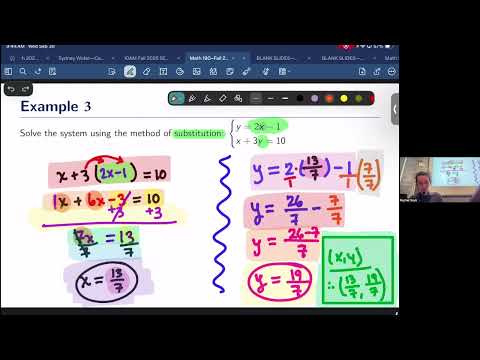
- In the first worked system, substitute y = 2x - 1 into x + 3y = 10 to obtain x = 13/7 and then y = 19/7.
- In another example, isolate y as y = 6x - 8, substitute into 4x + 2y = 4, and solve for (x, y) = (5/4, -1/2).
- Choose the equation that makes isolating a variable easiest, substitute into the other equation, and write the result as an ordered pair.
- Check the final ordered pair in both original equations to confirm the system solution.
- For 3x + 2y = 12 and 2x - y = 3, multiply the second equation by 2 to create 4x - 2y = 6.
- Add the equations to cancel +2y and -2y, giving 7x = 18 and x = 18/7.
- Substitute x = 18/7 into 2x - y = 3 to find y = 15/7, so the solution is (18/7, 15/7).
- When no coefficients cancel immediately, multiply an entire equation, including its right-hand side, to create opposite coefficients.
- For 3x + y = 5 and 2x - 3y = 7, multiply the first equation by 3 to produce 9x + 3y = 15.
- Add that result to 2x - 3y = 7 to eliminate y, yielding 11x = 22 and x = 2.
- Substitute x = 2 into 3x + y = 5 to get y = -1; the solution is (2, -1).
- Soyk closes section 4.1, the curriculum's only section in chapter four, before moving on to chapter five.
Transcript excerpt
0:00 Thanks. All right, so chapter four This actually is our only section in chapter four. So, once we finish section 4.1, we will move on to chapter five, which will begin next week. But so, there are three learning objectives here. Being able to determine whether an ordered pair is a solution of a system of equations. Be able to solve a system of equations by substitution. And then be able to solve a system of equations by elimination. Which we have all had exposure to substitution and elimination in high school, right? It's like probably the main topic when you were in algebra.
0:50 But even in middle school, you were exposed to this. So, let's just very formally define what a system of linear equations is. Uh it's essentially just grouping together multiple linear equations. Most commonly, we have two group together, especially at this level in mathematics. But then when you enter into any of you guys are in engineering and have to take linear algebra, we're going to be all be dealing with a lot more. And when you deal with a lot more, a lot more moving variables. And so, we come up with another system known as turning them into matrices to make it a little bit more
1:40 structured and easier to solve. But not in this class. This class most part, two, sometimes three. All right, we have some notes. Three volunteers? And uh what's your name again? Eric. I did know that in my head. And then, uh, Athena. All right. >> Linear equations in two variables such as 2x + y = 7 are said to be linear equations. If the graph is a line, then there every point on the line is a solution to the equation and every solution to the same
This is the start of the transcript. Save this video free for the whole transcript, searchable and time-coded.
Related notes
Summary, takeaways, and chapters were generated by AI from the video's transcript and may contain errors. The video belongs to its creator, Rachel Soyk.