5.4 Dividing Polynomials --Lesson 18--FA26
 Watch on YouTube →
Overview
Rachel Soyk teaches polynomial division through five objectives: dividing monomials, dividing polynomials by monomials, polynomial long division, function quotients, and the remainder and factor theorems. Across nine examples, she demonstrates exponent rules, placeholder terms, quotient and remainder notation, and evaluation methods, emphasizing that remainder and factor theorem questions appear regularly on exams.
Key takeaways
- For monomial division, divide coefficients and subtract exponents of matching variables; rewrite any negative exponent by moving that factor to the opposite side of the fraction.
- To divide a polynomial by a monomial, split the polynomial into one fraction per term and simplify each fraction separately.
- Polynomial long division requires descending powers and zero placeholders for missing degrees, such as 0x³ in x⁴ − x² + 5x − 6.
- The remainder theorem makes division by x − c equivalent to evaluating f(c); for a divisor x + 2, use c = −2.
- A polynomial divisor x − c is a factor if and only if f(c) = 0, which is equivalent to a zero remainder.
- Soyk identifies remainder theorem and factor theorem questions as recurring final exam material, so correctly determining c is especially important.
Chapters
- Rachel Soyk introduces five section 5.4 objectives, progressing from monomial division to the remainder and factor theorems.
- She says remainder theorem or factor theorem problems have appeared on every final exam she has graded over eight years.
- Rewrite division as a fraction, then simplify numerical coefficients and apply exponent subtraction to matching variables.
- For 54a²b³ divided by −6ab⁵, the result is −9a/b².
- For 14x⁷y¹² divided by 21x¹¹y⁶, reduce 14/21 to 2/3 and move the negative x exponent to the denominator, yielding 2y⁶/(3x⁴).
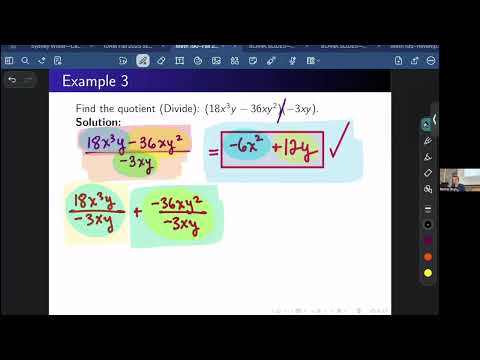
- When dividing a polynomial by one monomial, split the numerator into separate fractions so each term can be simplified independently.
- Soyk uses 18x³y − 36xy² over 3xy to demonstrate term-by-term division and canceling common variable factors.
- A common denominator allows fractions such as 3/d + x/d to be recombined as (3 + x)/d.
- In long division, the divisor sits outside the division bracket, the dividend inside, and the quotient above; the remainder is what remains after subtraction.
- For (x² + 9x + 20)/(x + 5), divide leading terms to get x, multiply x(x + 5), and subtract before repeating.
- The quotient is x + 4 and the remainder is 0, confirming that x + 5 divides the trinomial evenly.
- Write polynomials in descending degree order and insert zero-coefficient placeholders when a power is missing, such as 0x³ in x⁴ − x² + 5x − 6.
- For division by x + 2, the worked example produces quotient x³ − 2x² + 3x − 1 and remainder −4.
- When requested, express division as quotient plus remainder over divisor: x³ − 2x² + 3x − 1 − 4/(x + 2).
- A second worked division ends with quotient 4a² − 6a + 9 and remainder 0; its expressions connect to the sum-of-cubes pattern.
- Soyk defines f(x) = x² − 5x − 14 and g(x) = x + 2, then divides f by g using long division.
- The quotient is x − 7 with remainder 0, so the function quotient simplifies to x − 7.
- Evaluating that quotient at x = −4 gives −4 − 7 = −11.
- The remainder theorem states that dividing f(x) by x − c leaves remainder f(c); identify c by matching the divisor to x − c.
- For f(x) = x³ + 3x + 19 divided by x + 2, c = −2 and f(−2) = 5, so the remainder is 5.
- The factor theorem says x − c is a factor exactly when f(c) = 0, meaning division leaves no remainder.
- For f(x) = x³ − 64, evaluating f(4) gives 64 − 64 = 0, proving x − 4 is a factor.
Transcript excerpt
0:03 So in section 5.4, we have another nine examples. We have five learning objectives here. It's just all of the different ways that you can divide polynomials by one another, whether we're dealing with just monomials or we have binomials divided by polynomials. Um and then we're going to be learning how to utilize long division. Which um sometimes if we have time I teach you guys about synthetic division to help you guys check your work. If we have time today, we will. If not, then I can go over this uh fun method with you
0:53 guys next week. Our fourth objective, we're going to be dividing polynomials from a function standpoint. And then this last objective, I will say is probably one of the most important cuz you will always get questions like this on your exams. Uh and they'll always have a question like this on your final exam. Being able to use the remainder and factor theorems. So you might get a remainder theorem question, you might get a factor theorem question. It is like without a doubt, I've been here for over eight years now. It's been on every single final exam. And I haven't taught this course uh
1:38 every semester. Sometimes I'm in other courses. But uh I do help with the grading process and when I am grading the exams again eight years two semesters. Sometimes I teach winter and summer courses, so four times a year times eight, 32 times it's always on the exam. So, know your stuff so you can get full credit for those points or for those questions. First objective, dividing monomials. And I'll read this one for you guys. So, we're now familiar with all the properties of exponents. We have a very good grasp of that.
This is the start of the transcript. Save this video free for the whole transcript, searchable and time-coded.
Related notes
Summary, takeaways, and chapters were generated by AI from the video's transcript and may contain errors. The video belongs to its creator, Rachel Soyk.