7.2 Add and Subtract Rational Expressions --Lesson 25--FA26
 Watch on YouTube →
Overview
Rachel Soyk teaches how to add and subtract rational expressions by factoring denominators, finding a least common denominator (LCD), rewriting each fraction with an equivalent form of 1, and then combining and simplifying numerators. Worked examples progress from numerical fractions and shared denominators to unlike polynomial denominators, three rational expressions, and function notation, including a final difference that simplifies to (x + 4)/(x + 2).
Key takeaways
- For rational expressions with unlike denominators, factor each polynomial denominator first; the factors reveal both common factors and what each fraction must multiply by to reach the LCD.
- Construct the LCD by including each distinct denominator factor at its greatest required power, as in (x - 1)(x + 1)² for denominators x² - 1 and (x + 1)².
- Multiplying numerator and denominator by the same missing factor creates an equivalent fraction with the LCD, allowing the rewritten numerators to be combined over one denominator.
- Subtraction requires distributing the negative sign across every term in the subtracted numerator before combining like terms.
- After combining rational expressions, factor the numerator and denominator where possible; cancel only common factors, as in the function difference that simplifies from a denominator containing x - 2 to (x + 4)/(x + 2).
Chapters
- For 7/10 + 8/15, use 30 as the LCD and rewrite the fractions as 21/30 and 16/30, giving 37/30.
- For 3x/4 - 8/9, use the LCD 36 to obtain (27x - 32)/36.
- An LCD lets fractions be combined while preserving their values through multiplication by equivalent forms of 1.
- When denominators already match, combine the numerator terms and keep the common denominator.
- Combining x² + 11x + 28 over x + 4 allows the numerator to factor as (x + 7)(x + 4), simplifying to x + 7.
- For subtraction, distribute the negative across every term in the second numerator before combining like terms and factoring.
- Factor polynomial denominators before identifying shared factors and constructing the LCD.
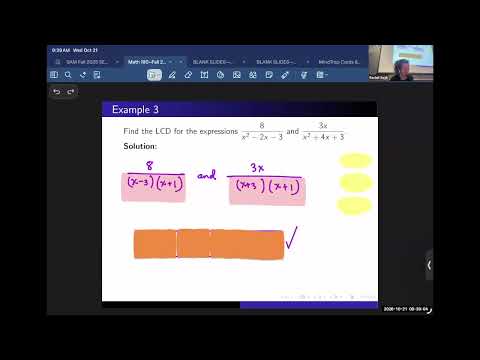
- The denominators x² - 2x - 3 and x² + 4x + 3 factor to (x - 3)(x + 1) and (x + 1)(x + 3).
- Include each distinct factor needed in the LCD only once at its highest required power, giving (x + 1)(x - 3)(x + 3) for the example.
- For 3/(x - 3) + 2/(x - 2), use (x - 3)(x - 2) as the LCD and combine to get (5x - 12)/((x - 3)(x - 2)).
- For 1/(x² - 1) - 2/(x + 1)², factor x² - 1 as (x - 1)(x + 1) and use (x - 1)(x + 1)² as the LCD.
- Distribute the negative in the second example before combining terms; the result is (-x + 3)/((x - 1)(x + 1)²).
- With denominators x² - 2x - 3 and x² + 4x + 3, factor both, use their shared factor x + 1 to build the LCD, and combine to get (3x² - x + 24)/((x - 3)(x + 1)(x + 3)).
- For expressions with denominators u - 1, u, and u² - u, factor the third denominator as u(u - 1).
- Use u(u - 1) as the LCD, multiply the first fraction by u/u and the second by (u - 1)/(u - 1), and leave the third fraction unchanged.
- After combining and simplifying the numerator, factor out u and cancel it against the denominator to obtain (2u - 1)/(u - 1).
- Rachel Soyk finds f(x) - g(x) for f(x) = (x + 5)/(x - 2) and g(x) = (5x + 18)/(x² - 4).
- Factor x² - 4 as (x + 2)(x - 2), making (x + 2)(x - 2) the LCD.
- Multiply the first function by (x + 2)/(x + 2) and distribute the subtraction across both terms of 5x + 18.
- Factor the resulting numerator x² + 2x - 8 as (x + 4)(x - 2), cancel x - 2, and get (x + 4)/(x + 2).
Transcript excerpt
0:03 All right. So 7.2 adding and subtracting rational expressions. We have four learning objectives in this section. Uh being able to add and subtract rational expressions with a common denominator. Uh to be able to find the least common denominator of rational expressions. adding and subtracting rational expressions with unlike denominators and then adding and subtracting rational functions, which that fourth objective once again is what we've been practicing in that third objective um and second objective, but it's just from a function notation standpoint, which if you haven't already noticed, uh
0:53 a lot of these lessons will always And with that last objective being in a function notation standpoint, let's do some warm-up problems. So reviewing our knowledge of adding fractions or subtracting fractions, especially when we have different denominators, the first thing that we have to do is find a least common denominator. So in this case, we need to find an LCD between 10 and 15. So let's use our handy dandy cake method. What's a factor that we can pull out of 10 and 15? >> We can pull out a five or Yeah, I don't know why I messed up here. It's not two.
1:45 And when we pull out a five, what are we left with? >> Yeah, exactly. Let's redo this. I wrote it again. Pull it out a five. And then we're left with two and three. Like my brain's not processing right now. Better remember to change that on my other notes. Okay. So, when we take the product of all of this, we get our LCD. So 5 * 2 is 10 * 3 gives you 30. And now uh let's go ahead and change up these denominators. So we have 7/10 + 8 15.
2:35 That first fraction, what fancy form of
This is the start of the transcript. Save this video free for the whole transcript, searchable and time-coded.
Related notes
Summary, takeaways, and chapters were generated by AI from the video's transcript and may contain errors. The video belongs to its creator, Rachel Soyk.