6.5 Polynomial Equations --Lesson 23--FA26
 Watch on YouTube →
Overview
Rachel Soyk teaches how to solve polynomial equations by putting them equal to zero, factoring, and applying the zero product property. Examples cover GCF factoring, the AC method, difference of squares, repeated roots and multiplicity, and using function notation to find zeros and graph intercepts.
Key takeaways
- Zero product property is useful only after an equation is written with zero on one side; then each variable-containing factor can be set equal to zero.
- For a quadratic ax² + bx + c with a not equal to 1, the AC method splits bx into two terms whose coefficients multiply to ac and add to b, enabling factoring by grouping.
- A nonzero constant factor, such as 3 in 3(x - 7)(x + 3) = 0, does not create an additional root; a variable factor can, as in m(3m - 10)² = 0.
- Repeated factors encode root multiplicity: (3m - 10)² gives m = 10/3 twice, and the graph touches the x-axis at that repeated zero.
- Function zeros and x-intercepts describe the same x-values: solve f(x) = 0, then write each intercept as (x, 0).
- For a quadratic ax² + bx + c, the y-intercept is (0, c), because setting x = 0 eliminates the terms containing x.
Chapters
- Solves 5y - 3 = 0 with inverse operations to get y = 3/5.
- Factors n³ - 9n² - 22n by taking out n, then factoring the trinomial as n(n - 11)(n + 2).
- Evaluates f(3) = 8 for f(x) = 8x - 16, then finds the function's zero at x = 2.
- Defines a polynomial equation by its polynomial expression and degree, identifying degree-one equations as linear and degree-two equations as quadratic.
- Uses standard form ax² + bx + c = 0 to prepare for finding values that make a quadratic equation true.
- Explains that if a product AB equals zero, at least one factor must equal zero, so each factor can be set equal to zero to find solutions.
- Solves (5n - 2)(6n - 1) = 0 by setting each binomial equal to zero.
- Finds the two solutions n = 2/5 and n = 1/6 using inverse operations.
- Connects the procedure to the general rule that a product of factors equals zero only when at least one factor is zero.
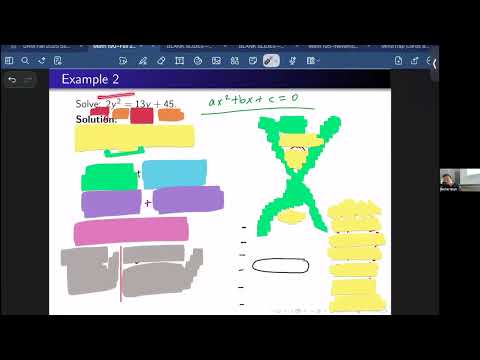
- Rewrites 2y² - 13y - 45 = 0 and uses AC = -90 to split the middle term into -18y + 5y.
- Factors by grouping to obtain (y - 9)(2y + 5) = 0, giving y = 9 and y = -5/2.
- Recognizes 169q² - 49 as a difference of squares and factors it as (13q + 7)(13q - 7), giving q = -7/13 and q = 7/13.
- Emphasizes that zero product property requires the equation to have zero on one side before factors can be set individually to zero.
- Uses the AC method to factor 3x² - 14x + 8 as (3x - 2)(x - 4), producing x = 2/3 and x = 4.
- Factors 3x² - 12x - 63 by first taking out 3, then factoring x² - 4x - 21 as (x - 7)(x + 3), with roots 7 and -3.
- Clarifies that a nonzero constant factor such as 3 does not add a root, while a variable factor such as x creates an additional solution.
- Applies zero product property to three or more factors, showing that every factor can contribute a solution.
- Factors m(9m² - 60m + 100) as m(3m - 10)², identifying m = 0 and m = 10/3 with multiplicity two.
- Explains that listing m = 10/3 twice or specifying multiplicity two records all three roots, counting repetition.
- Relates a repeated root to a graph that touches or bounces off the x-axis, unlike a simple root that crosses it.
- For f(x) = x² + 2x - 2, sets f(x) = 6, rearranges to x² + 2x - 8 = 0, and factors to find x = -4 and x = 2.
- Distinguishes the condition f(x) = 6 from x = 6 by setting the entire function expression equal to the requested output.
- Defines a zero of a function as an x-value where f(x) = 0, corresponding to an x-intercept on the graph.
- Factors 3x² + 10x - 8 using AC = -24 and the split 12x - 2x, obtaining (3x - 2)(x + 4).
- Finds zeros x = 2/3 and x = -4, which correspond to x-intercepts (2/3, 0) and (-4, 0).
- Finds the y-intercept by setting x = 0; the constant term gives the point (0, -8).
Transcript excerpt
0:00 that. So, our section 6.5, polynomial equations. We have three learning objectives here. Being able to use the zero product property, being able to solve quadratic equations by factoring, and then last but not least, being able to solve equations with polynomial functions, uh which is the same as our uh objective two. It's just from a function notation standpoint. The first part is really understanding that zero product property and getting a really good base of that before jumping into anything else. Let's do some warm-up problems. So,
0:50 question one, we just want to solve 5y - 3 is equal to zero, which means we're just going to isolate our y, get it by itself. Utilize our inverse operations. First step is we're going to add three to both sides. When we do that, it's going to cancel out on that left-hand side, and then we'll be left with 5y is equal to three. Then we're going to go ahead and divide both sides by five so that we get our final result to be just y is equal to 3/5. Second warm-up question is being able to factor this trinomial completely. Let's go ahead and first pull out a GCF,
1:40 which in this case is going to just be And so, when we pull out n, what are we left with? n squared minus 9 n minus 22. But, we're not done quite yet because we can go ahead and factor that trinomial. What are factor pairs of -22 that add to -9? -11 and +2. So, our final result is just n in parentheses n - 11 in parentheses n + 2. And then last but not least, our third problem in this warm-up is being able to
2:29 evaluate what f of 3 is when our f of x
This is the start of the transcript. Save this video free for the whole transcript, searchable and time-coded.
Related notes
Summary, takeaways, and chapters were generated by AI from the video's transcript and may contain errors. The video belongs to its creator, Rachel Soyk.