#168 Speech Perception & Multilevel Models, with Santiago Barreda
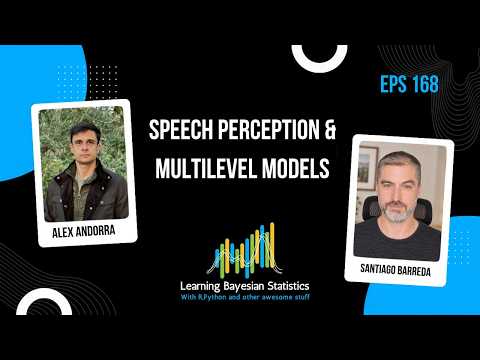 Watch on YouTube →
Overview
Santiago Barreda explains how listeners use the same acoustic signals to identify speech sounds and infer speaker characteristics, with vowel normalization understood as contextual perception akin to judging an object's size at different distances. He also argues that linguists should teach Bayesian multilevel models for repeated-measures data directly, using tools such as brms, and describes research on predictable perceptual errors, animal size signaling, language change, and improved speech analysis.
Key takeaways
- Speech perception and speaker perception draw on the same acoustic evidence, so listeners can make predictable social judgments even when those judgments are often inaccurate.
- Vowel normalization can be understood as perceptual constancy: listeners interpret vocal-tract-related changes in acoustic scale as speaker differences while preserving the perceived vowel category.
- For linguistics research with hundreds of trials per listener, Bayesian multilevel models are a practical starting point because they directly represent repeated measures and listener variation.
- Learning statistics is a practice-based skill like playing piano or learning a language; Barreda's teaching approach builds complexity gradually using one dataset rather than expecting instant understanding.
- Voice-based individual identification can be unreliable for high-stakes forensic use, even though acoustic patterns may systematically shape broader judgments about speakers.
- Speech research can improve by combining Bayesian modeling with tools such as brms and FastTrack, which supports flexible statistical analysis and more careful acoustic measurements.
Chapters
- Alex Andorra introduces Santiago Barreda, a UC Davis linguistics professor specializing in phonetics and speech perception.
- The discussion previews Barreda's book with Noah Silbert, Bayesian Multilevel Models for Repeated Measures Data.
- Topics include vowel normalization, listener judgments, language change, and the evolution of speech.
- Barreda's interest in linguistics began with Latin, where word endings can mark grammatical roles despite flexible word order.
- He studies how listeners map speech acoustics to linguistic categories, especially when hearing vowels across languages.
- His graduate work with Terry Nearey at the University of Alberta focused on speaker or talker normalization.
- Barreda's research asks whether acoustic differences between speakers correspond to differences listeners perceive as phonetic.
- Perceptual experiments collect listener judgments after researchers manipulate speech stimuli using acoustics and signal processing.
- He argues that comparing speakers' vowels is essential to speech research, yet the field lacks a settled method for doing it.
- Barreda initially used t-tests, ANOVAs, and lme4 mixed-effects models, but encountered convergence problems with complex repeated-measures designs.
- Around 2015, Noah Silbert introduced him to Bayesian modeling as a practical way to fit models that worked for his data.
- Barreda values Bayesian models for flexible error distributions and the ability to build a model around the research question rather than select only from standard options.
- Linguistics experiments commonly collect hundreds of trials from each listener and data from multiple speakers, making repeated measures the norm.
- Barreda and Silbert's book teaches multilevel models early instead of spending a long sequence on tests students may not use.
- Chapters walk through research questions, model structure, interpretation, plots, and reporting using a shared dataset that grows in complexity.
- The book compares Bayesian results with analogous frequentist analyses to help readers check whether results are broadly consistent.
- Barreda rejects the idea that not understanding a math chapter on the first reading means someone is bad at math.
- He compares learning statistics to piano practice and language immersion, which require repetition rather than instant mastery.
- The book uses an academic-paper structure and revisits one dataset through progressively more complex analyses.
- In Barreda's UC Davis graduate class, students learn more in ten weeks by starting with Bayesian multilevel models than by beginning with a sequence of simpler tests.
- Listeners use voice to infer characteristics such as age, gender, dialect, first language, and where someone has lived.
- The same acoustic signal supports both linguistic judgments about what was said and social judgments about who said it.
- Barreda studies how these judgments interact rather than treating speech recognition and speaker perception as independent processes.
- Listeners may identify a speaker's sexual orientation no better than chance, yet different listeners often make similar errors about the same voice.
- Barreda distinguishes accurate classification from predictable classification: acoustics can predict which voices are likely to be misidentified.
- Stereotypes such as the belief that New Yorkers are rude can shape judgments consistently, regardless of whether the stereotype describes reality.
- Barreda is skeptical of using voice to identify individuals with the certainty required for criminal proceedings, given impressionists and within-speaker acoustic variation.
- He distinguishes recognizing words from perceiving continuous traits such as accent, vowel quality, age, and timbre.
- For future human-computer interaction, he asks whether speech systems should model human-like social perception, including its biases, or aim to outperform it.
- Barreda compares vowel normalization to visual size constancy: a car's image shrinks with distance, but the brain infers that the car is farther away rather than smaller.
- In speech, listeners interpret changes in a vowel's acoustic scale as differences in speaker size while recognizing the vowel's underlying shape.
- The visual Ponzo illusion illustrates how context can alter perceived size even when the objects themselves remain the same size.
- A speaker's vocal tract acts like a tube: changing its length shifts the sound's spectral envelope and affects perceived size.
- A short vocal tract tends to sound small, while a long one can sound larger; vocal tract length also correlates with body size.
- Research on animals including red deer, koalas, dogs, and crocodilians links spectral properties of calls with receivers' responses to apparent size.
- In a red deer experiment, females approached speakers playing calls scaled to sound like larger deer.
- Animal size signals can be used to appear more threatening, and researchers such as David Reby study signaling, deception, and the detection of cheaters.
- One proposed account suggests speech sound distinctions may have developed partly through producing and detecting misleading size signals, though Barreda presents this as a hypothesis.
- Language change is an active research area, but predicting future shifts is difficult; Barreda likens language to a chaotic system such as weather.
- Researchers can quantify vowel shifts across dialects and generations, even when they cannot reliably predict whether a change will continue.
- Barreda notes that Latin did not simply vanish: it developed into languages such as Spanish, French, and Italian.
- Deciding when a changing variety becomes a distinct language is difficult because linguistic categories have no simple boundaries.
- Questions about California English depend on who counts as a local speaker and how ethnicity, socioeconomic status, and gender shape variation.
- African American English both influences and develops alongside varieties often called mainstream American English.
- Barreda is developing the probabilistic sliding template model, proposed by Terry Nearey and Peter Assmann in 2007.
- A reintroduction with Florian Jaeger presents the model as a Bayesian approach to jointly infer speech content, continuous phonetic detail, and speaker characteristics.
- Barreda is studying wave acoustics, including impedance matching and reflections, to make explanations of vowel acoustics more intuitive.
- He is building a Python GUI version of FastTrack, which helps find suitable formant-analysis parameters instead of relying blindly on defaults.
- Barreda says the R package brms made his book practical by translating familiar lme4-style syntax into Bayesian models.
- He argues that concerns about priors are often manageable in linguistics and can be checked directly against the results.
- Bayesian multilevel models can represent listener variation and handle outliers, heteroscedasticity, ordinal outcomes, and multinomial outcomes.
- Barreda encourages speech researchers to try Bayesian methods; the host also points to a PyMC workshop and resources using Stan and brms.
- With more resources, Barreda would collect speech from many speakers and ask listeners to judge vowels and speaker characteristics across many stimuli.
- The goal is to model continuous phonetic judgments, such as distinctions between shades of red that share the same category label.
- He wants the dataset to be large enough to test perceptual models and publicly available for other researchers to use.
- Barreda chooses Socrates as a dinner guest for his method of questioning, use of counterarguments, and pursuit of knowledge.
- He would ask how much of the Socrates known through Plato reflects Socrates' actual words.
- He would also seek Socrates' perspective on modern society and scientific discoveries such as atoms and magnetism.
- Alex Andorra closes the episode by directing listeners to learnbayesstats.com and the show's Patreon.
- The closing credits identify the theme music as Good Bayesian by Baba Brinkman, featuring MC Lars and Mega Ran.
- The episode ends by returning to the show's theme of updating predictions when new information arrives.
Transcript excerpt
0:02 Sure you had to be a good Bayesian. Hello my dear Bayesians. Today we're talking about voices, vowels, and everything your brain infers every time someone opens their mouth. My guest is Santiago Barreda, professor of linguistics at UC Davis, phonetician, and co-author with Noah Silbert of Bayesian Multilevel Models for Repeated Measures Data. A book written to get linguists doing Bayesian stats on the data they actually collect. We start with how Santiago came to Bayes, and why he thinks students should jump straight to multi-level models instead of spending a year t-tests. We also talk about math anxiety and why learning statistics is more like learning the piano than memorizing facts. Then we dive into his research, why listeners are often wrong about who's speaking, but wrong in predictable ways, and how vowel normalization works a lot, like seeing that a car
1:01 is far away rather than tiny. Along the way, we cover red deer, koalas, how languages change, and David Reby's idea that speech may have evolved from catching cheaters. A big thank you to Kristin Predeck for connecting us. This is Learning Bayesian Statistics, episode 168, recorded September thirtieth, 2026. Show you how to be a good Bayesian and change your predictions after taking information. And if you're thinking I'll be less than amazing, let's adjust those expectations. What's a Bayesian? It's someone who cares about. Welcome to Learning Bayesian Statistics, a podcast about Bayesian inference, the methods, the projects, and the people who make it possible. I'm your host, Alex Andorra.
1:51 You can follow me on Twitter at Alex underscore andorra, like the country, for any info about the show. learnbayesstats.com is Laplace to be. Show notes, becoming a corporate sponsor, unlocking Bayesian merch, supporting the show on Patreon, everything is in there. That's learnbayesstats.com.
This is the start of the transcript. Save this video free for the whole transcript, searchable and time-coded.
Related notes
Summary, takeaways, and chapters were generated by AI from the video's transcript and may contain errors. The video belongs to its creator, Learning Bayesian Statistics.