112026 L1 Chemistry 221 Video Lecture
Overview
Michael Russell explains how to write net ionic equations by separating aqueous ionic compounds, canceling spectator ions, and using solubility rules to predict precipitates and double-displacement products. He applies the method to precipitation and acid-base reactions, then introduces water’s polarity, five strong acids, and the distinction between strong and weak acids and bases.
Key takeaways
- To derive a net ionic equation, dissociate aqueous ionic compounds, keep solids, liquids, and gases intact, and cancel identical aqueous ions on both sides.
- Solubility rules predict precipitates: Pb2+ and I- form yellow PbI2(s), while K+ and NO3- remain dissolved as spectator ions.
- Double-displacement reactions exchange ion partners while preserving their charges; ion ratios in each product follow from charge balance.
- Water’s partial charges orient around cations and anions, creating ion-dipole attractions that help separate ions from an ionic crystal.
- Strong acid-base neutralization has the net ionic form H+ + OH- -> H2O; leftover acid or base can still make the mixture hazardous.
- The lecture identifies HCl, HBr, HI, HNO3, and HClO4 as strong acids, and NaOH, KOH, and LiOH as strong bases, contrasting their extensive dissociation with partial ionization by weak examples such as HF and NH3.
Chapters
- A balanced chemical equation accounts for every atom under the law of conservation of mass.
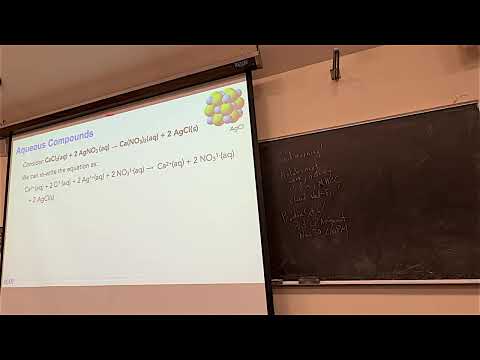
- The example CaCl2 + 2AgNO3 produces Ca(NO3)2 and 2AgCl, with aqueous reactants forming a solid precipitate.
- Michael Russell reviews the Thanksgiving-week schedule, including the November 30 net ionics lab and Problem Set 6.
- Water’s polarity separates soluble ionic compounds such as CaCl2 into Ca2+ and 2Cl- in aqueous solution.
- For complete ionic equations, split aqueous compounds into ions but leave solids, liquids, and gases intact.
- Cancel unchanged Ca2+ and NO3- spectator ions to obtain Ag+ + Cl- -> AgCl(s).
- The net ionic equation identifies the reaction’s essential chemistry and shows how a different soluble chloride source could replace CaCl2.
- Magnesium reacts with hydrochloric acid to produce aqueous MgCl2 and hydrogen gas: Mg + 2HCl -> MgCl2 + H2.
- After dissociation, the two Cl- ions appear unchanged on both sides and cancel as spectators.
- The net ionic equation is Mg(s) + 2H+(aq) -> Mg2+(aq) + H2(g), so another acid can supply the H+ ions.
- Mixing aqueous lead(II) nitrate and potassium chromate forms insoluble, intensely yellow PbCrO4(s).
- K+ and NO3- remain in aqueous compounds on both sides, so they are spectator ions.
- Aqueous ions that remain unchanged can often be spotted by tracking their compounds, while ions incorporated into a solid cannot be spectators.
- Changing the soluble source of an ion, such as using sodium chromate instead of potassium chromate, can preserve the same net ionic reaction.
- Group 1 ions, NH4+, and NO3- are treated as soluble, while many hydroxides, carbonates, chromates, and phosphates are insoluble unless an exception applies.
- Cl-, Br-, and I- are generally soluble, with common exceptions involving Ag+, Hg2^2+, and Pb2+.
- Most sulfates are soluble, but BaSO4 is a notable insoluble exception; Ba(NO3)2 and BaCl2 are treated as soluble.
- The course solubility guide is intended as a quick way to assign aqueous or solid states when predicting reactions.
- The solubility examples identify PbI2 as insoluble because Pb2+ is an exception to the usual solubility of iodides.
- NaOH dissolves because sodium salts are soluble, despite hydroxides generally being insoluble; potassium carbonate and lithium chloride are also treated as soluble.
- Water’s partial negative oxygen end surrounds cations, while its partial positive hydrogen ends orient toward anions.
- These ion-dipole attractions help pull ionic crystals such as KMnO4 apart into dissolved ions.
- Aqueous Pb(NO3)2 and KI exchange ions to form PbI2 and KNO3.
- Balancing the charges gives Pb(NO3)2 + 2KI -> PbI2 + 2KNO3.
- PbI2 is an insoluble yellow precipitate, while KNO3 remains aqueous because both K+ and NO3- favor solubility.
- In double-displacement reactions, ions change partners without changing their charges.
- Combining an aqueous Fe3+ source with NaOH forms brown, insoluble Fe(OH)3.
- Three hydroxides are needed per Fe3+, giving Fe(NO3)3 + 3NaOH -> Fe(OH)3(s) + 3NaNO3.
- Na+ and NO3- are spectators; the net ionic equation is Fe3+(aq) + 3OH-(aq) -> Fe(OH)3(s).
- Solubility rules let chemists predict whether a solid forms before mixing the solutions.
- In the HCl and NaOH reaction, H+ and OH- form water, while Na+ and Cl- form aqueous NaCl.
- For strong acid and strong base solutions, the net ionic equation is H+(aq) + OH-(aq) -> H2O(l).
- The other product is called a salt in chemistry; it can be something other than table salt, NaCl.
- Neutralization does not make a mixture safe if excess acid or base remains, so acids and bases should never be ingested.
- The five strong acids highlighted are HCl, HBr, HI, HNO3, and HClO4; they ionize essentially completely in water.
- Weak acids such as HF and acetic acid, CH3CO2H, ionize only partially, producing fewer H+ ions at a time.
- NaOH, KOH, and LiOH are presented as strong bases that dissociate to provide OH-; ammonia, NH3, is a weak base that reacts with water to form NH4+ and OH-.
- Strong acids and bases require careful lab handling: goggles are essential, and contact with bases calls for prompt rinsing.
Transcript excerpt
0:01 Good morning. I hope your Friday has been going well and I hope you have a wonderful weekend. Uh just as a reminder, next week is Thanksgiving week. So the only thing that's happening uh Monday morning at 9:00 I'll have a lecture in here, but there are no labs. Uh nothing else will happen. Nothing is due. So definitely take some time to kind of catch your breath after the excitement that's happened these last couple weeks. And uh I hope you have a great uh holiday. Uh, Monday, November the 30th will be the beginning of the last week of classes at Mount Hood. And on that day at 1:10 p.m., we'll meet we'll go uh you'll turn in problems set six. Uh we'll do quiz 6 uh seminar selfquiz 6. You'll turn in the postclass presentations assignment that you
0:50 started uh this week during the class presentations and we'll do the net ionics lab. But honestly, next week, just kind of take some time for yourself, kind of get it together. Almost through with the term. Questions on any of that kind of stuff? >> Yeah. So, no lecture the 30th, just meeting at 1:10. >> We will absolutely have a lecture on the 30th. That's the beginning of like a regular week. Okay. Yeah. Next Monday, we'll have a lecture at 9:00 and then the next time I'll see you will be the 30th. Will we have the normal kind of schedule and stuff? Yeah, that's a good question. Other questions? On Wednesday, we talked about balancing chemical reactions like this one right
1:38 here. And in this reaction, this is literally like a type of a recipe for a scientist. And it says that calcium chloride, which is a solution, things that are in aquous mean dissolved in
This is the start of the transcript. Save this video free for the whole transcript, searchable and time-coded.
In this course
Related notes
Summary, takeaways, and chapters were generated by AI from the video's transcript and may contain errors. The video belongs to its creator, Michael Russell.