111326 L1 Chemistry 221 Video Lecture
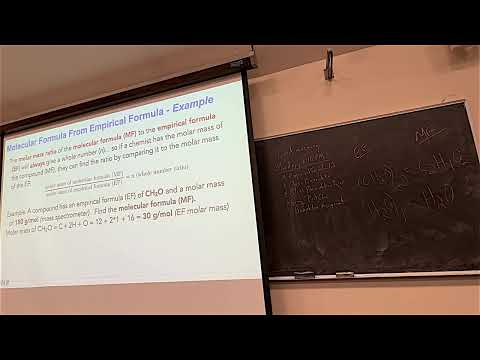
Overview
Michael Russell explains how to move from empirical formulas to molecular formulas using molar mass, then demonstrates how combustion analysis determines an organic compound’s carbon-to-hydrogen ratio. He also introduces heterogeneous and homogeneous mixtures, solution terminology, molarity in moles per liter, and a worked preparation calculation for 0.0841 M nickel(II) chloride hexahydrate.
Key takeaways
- A molecular formula is an integer multiple of its empirical formula: divide the compound’s measured molar mass by the empirical formula’s molar mass, then multiply every empirical subscript by the resulting whole number.
- Combustion analysis recovers a hydrocarbon’s elemental ratio from product masses: moles of CO2 equal moles of carbon, while moles of H2O must be multiplied by 2 to obtain moles of hydrogen.
- Compounds can share an empirical formula and elemental mass percentages while having different molecular formulas and properties, as NO2 and N2O4 demonstrate.
- A mixture is heterogeneous when its components are visibly distinguishable and homogeneous when it appears uniform; solutions are homogeneous mixtures of solute and solvent.
- Molarity is moles of solute per liter of final solution, so a measured volume in milliliters must be converted to liters before using the formula.
- The 5.00 g NiCl2·6H2O preparation in a 250. mL volumetric flask yields approximately 0.0841 M solution when the hydrate’s full formula mass is included.
Chapters
- Monday’s class is reserved for presentations and turning in the empirical formula lab and presentation paper.
- There will be no quiz 6, problem set 6 review, or lab next week.
- Students can choose a presentation order by signing up in room 251 or wait to be called.
- An empirical formula gives the smallest whole-number atom ratio, while a molecular formula gives the actual atom counts in a molecule.
- Acetic acid has molecular formula C2H4O2 but empirical formula CH2O; benzene is C6H6 with empirical formula CH.
- Divide a compound’s molar mass by the empirical-formula molar mass to find the whole-number multiplier.
- For glucose, 180 g/mol divided by 30 g/mol for CH2O gives a multiplier of 6, producing C6H12O6; glyceraldehyde at about 90 g/mol gives C3H6O3.
- Combustion analysis burns an organic compound containing carbon and hydrogen in O2, producing CO2 and H2O.
- Absorbent chambers collect the products: magnesium perchlorate can capture water, while a sodium hydroxide source can capture CO2.
- The mass increase in each chamber measures the amount of product formed, which can be traced back to the sample’s carbon and hydrogen.
- Each mole of CO2 corresponds to one mole of carbon, while each mole of H2O corresponds to two moles of hydrogen.
- A sample yields 0.253 g CO2 and 1.035 g H2O; convert each product mass to moles using 44.01 g/mol for CO2 and 18.02 g/mol for water.
- The CO2 amount gives about 5.75 × 10^-3 mol carbon; the water amount, multiplied by 2, gives about 1.149 × 10^-2 mol hydrogen.
- Dividing both mole amounts by the smaller gives a 1:2 carbon-to-hydrogen ratio and empirical formula CH2.
- An independently measured molar mass of about 84.16 g/mol divided by CH2’s roughly 14 g/mol gives a multiplier of 6 and molecular formula C6H12.
- NO2 and N2O4 share the empirical formula NO2 and the same elemental mass percentages, but they are distinct compounds.
- Russell contrasts brown, reactive, paramagnetic NO2 with colorless, less reactive, diamagnetic N2O4.
- For a boron-hydrogen compound with 81.10% boron and molar mass 53.3 g/mol, assume a 100 g sample to convert percentages into masses and then moles.
- The resulting empirical formula is multiplied by 2 using the molar-mass ratio, giving molecular formula B4H10.
- Heterogeneous mixtures have visibly distinct components, as in pizza, chocolate-chip cookies, or rocks in water.
- Visible components can often be separated directly, such as removing rocks from water or evaporating the water.
- Homogeneous mixtures appear to have one phase even though they contain multiple substances, as with salt water or sugar water.
- Visual appearance alone cannot establish what a homogeneous mixture contains, so lab materials should never be tasted or drunk.
- A solution is a homogeneous mixture with uniform composition and consists of a solute dissolved in a solvent.
- In salt water, water is the solvent and sodium chloride is the solute; the solute is often the component named in descriptions such as “salt solution.”
- The solvent is usually the more abundant component and determines the solution’s physical phase; water is common, though organic chemistry uses other solvents.
- The notation (aq) means a substance is dissolved in water, so NaCl(aq) differs from solid NaCl.
- Molarity, symbolized by capital M, equals moles of solute divided by liters of solution.
- A 3.6 M solution contains 3.6 moles of solute per liter; a larger molarity indicates more solute per unit volume.
- Convert measured milliliters to liters using 1,000 mL per L before calculating molarity.
- Chemists often use “concentration” to mean molarity, although other concentration units also exist.
- To prepare a solution accurately, weigh the solute, dissolve it in part of the water, and then bring the solution to the volumetric flask’s final volume.
- For 5.00 g of NiCl2·6H2O, include one nickel, two chlorines, and six waters in the molar-mass calculation, giving about 237.71 g/mol.
- The 5.00 g sample is about 0.0210 mol; a final volume of 250. mL is 0.250 L.
- Dividing 0.0210 mol by 0.250 L gives a concentration of 0.0841 M NiCl2·6H2O.
Transcript excerpt
0:01 Good morning. I hope your day is going well. Happy Friday. Uh Monday, exciting day. Monday is class presentations day. So we will not be looking at problem set six, taking quiz 6, etc., etc. So Monday afternoon when you come in, uh get ready to turn in the empirical formula lab that we did on Monday. You will give your class presentation. You'll turn in your class presentation paper. Um that's the only thing we're going to do. We won't have a lab afterwards or anything like that. I recommend that you bring the postcl class presentation assignment. I think that's what I called it. It's at the very end of the class presentation packet I gave you on the first day. I'll send a link with it uh as well to so you can kind of see what it is. But this will be due the week
0:49 after Thanksgiving and you need to have the order of the presentations. So, if you write that down at the same time, it'll just make your life easy kind of thing. Should be pretty chill. >> Questions on any of that kind of stuff? Yeah. >> Is there a lab next week? >> No lab next week? >> No. No labs? No problems. That's Yeah. Question. >> So, would this would the like class period that's at starts at 1:10 and ends at 3, would that just be the time we have or are we going till 5? Cool. We have up until 5. That's a good question. Yeah. And uh I doubt if we'll go until 5, but we do have that long. That's right. So, yeah. So, that's the only thing we'll do when everybody gives their presentations, then we're good to
1:36 go. So, cool. Um on the board in 251 on the right hand
This is the start of the transcript. Save this video free for the whole transcript, searchable and time-coded.
In this course
Related notes
Summary, takeaways, and chapters were generated by AI from the video's transcript and may contain errors. The video belongs to its creator, Michael Russell.