110426 Lecture Video
 Watch on YouTube →
Overview
Tim Johann surveys lipid classes beyond triacylglycerols, explaining how waxes serve in water repellency, structure, buoyancy, and energy storage, while sterols include membrane cholesterol, long-range steroid hormones, and digestive bile salts. The lecture connects bile-salt emulsification to increased enzyme-accessible surface area, then explains local eicosanoid signaling and how NSAIDs such as ibuprofen inhibit COX enzymes, before introducing vitamin D’s role in bone growth and rickets prevention.
Key takeaways
- Waxes are long-chain esters with several organism-specific roles: beeswax provides structure, surface waxes repel water, and some marine organisms use waxes for buoyancy or energy storage.
- Cholesterol moderates membrane fluidity, while steroid hormones use the sterol framework for long-range signaling and bile salts help emulsify fats in the small intestine.
- Bile salts disperse fat into smaller droplets, increasing enzyme-accessible surface area; the lecture’s 100-nanometer cube example shows area rising from 60,000 to 6,000,000 square nanometers when divided into one-nanometer cubes.
- Prostaglandins are eicosanoids derived from membrane arachidonic acid and participate in localized pain, inflammation, stomach-lining maintenance, and labor signaling.
- Ibuprofen inhibits both COX-1 and COX-2, reducing pain and inflammation but potentially impairing stomach protection; prolonged NSAID use also carries cardiovascular risks.
- Vitamin D supports bone development, and deficiency can cause rickets; UV exposure contributes to skin production of vitamin D, while supplementation can treat deficiency.
Chapters
- Waxes are long-chain esters, distinct from cholesterol, which is a sterol rather than a wax.
- Examples include water-repellent coatings on leaves and duck feathers, structural beeswax, and waxes used by some whales, fish, and plankton for buoyancy.
- Some zooplankton use waxes for energy storage as well as buoyancy; most naturally occurring fatty-acid chains are even-numbered.
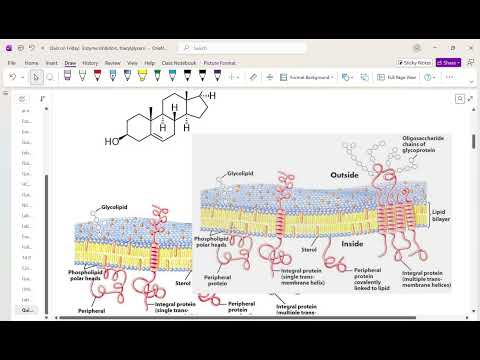
- Sterols are hydrophobic molecules recognizable by their characteristic four-ring system.
- Cholesterol is a membrane component that moderates fluidity: it can make overly fluid membranes more rigid and overly rigid membranes less rigid.
- The lecture groups sterol functions into membrane structure, long-range signaling by steroid hormones, and digestion aided by bile salts.
- Steroid hormones circulate through the blood and produce body-wide, long-range responses rather than localized effects.
- Testosterone contributes to male secondary sex characteristics, while estradiol contributes to female secondary sex characteristics and menstrual-cycle signaling.
- Cortisol coordinates stress responses, including immune suppression and increased glucose release.
- Aldosterone regulates blood volume and can thereby influence blood pressure through effects on fluid retention and excretion.
- Prednisone is described as a synthetic prodrug converted by the liver to prednisolone, an active steroid that suppresses immune activity.
- The lecture gives lupus, rheumatoid arthritis, and severe poison-ivy reactions as examples where steroid treatment may be used.
- Bile salts aid digestion by surrounding fat droplets with hydrophobic regions facing the lipid and polar regions interacting with water.
- The gallbladder delivers bile into the small intestine, where the higher pH allows bile-salt carboxyl groups to become charged.
- Emulsification helps disperse and suspend fat droplets, making them easier for digestive processes to work on.
- Breaking a 100-nanometer cube into one-nanometer cubes preserves its volume but increases total surface area from 60,000 to 6,000,000 square nanometers.
- The thousandfold area increase in the example illustrates why dispersed fat offers more surface for enzymes to act on.
- Surface-area-to-volume ratio is a recurring principle in biology and helps explain the digestive advantage of emulsification.
- Dexamethasone is presented as a synthetic steroid, with its fluorine atom highlighted as a clue that it is not a typical naturally occurring biological molecule.
- The lecture says dexamethasone improved survival by about 36% among ventilated COVID-19 patients in the cited treatment context.
- Its immune-suppressing effect can limit harmful overreactions such as cytokine storms.
- Eicosanoids are short-range signaling molecules made from arachidonic acid, a membrane-lipid fatty-acid tail.
- Different enzymes and pathways can convert arachidonic acid into prostaglandins, thromboxanes, or leukotrienes.
- Prostaglandins contribute to pain and inflammation, help maintain the stomach lining, and can participate in labor.
- NSAID means nonsteroidal anti-inflammatory drug; aspirin and ibuprofen are examples discussed for treating pain, fever, and inflammation.
- Cyclooxygenase enzymes, abbreviated COX, help produce prostaglandins; COX-2 is associated with pain and inflammation, while COX-1 helps maintain the stomach lining.
- Ibuprofen inhibits both COX-1 and COX-2, which can reduce inflammation but also contribute to stomach irritation and ulcers with prolonged use.
- COX-2-selective inhibitors were developed to reduce pain and inflammation while avoiding some COX-1-related stomach effects.
- The lecture notes that an early COX-2 inhibitor was withdrawn after evidence of increased heart-attack and stroke risk, and cites an approximately 30% increase in those risks with long-term ibuprofen use.
- Ibuprofen may inhibit bone growth, so the lecturer advises discussing pain treatment after a fracture with a physician.
- Vitamin D is lipid-soluble and supports normal bone growth; UV light helps the body produce it in the skin.
- Insufficient vitamin D can cause rickets, a disorder of abnormal bone development, and the lecture notes that supplementation can treat the deficiency.
- Cod-liver oil was historically used as a vitamin D source, particularly during winters when people had less sun exposure.
Transcript excerpt
0:03 All right, so we've been talking about lipids. Um >> [clears throat] >> we had done triacylglycerols. The next category I want to cover is I want to talk about waxes. Okay, waxes as we said before are long-chain fatty acids or sorry, long-chain esters. Okay, so what we're looking at below us is cholesterol. That is not a wax. Um so the long-chain esters, so when we talk about long-chain esters, um we're looking at things that, you know, have the structure of something like this. So I'm going to go ahead and make an ester. Right? And then esters have they have an R group, some sort of chain on each side. And so these chains are
0:52 long. Okay, that'd be an example of a wax. Yes. >> You said the thing yesterday that they like even numbers. Same thing here? >> I'm not sure. I think so. >> [snorts] >> Is there a reason that they were even numbers or that you were like specifically making sure they were even? >> So so essentially um most of your your most of your metabolic systems for breaking down fats, right? Um and you can you can break these down, okay? But that doesn't mean that the the uh organisms in nature that use these actually care whether you can break these down or not, right? But your body is good with um with even chained fats. And most of nature actually makes in terms of fatty acids even chains. And
1:41 it's rare you end up with odd chains. So I don't know if that helps at all. It just that's the way it is. >> So if we were to draw one and it wasn't even >> I'm probably not counting it. I'm not I'm not going to care. But I'm
This is the start of the transcript. Save this video free for the whole transcript, searchable and time-coded.
In this course
Related notes
Summary, takeaways, and chapters were generated by AI from the video's transcript and may contain errors. The video belongs to its creator, Tim Johann.