102926 L2 Chemistry 221 Video Lecture Part III
 Watch on YouTube →
Overview
Michael Russell explains how molecular orbital (MO) diagrams for second-row diatomic molecules use different 2p energy orderings: the NBC sequence for boron, carbon, and nitrogen, and the FONE sequence when oxygen, fluorine, or neon is present. He applies the diagrams to predict bond order and magnetism in B2, O2, and N2, then shows how HOMO/LUMO electron changes, shorthand notation, and separate sigma and pi counts simplify molecular analysis.
Key takeaways
- Three 2p orbitals on each atom combine into six molecular orbitals: two sigma orbitals and four pi orbitals, each with bonding and antibonding forms.
- Use the NBC 2-1-2-1 ordering for B2, C2, and N2; use the FONE 1-2-2-1 ordering when a molecule contains O, F, or Ne.
- MO diagrams explain the paramagnetism of B2 and O2 by showing their unpaired electrons, a property their basic Lewis structures fail to predict.
- Bond order is one half the difference between bonding and antibonding electron counts; this gives N2 a bond order of 3, N2+ 2.5, O2 2, and O2− 1.5.
- Removing an electron to make a cation starts at the HOMO, while adding an electron to make an anion starts at the LUMO.
- Separate sigma and pi bond calculations should sum to the total bond order; for N2, one sigma plus two pi bonds equals 3.
Chapters
- Combining three 2p atomic orbitals from each atom produces six molecular orbitals: one bonding and one antibonding sigma, plus two bonding and two antibonding pi orbitals.
- For B2, C2, and N2, the NBC ordering places the bonding pi orbitals below bonding sigma, summarized as 2-1-2-1.
- The NBC ordering applies to pairs such as N2 and to mixed combinations such as CN− when both atoms are boron, carbon, or nitrogen.
- Each boron atom has electron configuration 1s² 2s² 2p¹; the 1s and 2s bonding and antibonding electrons cancel in bond-order calculations.
- The two 2p electrons occupy separate degenerate bonding pi orbitals under Hund's rule, making B2 paramagnetic.
- B2 demonstrates a limitation of its Lewis structure, which suggests diamagnetism, while the MO diagram predicts the observed unpaired electrons.
- Core electrons can be abbreviated as “core” because equal populations in bonding and antibonding orbitals contribute zero net bond order.
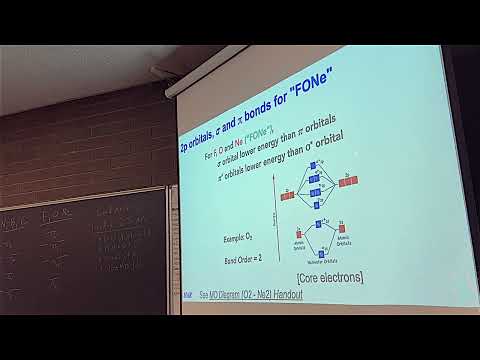
- When oxygen, fluorine, or neon is present, use the FONE ordering, summarized as 1-2-2-1: bonding sigma lies below the two bonding pi orbitals.
- For mixed second-row molecules containing O, F, or Ne, Russell recommends the FONE ordering, including examples such as C–O and N–O.
- Each O atom has 1s² 2s² 2p⁴; filling O2 orbitals from lowest to highest leaves two unpaired electrons in antibonding pi orbitals.
- The O2 MO diagram predicts paramagnetism, unlike the conventional Lewis structure, and gives an O2 bond order of 2.
- Nitrogen contributes three 2p electrons per atom; the NBC diagram fills the bonding pi and sigma orbitals, giving N2 a bond order of 3 and no unpaired electrons.
- N2 is diamagnetic, consistent with its Lewis structure, while its MO filling makes the electron arrangement explicit.
- Removing one electron from N2 takes it from the highest occupied sigma 2p orbital, leaving N2+ paramagnetic.
- The N2+ bond order falls from 3 to 2.5 after that electron is removed.
- To form a positive molecular ion, remove an electron from the highest occupied molecular orbital, or HOMO.
- Removing one electron from an O2 antibonding pi orbital gives O2+, which remains paramagnetic and has bond order 2.5.
- To form a negative molecular ion, add an electron to the lowest unoccupied molecular orbital, or LUMO.
- Adding one electron to O2 gives O2−; it remains paramagnetic and has bond order 1.5.
- MO shorthand lists orbitals in increasing energy, with electron counts as superscripts, for example (π2p)⁴ and (σ2p)².
- For N2+, removing one electron from the σ2p HOMO changes the bond-order calculation to ½(7 bonding − 2 antibonding) = 2.5.
- Calculate sigma and pi bond contributions separately using ½(bonding electrons − antibonding electrons) for each orbital type.
- For N2, the diagram gives one sigma bond and two pi bonds; their total, 3, matches the overall bond order.
- Across B2 through N2, bond order increases and bond length decreases; O2 has two unpaired electrons, while F2 is diamagnetic and Ne2 has bond order zero.
- For NO+, use the FONE ordering because oxygen is present; the positive charge means one electron is removed from the neutral atom total.
- In rhodopsin, light promotes a pi-bonding electron to a pi-antibonding orbital, reducing a double bond to single-bond character so it can rotate.
- The resulting cis-trans shape change in rhodopsin initiates a nerve impulse associated with visual perception.
Transcript excerpt
0:00 We're continuing our discussion of the models used to describe why molecules are as they are. [clears throat] Uh, valence bond is great, works for almost everything, but not as cool as molecular orbital theory, which is what we're looking at now. We went through how to do the molecular orbital diagram for hydrogen, dihydrogen, dihelium, dilithium, diberyllium. Kind of got a tease there as to how you can mix different atoms together, but we're all we are going to go all the way up through neon. [clears throat] All right? And like we talked about in the last section, the number of atomic orbitals you have equals the number of molecular orbitals. So the 2p orbital set we saw was three orbitals. So you're going to have 2p6. Three lines means three orbitals.
0:50 So if you [clears throat] start mixing the 2p orbitals, which are in nitrogen, boron, carbon, fluorine, oxygen, neon, the three 2p's on one mix with three 2p's on the other, you end up making six molecular orbitals. All right? [clears throat] Now of those six molecular orbitals, you're going to have two of them be sigma. You'll have a bonding lower energy sigma and a higher antibonding sigma. And you're also going to create then four pi molecular orbitals. Two bonding pi's and two antibonding pi's. So earlier when I had the make the sandwich thing with me, the sigma bond was in the middle and there was two possible pi sets above and below and left and right. Well, in molecular
1:38 orbital world, you're always going to have a bonding version and an antibonding. So it's not just one sigma in the middle, it would be one bonding and one antibonding sigma. And instead of two pi bonds, you'll have two pi's that are bonding and two that are
This is the start of the transcript. Save this video free for the whole transcript, searchable and time-coded.
Related notes
Summary, takeaways, and chapters were generated by AI from the video's transcript and may contain errors. The video belongs to its creator, Michael Russell.