103026 L1 Chemistry 221 Video Lecture
 Watch on YouTube →
Overview
The lecture explains how molecular orbital theory predicts whether diatomic molecules exist, their bond order, and their magnetic behavior, then connects those predictions to Lewis structures. Examples include nonbonding He₂ and Be₂, stable Li₂ and N₂, paramagnetic O₂, fractional resonance bond orders, and the different 2p orbital orderings used for B, C, N versus O, F, Ne.
Key takeaways
- A molecular orbital bond order of 0 predicts no stable bond, as illustrated by He₂ and Be₂, while Li₂ has bond order 1 and is predicted to exist.
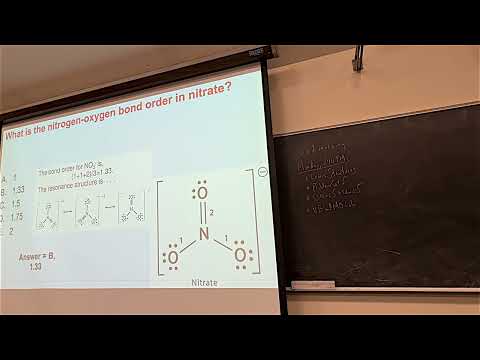
- Equivalent resonance structures produce fractional bond orders: carbonate and nitrate have C–O or N–O bond orders of 4/3, while ozone has O–O bond order 1.5.
- The 2p energy ordering differs across the second row: B₂, C₂, and N₂ use π2p below σ2p, while O₂, F₂, and Ne₂ use σ2p below π2p.
- O₂ has two unpaired electrons in π*2p orbitals and is paramagnetic; N₂ has all electrons paired and is diamagnetic.
- For molecular ions, remove electrons from the HOMO and add electrons to the LUMO; this gives N₂⁺ bond order 2.5 and leaves O₂⁺ and O₂⁻ paramagnetic.
- For N₂, molecular orbital counting gives one σ bond plus two π bonds, for total bond order 3, consistent with its Lewis triple bond.
Chapters
- Molecular orbital bond order is ½ × (bonding electrons − antibonding electrons); He₂ has two electrons in each, giving bond order 0 and no stable molecule.
- A positive bond order indicates a bond can exist, including fractional values such as ½.
- In Lewis structures, bond order is the number of connections between two atoms: single, double, and triple bonds have orders 1, 2, and 3.
- Higher bond order generally means shorter bonds; formaldehyde has a C=O bond order of 2 and C–H bond orders of 1.
- For resonance, average the total number of bonds across the equivalent positions in the resonance structures.
- Carbonate has four C–O bonds distributed across three equivalent resonance forms, so each C–O bond has order 4/3, or about 1.33.
- Ozone has three O–O bonds distributed across two resonance forms, giving each O–O bond order 3/2, or 1.5.
- Nitrate also has four N–O bonds distributed across three resonance forms, giving each N–O bond order 4/3.
- Molecular orbitals form effectively when the starting atomic orbitals have comparable energies, such as 1s with 1s or 2s with 2s.
- Orbitals with large energy differences, such as 1s and 2s or 2s and 2p, mix poorly.
- The greater orbital overlap among higher-energy orbitals makes molecular orbital diagrams more complicated beyond the lighter elements.
- For the orbital-overlap comparison, matching 3d orbitals provide better mixing than orbitals that differ substantially in energy.
- Each lithium atom has configuration 1s²2s¹, so Li₂ has six electrons to fill its molecular orbitals.
- The 1s bonding and antibonding electrons cancel; the two electrons left in the bonding σ2s orbital give Li₂ bond order 1.
- Each beryllium atom contributes 1s²2s², filling both bonding and antibonding 2s orbitals in Be₂.
- With equal bonding and antibonding electron counts, Be₂ has bond order 0 and is predicted not to exist as a stable molecule.
- Each atom contributes three 2p orbitals, which combine into six molecular orbitals: one bonding and one antibonding σ orbital, plus two bonding and two antibonding π orbitals.
- For B₂, C₂, and N₂, the bonding π2p orbitals lie below the bonding σ2p orbital, followed by π*2p and σ*2p.
- This ordering is nicknamed 2-1-2-1: two π orbitals, one σ, two π* orbitals, and one σ* orbital.
- B₂ has two electrons in separate bonding π orbitals under Hund’s rule, giving bond order 1 and two unpaired electrons.
- For O₂, F₂, and Ne₂, the bonding σ2p orbital lies below the two bonding π2p orbitals; the full sequence is summarized as 1-2-2-1.
- When a diatomic combines an O, F, or Ne atom with a B, C, or N atom, use the 1-2-2-1 ordering; CO is one example.
- O₂ has two unpaired electrons in separate π*2p orbitals, making it paramagnetic, unlike what its Lewis structure alone suggests.
- N₂ fills its orbitals with all electrons paired, so it is diamagnetic.
- To form a positive molecular ion, remove an electron from the highest occupied molecular orbital, or HOMO.
- N₂⁺ loses one electron from its σ2p HOMO, leaving one unpaired electron and a bond order of 2.5.
- To form a negative ion, add an electron to the lowest unoccupied molecular orbital, or LUMO.
- O₂⁺ and O₂⁻ each retain one unpaired electron and remain paramagnetic; the HOMO–LUMO energy gap also helps explain how molecules respond to light.
- After learning the full diagram, write occupied molecular orbitals in increasing energy, place each orbital in parentheses, and use a superscript for its electron count.
- Use [core] in place of the 1s interactions, and combine the two π2p orbitals in the notation rather than listing them separately.
- For N₂, the shorthand records four electrons in π2p and two in σ2p, along with the occupied 2s orbitals.
- N₂ has one net σ bond and two net π bonds; their sum gives bond order 3, matching its Lewis triple bond.
- Across the second-row diatomics, bond order rises from B₂ toward N₂ and then falls toward Ne₂; increasing bond order generally raises bond energy and shortens bond length.
- Molecular orbital theory predicts paramagnetism for both B₂ and O₂, properties that Lewis structures do not readily explain.
- For mixed species, CN⁻ uses the 2-1-2-1 ordering, while NO⁺ uses the O/F/Ne 1-2-2-1 ordering; the lecture calculates NO⁺ as bond order 3 and diamagnetic.
- In rhodopsin, light promotes a π electron into a π* orbital, temporarily weakens a double bond, and enables molecular rotation that initiates a visual signal.
Transcript excerpt
0:00 Good morning. Happy Friday. Happy Halloween if that's your jam. Monday 1:10 p.m. What we're going to do, Lewis structures lab will be due. You'll turn in problem set number five over chapter 5. You'll take uh seminar self quiz 5 and the actual quiz 5 after and then we'll go next door and do the veence bond and molecular orbital lab where we'll have more experience kind of checking that stuff out. Um questions, any of that jazz? We left off on Wednesday talking about bond order for molecular orbital theory. [snorts] And when you have a molecular orbital diagram like this one, which is for dihelium, all right, you have just as many electrons in the lower bonding orbitals as you have the anti-bonding orbitals. And chemists use this
0:48 definition of bond order to tell if the molecule will exist or not. So bond order in molecular orbital theory equals 1/2 * the bonding electrons minus anti-bonding electrons. So in this diagram there's two bonding electrons down here in the sigma 1s orbital. There are two anti-bonding electrons in the sigma star 1s orbital. So bond order for this one equals 1/2 parentheses 2 - 2 the bonding minus antib-bonding. And if your bond order equals zero, even sometimes it can be negative, but you won't see that in my class. Uh if it equals zero, that means it doesn't exist. So like we talked about on Wednesday, uh back in chapter 2, I told you about the seven diatomics. Have no fear of ice clear. Dihelium was not one
1:38 of them because no one to my knowledge has ever made dihelium. It's very happy by itself. It doesn't want to make a bond. If the bond order is even just a little bit greater than zero though,
This is the start of the transcript. Save this video free for the whole transcript, searchable and time-coded.
Related notes
Summary, takeaways, and chapters were generated by AI from the video's transcript and may contain errors. The video belongs to its creator, Michael Russell.