102926 L2 Chemistry 221 Video Lecture Part II
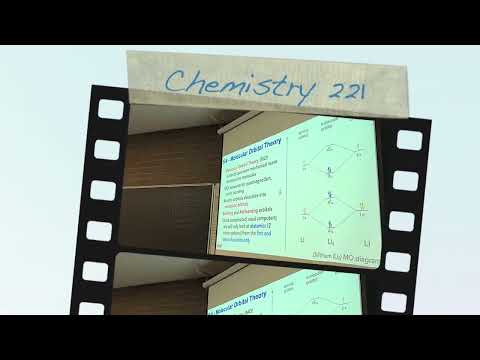 Watch on YouTube →
Overview
Michael Russell introduces molecular orbital (MO) theory for diatomic molecules in the first and second periods, explaining how atomic orbitals combine into lower-energy bonding and higher-energy antibonding orbitals. Examples including O₂, H₂, He₂, Li₂, Be₂, and LiBe show how MO diagrams account for magnetism and stability, while bond order connects MO predictions to Lewis structures and resonance.
Key takeaways
- MO theory explains O₂ paramagnetism by representing unpaired electrons in molecular orbitals, a property that the ordinary Lewis structure fails to show.
- Combining N atomic orbitals produces N molecular orbitals; each orbital can hold up to two electrons, and bonding orbitals lie lower in energy than their antibonding partners.
- Bond order equals one-half the difference between bonding and antibonding electron counts; H₂ has bond order 1, while He₂ and Be₂ have bond order 0 in the lecture's model.
- Lewis bond order is the number of bond lines, but resonance can produce fractional average values, such as 4/3 for carbonate and 1.5 for ozone.
- In Li₂, the 1s core electrons cancel because they fill both bonding and antibonding orbitals; the two 2s valence electrons create the net bond.
- Orbitals with similar energies and matching types mix most effectively, which is why the course treats 1s, 2s, and 2p combinations separately for first- and second-period diatomics.
Chapters
- MO theory combines atomic orbitals into molecular orbitals spread across the molecule; diagrams place the two atoms on the sides and the molecule in the center.
- The course focuses on diatomic molecules from hydrogen through neon, leaving out larger molecules such as CH₄ and third-period examples such as NaCl.
- The Lewis structure for O₂ pairs its 12 valence electrons, but liquid O₂ is attracted into a magnetic field, showing that the Lewis picture misses its unpaired electrons.
- MO theory can predict magnetism and bonding, and can also help explain molecular color, though color calculations are outside the course scope.
- The number of molecular orbitals equals the number of atomic orbitals combined: two H 1s orbitals produce two molecular orbitals.
- Each O atom has five orbitals, one 1s, one 2s, and three 2p, so O₂ has ten molecular orbitals in a full diagram.
- Constructive overlap creates a bonding orbital with increased electron density between nuclei; destructive overlap creates an antibonding orbital with a node and a star in its notation.
- Bonding orbitals are lower in energy and stabilize molecules, while antibonding orbitals are higher in energy; electrons fill from low to high energy under Pauli exclusion and Hund's rule.
- Each hydrogen atom contributes one 1s electron, and their two 1s atomic orbitals form σ1s and σ*1s molecular orbitals.
- The two H₂ electrons occupy the lower-energy σ1s bonding orbital, leaving σ*1s empty.
- Electron density in σ1s lies mainly between the nuclei and attracts them together, giving H₂ a bond order of 1.
- Each helium atom contributes two 1s electrons, so He₂ would place two electrons in σ1s and two in σ*1s.
- Bond order is calculated as one-half the number of bonding electrons minus the number of antibonding electrons.
- H₂ has bond order ½(2 − 0) = 1, while He₂ has ½(2 − 2) = 0, so the course model treats H₂ as stable and He₂ as not forming a stable bond.
- In a Lewis structure, a single, double, or triple bond corresponds to bond order 1, 2, or 3; formaldehyde has a C=O bond order of 2.
- For carbonate, CO₃²⁻, the three equivalent resonance structures distribute four C–O bond connections across three equivalent bonds, giving an average bond order of 4/3.
- Ozone has one single and one double bond distributed across two resonance forms, giving each O–O linkage an average bond order of 1.5.
- Resonance makes equivalent bonds have the same intermediate length, rather than leaving one bond permanently single and another double.
- Atomic orbitals combine effectively when their energies are similar, such as 1s with 1s or 2s with 2s.
- The lecture treats 1s, 2s, and 2p orbitals as separate matching sets; 1s and 2s do not mix significantly because their energies differ.
- As an orbital-matching example, 1s with 1s is a better combination than 1s with 2p; considering matching orbitals simplifies diagrams through neon.
- Each lithium atom has electron configuration 1s² 2s¹, so Li₂ combines two 1s orbitals and two 2s orbitals.
- The four 1s core electrons fill σ1s and σ*1s equally, so their bonding and antibonding effects cancel.
- The two 2s valence electrons fill σ2s while σ*2s remains empty, giving Li₂ a bond order of ½(2 − 0) = 1.
- For a faster bond-order calculation, the lecture recommends focusing on valence electrons when core bonding and antibonding contributions cancel.
- Each Be atom is 1s² 2s²; in Be₂, the additional 2s electrons fill σ*2s, balancing the bonding electrons and producing bond order 0.
- The lecture contrasts Be₂ with H₂ and Li₂: the course model predicts no stable Be₂ bond because its bonding and antibonding populations cancel.
- LiBe combines one Li valence electron with two Be valence electrons, filling σ2s with two electrons and σ*2s with one.
- LiBe has bond order ½(2 − 1) = 0.5, so the lecture treats it as a possible but weaker and less stable bond than Li₂.
Transcript excerpt
0:00 Does anybody here like Star Trek? My man. Star Trek, to make the warp drives happen, they use dilithium. And dilithium is, believe it or not, a real substance. Now, dilithium in Star Trek, to make the warp drives go, probably not the same as the dilithium we know. But, believe it or not, >> [clears throat] >> this picture on the right is a picture of dilithium. Now, dilithium is a real reactive substance. It has kind of a red color, apparently, when it can be made. Uh this is an example of the molecular orbital diagram. And so, in the first part there, we use valence bond to understand how those molecules came together. Well, molecular orbital theory is an even
0:48 better way, honestly, to describe how molecules come together. So, MO theory takes atomic orbitals. So, for example, lithium, if you remember, it was 1s2 2s1, three electrons total. So, here we have the 1s2, the 2s1. It takes atomic orbitals and creates molecular orbitals out of them. So, on the right-hand side is a second lithium atom. It's also 1s2 2s1. >> [snorts] >> And when they come together, they create a molecular orbital set, which is what we have here in the middle. So, when you see one of these MO diagrams, I know at first it's a little strange. The left-hand side is an atom, the right-hand side is an atom, and the
1:39 middle part is the molecule. All right? And we'll talk about what this all means here in a little bit. Now, [snorts] molecular orbital theory is fantastic for explaining a lot of things that even Lewis structures get wrong, which we'll talk about here in a little bit. It can account though for the magnetism. So, you can tell if something is diamagnetic
This is the start of the transcript. Save this video free for the whole transcript, searchable and time-coded.
Related notes
Summary, takeaways, and chapters were generated by AI from the video's transcript and may contain errors. The video belongs to its creator, Michael Russell.