102826 L1 Chemistry 221 Video Lecture
 Watch on YouTube →
Overview
Michael Russell connects Lewis structures to valence bond theory and molecular orbital theory, showing how electron-pair geometry predicts hybridization and how orbital overlap explains sigma and pi bonds. He then builds molecular orbital diagrams for examples including H₂ and He₂, using bond order to assess stability and MO theory to explain why O₂ is paramagnetic when a simple Lewis structure is not.
Key takeaways
- Determine hybridization by counting electron domains around the atom: linear corresponds to sp, trigonal planar to sp², tetrahedral to sp³, trigonal bipyramidal to sp³d, and octahedral to sp³d².
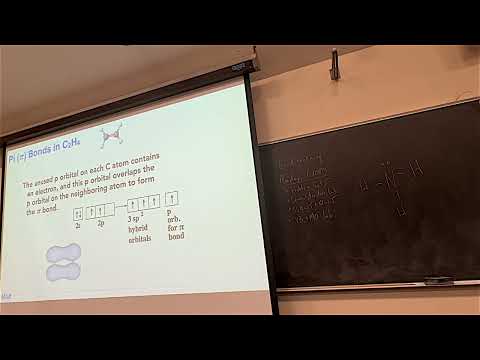
- A C=C double bond consists of one sigma bond and one pi bond; sideways overlap of unhybridized p orbitals places pi electron density above and below the sigma framework and restricts rotation.
- A triple bond consists of one sigma bond and two perpendicular pi bonds, while acetylene also has two C–H sigma bonds, for three sigma and two pi bonds overall.
- Molecular orbital theory forms as many molecular orbitals as the atomic orbitals combined; two oxygen atoms contribute ten orbitals because each has one 1s, one 2s, and three 2p orbitals.
- Bond order is calculated as ½(bonding electrons − antibonding electrons): H₂ has bond order 1 and is stable, while He₂ has bond order 0 and is not stable.
- O₂’s paramagnetism reflects unpaired electrons that a conventional Lewis structure does not reveal, illustrating a key advantage of molecular orbital theory.
Chapters
- Russell frames the chapter around electron pairs arranging themselves as far apart as possible, producing geometries such as tetrahedral rather than 90° arrangements.
- In valence bond theory, orbitals on the central atom mix, or hybridize, while outer atoms retain their atomic orbitals.
- The hybridization mapping is linear sp, trigonal planar sp², tetrahedral sp³, trigonal bipyramidal sp³d, and octahedral sp³d².
- For NH₃, nitrogen has three N–H bonds and one lone pair, giving four electron domains, tetrahedral electron-pair geometry, and sp³ hybridization.
- Russell applies the same geometry-first method to BeCl₂, BF₃, and CH₄: linear/sp, trigonal planar/sp², and tetrahedral/sp³, respectively.
- Count a multiple bond as one electron domain: a carbon with two single bonds and one double bond is trigonal planar and sp², while an oxygen with two lone pairs and two bonds is tetrahedral and sp³.
- In C₂H₄, each carbon is sp² and trigonal planar, forming sigma bonds through overlap of sp² orbitals with orbitals on hydrogen and the adjacent carbon.
- Each carbon retains one unhybridized 2p orbital; their sideways overlap creates a pi bond with electron density above and below the sigma-bond framework.
- The sigma and pi bonding arrangement keeps ethylene’s atoms in a planar structure, and the exposed pi electrons are often more reactive than sigma electrons.
- A double bond contains one sigma bond and one pi bond; a triple bond contains one sigma bond and two pi bonds, with the two pi systems oriented at 90° to each other.
- Acetylene, C₂H₂, has three sigma bonds in total, including its two C–H bonds, and two pi bonds across the C≡C bond.
- Rotation around a C=C bond requires disrupting the pi bond and has a substantial energy barrier, unlike relatively free rotation around a C–C single bond.
- Unlike valence bond theory’s focus on hybridization at a central atom, molecular orbital theory combines atomic orbitals across the whole molecule.
- Molecular orbital diagrams place the two atoms on the sides and the resulting molecular orbitals in the center; Russell limits the course treatment to diatomic molecules through neon.
- MO theory can explain properties that Lewis structures miss: O₂ is paramagnetic because it has unpaired electrons, despite a typical Lewis structure showing paired electrons.
- The number of molecular orbitals formed equals the number of atomic orbitals combined; two H 1s orbitals produce two molecular orbitals.
- Each oxygen atom contributes five atomic orbitals, one 1s, one 2s, and three 2p, so combining two oxygen atoms gives ten molecular orbitals.
- Constructive wave overlap creates a lower-energy bonding orbital with increased electron density between nuclei; destructive overlap creates a higher-energy antibonding orbital with a node, marked by an asterisk.
- Bonding molecular orbitals lie below the original atomic orbitals in energy, while antibonding orbitals lie above them.
- Electrons fill the lowest available molecular orbitals first, with a maximum of two electrons per orbital and Hund’s rule applying to orbitals of equal energy.
- For H₂, the two hydrogen 1s electrons occupy the lower-energy σ1s bonding orbital, stabilizing the molecule relative to two separate hydrogen atoms.
- The H₂ configuration has two electrons in σ1s and none in σ*1s, producing bond order ½(2 − 0) = 1.
- For He₂, four electrons fill both σ1s and σ*1s, giving bond order ½(2 − 2) = 0, so the molecule has no net stabilization.
- Russell treats a bond order greater than zero as evidence of a stable molecule in this course context, while bond order zero predicts that it will not exist as a stable molecule.
- Lewis bond order corresponds to the number of bond lines: a single bond is order 1, a double bond is order 2, and a triple bond is order 3.
- The MO bond order of H₂ is 1, matching the single H–H bond in its Lewis structure.
- For formaldehyde, H₂CO, each C–H bond has order 1 and the C=O bond has order 2; higher bond orders generally indicate bonds that are harder to break.
Transcript excerpt
0:01 Good morning. I hope your day is going well. I'm really glad to have you here. Uh Monday, next Monday at 1:10 when you come to class, uh problem set five will be up, which is over chapter 5, the stuff we're studying right now, the Lewis structures lab that we started on Monday will be due. Uh seminar selfquiz 5 and quiz 5 will be on the docket. Again, material over chapter 5, stuff like that. and then we'll go next door and do the veence bond and molecular orbital lab. So make sure you bring a printed copy of that questions that kind of stuff. So we're talking in this chapter about why Lewis structures are as they are like why do things make tetrahedrrons instead of being like 90° and 180. And
0:50 the punchline for this whole chapter is that electrons want to be as far apart from each other as they can. And so in order to understand then why the tetrahedrin comes up, people use different theories. And the two current theories that are used in chemistry right now, one is called veence bond theory, which is what we talked about on Monday. The other one is molecular orbital theory. And we'll hopefully start talking about that today. So veence bond theory, it's pretty chill. It basically says that the central atom in your molecule the s the 2s2 and 2p3 these kind of orbitals they are mixed and mixed in this world means hybridized. So hybridized is just another word for mixing. Okay. And instead of having a 2s2 lower and a 2p
1:40 higher, they all hybridize mix and they all become equivalent. At least in the case of tetrahedral, they become sp3 hybrid orbitals. And I showed you some pictures on Monday. They look kind of
This is the start of the transcript. Save this video free for the whole transcript, searchable and time-coded.
Related notes
Summary, takeaways, and chapters were generated by AI from the video's transcript and may contain errors. The video belongs to its creator, Michael Russell.